





Towing to Lake Oahe: How the Silverado 1500 Handles Mobridge’s Biggest Recreation Season
Published: April 8, 2026 | Author: Lexy Tabbert, Director of Sales and Marketing
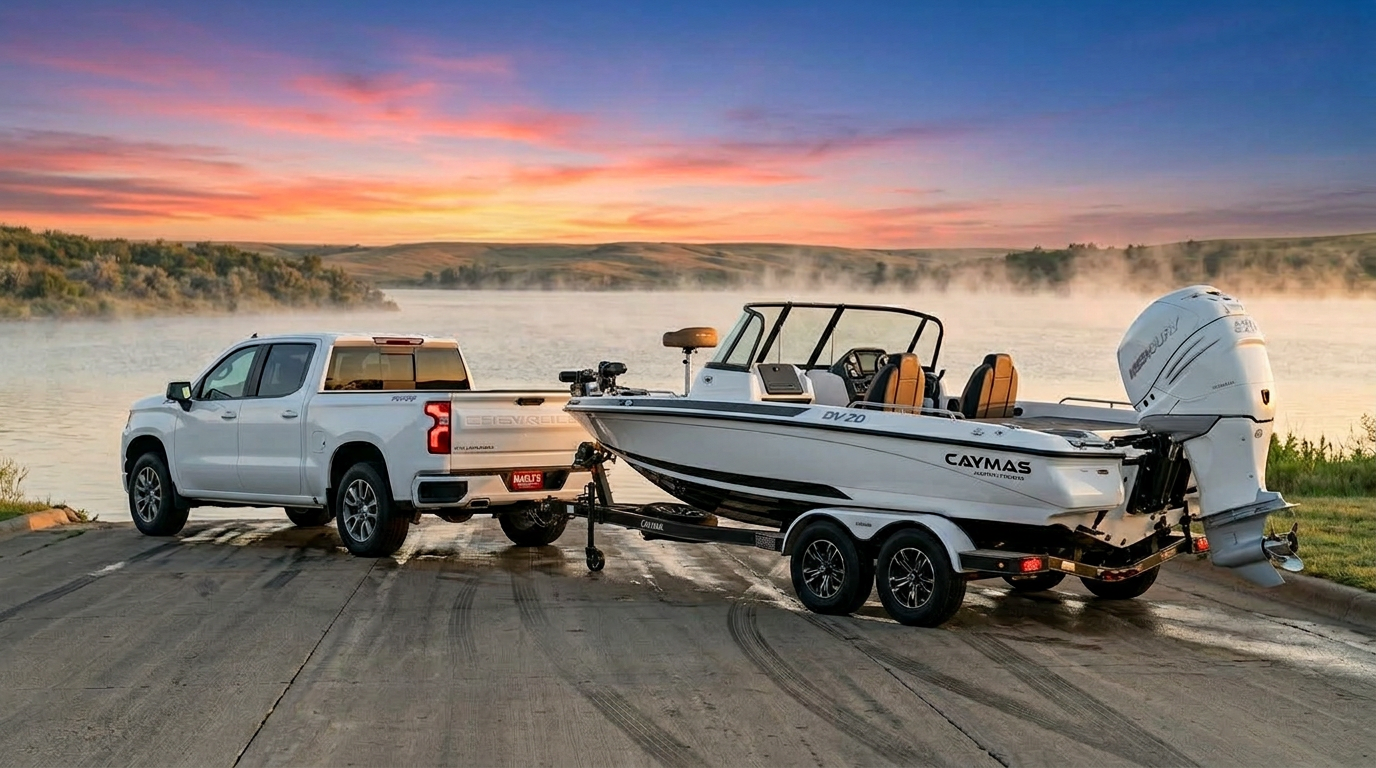
Lake Oahe doesn’t care how capable your truck looks in the parking lot. What matters is whether it can back a loaded pontoon trailer down a wet concrete ramp at 6 a.m., hold position while you float the boat off, then pull the empty trailer back up without losing grip. Or haul a 24-foot cabin cruiser across 60 miles of South Dakota highway without trailer sway every time the wind picks up on the open prairie.
This is a guide written for Mobridge drivers who use their truck at the lake — with real weights, real ramps, and real configurations from Beadle Chevrolet.
Jump to Section
Why Lake Oahe Demands More From a Tow Vehicle
Lake Oahe is one of the largest reservoirs in the United States — 231 miles long, stretching from Bismarck, ND to Pierre, SD, with Mobridge sitting near the midpoint. It is not a small fishing pond. The open water generates real wind, real chop, and real current near the dam. Boats on Oahe are not small either — the lake’s size and quality attract cabin cruisers, large pontoons, and serious walleye rigs that need real towing equipment behind them.
The Mobridge Marina launch ramp on the south side of the US-12 bridge is the primary entry point for most local boaters. West Whitlock Recreation Area, about 20 miles south, handles a large share of the pontoon traffic. Both ramps share characteristics that matter for your truck: concrete surfaces that get slick with algae and boat wash, steep grades on certain ramps, and gravel approach roads that turn soft after spring rains.
Getting to the ramp also requires towing. Most Mobridge-area residents are 20–60 miles from storage facilities or home — meaning every Lake Oahe trip involves a real highway tow, not a short suburban hop. That distance matters for engine temperature, fuel consumption, and trailer sway stability on the open plains.
What Boats Launch at Lake Oahe — and What They Actually Weigh
The weight of your boat on the highway is not the dry weight on the spec sheet. It is boat plus trailer plus fuel plus gear plus any water that found its way into the bilge. The table below shows realistic combined weights for the most common boat types on Lake Oahe. These are the numbers that determine which Silverado 1500 you need.
| Boat Type | Typical Size | Combined Weight (Loaded) | Recommended Engine |
|---|---|---|---|
| Walleye / Bass Boat | 17–20 ft | 2,000–4,500 lbs | TurboMax or 5.3L V8 |
| Pontoon (Standard) | 20–22 ft | 4,500–7,000 lbs | 5.3L V8 |
| Pontoon (Large / Tri-toon) | 23–28 ft | 7,000–10,000 lbs | 5.3L V8 or Duramax Diesel |
| Deck Boat / Bowrider | 19–24 ft | 3,500–6,000 lbs | 5.3L V8 |
| Cabin Cruiser (Smaller) | 22–25 ft | 6,000–10,000 lbs | 5.3L V8 or Duramax Diesel |
| Cabin Cruiser (Larger) | 25–30 ft | 10,000–13,000 lbs | Duramax Diesel + Max Trail Pkg |
| Personal Watercraft (2 on trailer) | — | 1,800–3,500 lbs | Any engine |
Combined weight = boat dry weight + trailer weight + fuel (approx. 6 lbs/gallon) + gear and equipment. Always weigh your actual rig before choosing a towing configuration — or ask us to confirm capacity on a specific stock number.
Which Silverado 1500 Configuration Is Right for Your Boat?
The honest answer depends on two numbers: your boat’s combined loaded weight, and how often you’re making the haul. Here’s how to match the right Silverado to the most common Lake Oahe setups.
Walleye and Bass Boat Owners
A dedicated walleye rig in the 18–20 foot range typically comes in at 3,000–4,500 lbs combined. Any Silverado 1500 engine handles this load, including the 2.7L TurboMax. If you’re making multiple trips per week during the spring run and want the best fuel efficiency for the haul, the TurboMax is the most economical choice. If you also pull livestock or equipment the rest of the year, the 5.3L V8 gives you more range without pushing the engine.
Standard Pontoon Owners (20–22 ft)
This is the most common boat type at Mobridge Marina. A 20-foot pontoon with trailer, fuel, and a full day’s gear runs between 4,500 and 7,000 lbs. The 5.3L V8 handles this range with 4,000–6,900 lbs of margin below its 11,400 lb limit. You don’t need the diesel for this setup — but if you also pull a horse trailer or camper with the same truck, the diesel’s flexibility makes it worth the step up.
Large Pontoon or Cabin Cruiser Owners (23 ft+)
A 24-foot tri-toon with trailer loaded for a weekend can push 9,000–10,500 lbs. A larger cabin cruiser on a tandem-axle trailer approaches 12,000 lbs or more. At this weight, the Duramax diesel with the Max Trailering Package is the right tool — not because the V8 necessarily can’t handle it on flat highway, but because the ramp grades, the summer heat, and the return trip fully loaded demand an engine with torque reserves. The diesel’s 495 lb-ft at low RPM is exactly what steep ramp launches need.
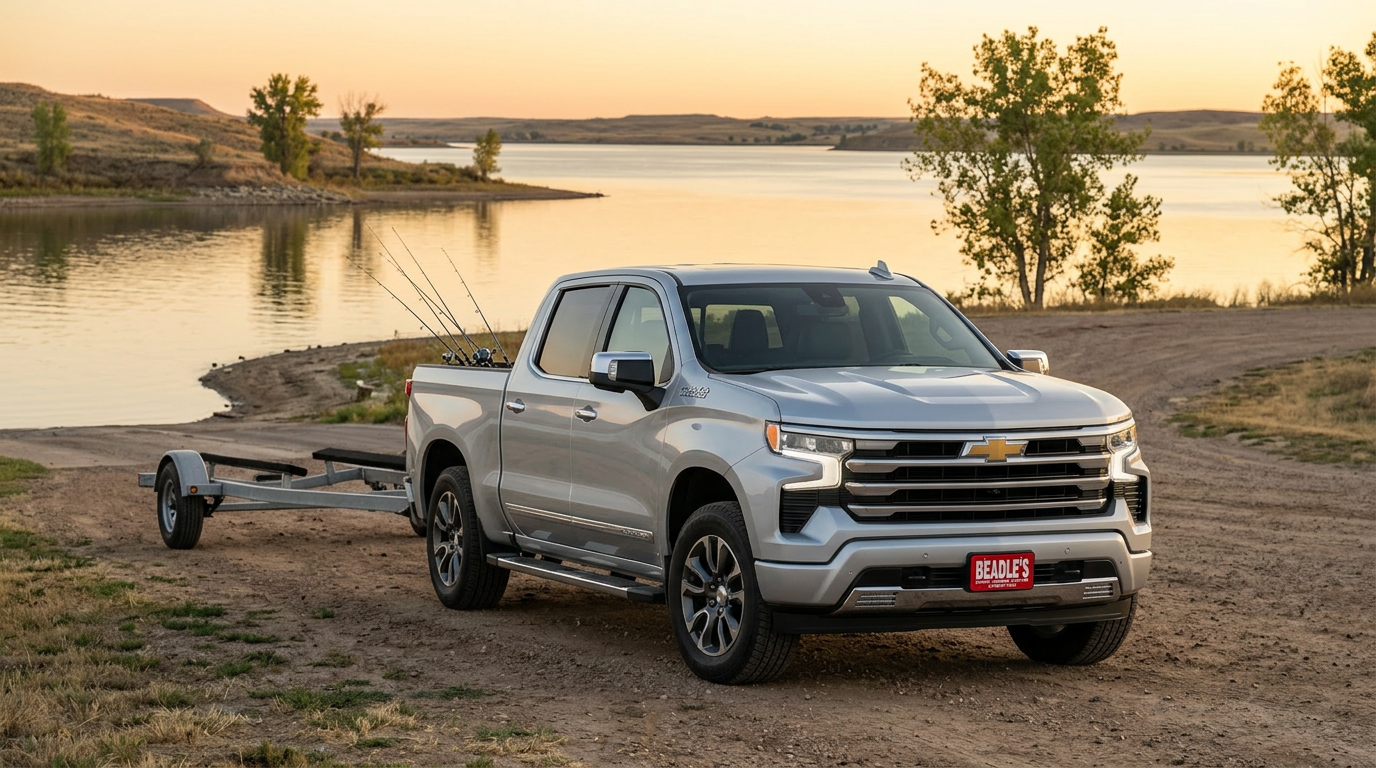
Most Mobridge-area residents tow 20–60 miles to reach storage or the lake — the highway haul matters as much as the ramp.
What the Ramp Experience Actually Demands From Your Truck
Boat ramp performance is not the same as highway towing performance. A truck can tow 11,000 lbs on flat pavement without breaking a sweat and still struggle on a wet, steep, or uneven ramp with a heavy boat. Here’s what to expect at the most common Lake Oahe launches.
Wet Concrete Traction
Boat ramp concrete gets slick — from algae growth, boat wash, and early morning dew. The Silverado 1500’s 4WD AutoTrac system engages automatically when the wheels slip, shifting torque to the tires with grip. For particularly slick conditions, switching to 4WD High manually before you back down eliminates the hesitation. This is standard on all 4WD Silverado trims and especially useful at West Whitlock, where the approach has gravel and the concrete extends steeply into the water.
Backing Precision
The available Trailer Reverse Guidance system on equipped Silverados shows a guide overlay on the backup camera that steers the trailer left or right based on where you turn the wheel. For solo ramp launches without a spotter, this dramatically reduces the number of pull-forwards needed to line up correctly. It is available as part of the Trailering Package and is standard on higher trims.
What Most Buyers Overlook: Ramp Grade vs. Rated Tow Capacity
A truck rated to tow 11,400 lbs on flat pavement is working significantly harder on a 15% ramp grade — the effective load on the drivetrain is much higher when you factor in grade resistance. If your loaded boat is consistently near your truck’s maximum tow rating, the ramp will expose that margin every single time. Build in at least 15–20% headroom between your loaded weight and your truck’s rated capacity for comfortable ramp performance.
After the launch, pulling the empty trailer back up the ramp is straightforward with any Silverado configuration. The challenge is the loaded pull-out after a day on the water — particularly if the boat picked up water, gear got added, or you’re launching in the heat of July with a full tank of gas. That’s when ramp margin shows its value.
Towing on South Dakota Highways to the Lake
The stretch of US-12 east and west of Mobridge is open, straight, and frequently windy. Trailer sway is a real concern on this road — especially with a tall pontoon on a single-axle trailer running broadside to a southwest wind. Every 2026 Silverado 1500 includes Trailer Sway Control as part of the standard stability system, which detects oscillation and applies selective braking to correct it before the driver has to react.
For the return trip — particularly in summer — pay attention to your coolant and transmission temperatures if you’re towing near your rated capacity. The Silverado’s available Trailering App on Google built-in displays these readouts in real time. On a 90-degree July day hauling a heavy cabin cruiser up the hill on the south end of the bridge, this information is genuinely useful. If temperatures climb, slowing to 55 mph drops heat significantly without adding much time to a local haul.
One configuration point worth noting for frequent towing: the integrated trailer brake controller, included with the Max Trailering Package and available as a standalone add-on, allows you to adjust trailer brake gain directly from the cab. For a loaded pontoon coming down a hill toward a congested marina area, having independent trailer brake control is a practical safety feature — not just a spec on a window sticker.
Is the Duramax Diesel Worth It for Lake Oahe Towing?
For most standard pontoon and walleye boat owners, the 5.3L V8 is enough. For large boat owners or drivers who tow year-round with the same truck, the diesel’s advantages compound.
| Diesel Worth It for Lake Towing If… | 5.3L V8 Is Enough If… |
|---|---|
|
Your boat + trailer exceeds 9,000 lbs loaded You tow to the lake more than once a week in season You also pull livestock or equipment with the same truck You want maximum ramp torque on steep grades You store the boat 40+ miles from the water |
Your pontoon or fishing rig is under 8,000 lbs loaded You primarily launch at Mobridge Marina (manageable grade) Boat towing is the truck’s primary or only towing use You prefer a lower purchase price You make fewer than 20–25 lake trips per season |
Key Takeaways
- • The 5.3L V8 Silverado handles the majority of Lake Oahe boat types — walleye rigs, standard pontoons, deck boats, and smaller cabin cruisers — at up to 11,400 lbs when properly equipped with the Max Trailering Package.
- • Large pontoons (23 ft+), tri-toons, and cabin cruisers above 9,000 lbs loaded belong in the Duramax diesel with the Max Trailering Package.
- • Build at least 15–20% headroom between your loaded boat weight and your truck’s rated capacity — ramp grades increase effective load significantly beyond highway towing.
- • 4WD AutoTrac and available Trailer Reverse Guidance are the two most practically useful features at the ramp — both available on 4WD Silverado trims.
- • Every 2026 Silverado 1500 includes Trailer Sway Control standard — relevant on the open, wind-exposed stretches of US-12 east and west of Mobridge.
- • Always use loaded weight — boat + trailer + fuel + gear — not the boat’s dry weight spec sheet number when matching to towing capacity.
Frequently Asked Questions
What size truck do I need to tow a pontoon boat to Lake Oahe?
For a standard 20–22 foot pontoon with trailer — typically 4,500–7,000 lbs loaded — the 2026 Silverado 1500 with the 5.3L V8 handles it comfortably, with several thousand pounds of margin below its 11,400 lb max rating. For larger pontoons (24 ft+) or boats over 9,000 lbs, the Duramax diesel and Max Trailering Package provide the additional capacity and low-RPM torque for confident towing on steep ramps.
Is the Silverado 1500 good for launching at Mobridge Marina?
Yes. The Silverado 1500 with 4WD handles the Mobridge Marina launch ramp and West Whitlock boat ramp confidently. The 4WD AutoTrac system provides traction on wet concrete, and available Trailer Reverse Guidance assists with backing precision. For steep or slick conditions, 4WD High engaged manually before backing down removes any hesitation.
What is the walleye fishing season on Lake Oahe near Mobridge?
Lake Oahe’s walleye fishing peaks in spring (April through May) and fall (September through November), with consistent summer fishing through the warmer months. Ice fishing runs December through February depending on ice conditions. Mobridge is widely regarded as one of the top walleye fishing destinations in the country — the lake’s size, depth, and cold Missouri River water produce consistent trophy walleye.
Can the Silverado 1500 tow a cabin cruiser on Lake Oahe?
It depends on the boat and trailer weight. Most cabin cruisers in the 22–24 foot range run 6,000–10,000 lbs combined with trailer and gear. The 5.3L V8 Silverado handles the lower end of that range, and the Duramax diesel reaches 13,300 lbs for larger setups. Cabin cruisers consistently above 13,500 lbs belong on a Silverado 2500HD or 3500HD. Always confirm your combined loaded weight before choosing a configuration.
Does the Silverado 1500 have trailer sway control?
Yes — Trailer Sway Control is standard on every 2026 Silverado 1500. When the system detects trailer oscillation, it automatically applies selective braking to correct the vehicle and trailer before the driver needs to react. This is particularly relevant on the open, wind-exposed stretches of US-12 east and west of Mobridge where crosswinds are common.
From Lexy
Lake Oahe season is a big deal in Mobridge. We have customers who are out there every weekend from ice-out in April through the walleye run in fall, and they need a truck that handles the ramp as reliably as it handles the highway. The questions I hear most at the dealership aren’t about max towing numbers — they’re about whether a specific truck can handle a specific boat on a specific ramp without drama. That’s the real question, and the answer is almost always about choosing the right configuration, not just any Silverado.
If you know what you’re towing, we can match you to the right engine, package, and trim before you’re standing at the bottom of the ramp wishing you’d gone to the diesel. The full year-specific breakdown — including every engine, towing configuration, and available technology — is on the 2026 Chevrolet Silverado 1500 overview.
— Lexy Tabbert, Director of Sales and Marketing
Beadle Chevrolet, Mobridge, SD
About the Author
Lexy Tabbert — Beadle Chevrolet, Mobridge, SD
Lexy Tabbert is the Director of Sales and Marketing at Beadle Chevrolet in Mobridge, South Dakota. She covers Chevrolet and GMC vehicles, trim comparisons, and buyer guidance — helping families, ranchers, and ag operators across the region find the right truck and configuration for their needs. Learn more about Lexy.
Connect with us

