





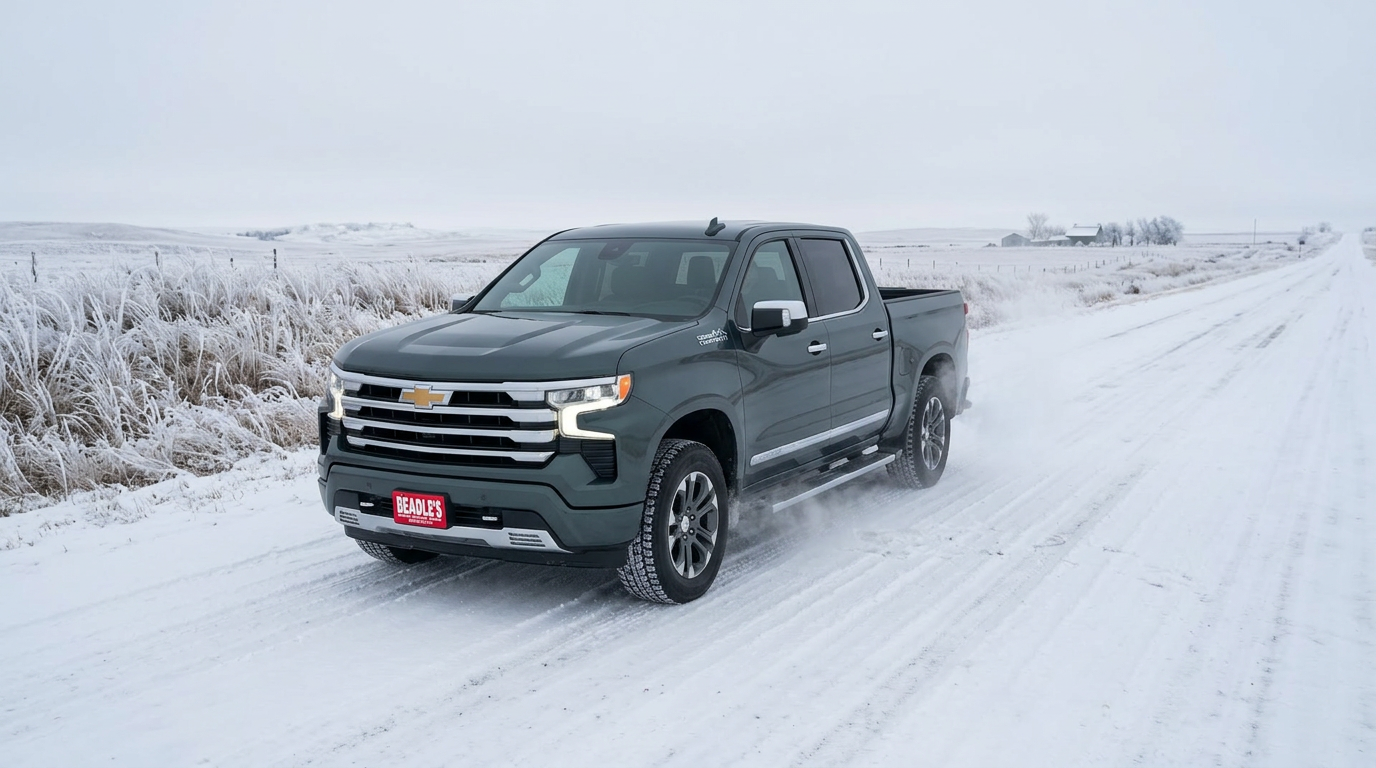
2026 Silverado 1500 in South Dakota: Built for Winters, Ranch Roads, and Everything In Between
By Lexy Tabbert, Beadle Chevrolet — April 9, 2026
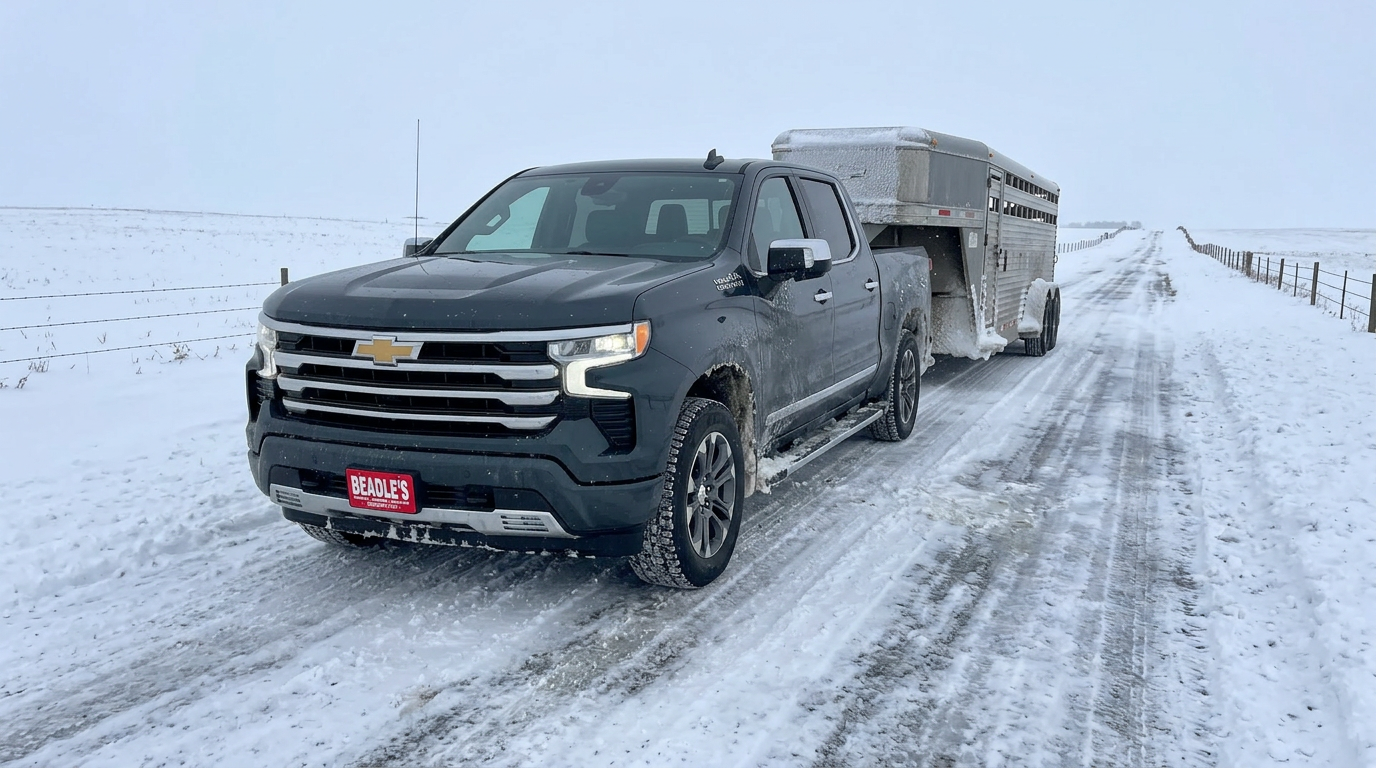
South Dakota winters aren’t like anywhere else. A January morning in Mobridge can start at -20°F before the wind chill, and by afternoon you might be pulling a livestock trailer across roads that haven’t seen a plow since last night. The 2026 Chevrolet Silverado 1500 is not designed for an average American driver in an average American climate — and for buyers in this part of the country, that matters.
This guide covers the features that actually make a difference when the temperature drops and the roads get bad — 4WD system, Snow/Ice mode, block heaters, heated features by trim, cold-weather towing, and what ranch buyers should know about the Durabed and all-terrain tire availability. No filler. Just what you need to know before buying.
In This Article
- The 4WD System: AutoTrac Explained
- Snow/Ice Mode: What It Does and When to Use It
- Engine Block Heater and Cold-Weather Starting
- Heated Features by Trim
- Durabed and Ranch Work Capability
- Towing Livestock Trailers in Winter Conditions
- Trail Boss and ZR2: Off-Road Tires for Ranch Roads
- Frequently Asked Questions
The 4WD System: AutoTrac Explained
The 2026 Silverado 1500 uses an AutoTrac electronic transfer case with four selectable modes. Understanding when to use each one is the difference between confident winter driving and spinning out on an icy county road.
| Mode | When to Use It | How It Works |
|---|---|---|
| 2WD | Dry pavement, normal conditions | Rear-wheel drive only; best fuel economy |
| 4WD Auto | Mixed conditions — light snow, wet roads, gravel | Monitors wheel slip and engages front axle automatically as needed; can stay engaged on pavement |
| 4WD High | Sustained low-traction: packed snow, icy roads, muddy pasture access | Full-time 4WD; engages both axles. Do not use on dry pavement — causes driveline binding |
| 4WD Low | Slow, high-torque situations: deep mud, steep grades, heavy-load maneuvering | Geared down for maximum torque multiplication; maximum speed approximately 25 mph |
For most South Dakota winter driving — running county roads with light snow cover, navigating a ranch approach, or pulling out of a field — 4WD Auto handles the transition automatically without you having to think about it. 4WD High is the right call when you know traction is consistently limited and you need all four wheels engaged before you get into trouble, not after. 4WD Low is specifically for situations where you need the truck to move very slowly with maximum pulling force — backing a heavy trailer up a steep icy approach, working through deep mud, or recovering a stuck piece of equipment.
One practical note: you can shift between 2WD, 4WD Auto, and 4WD High while moving. Engaging 4WD Low requires slowing to a near-stop and shifting the transmission to neutral first.
Snow/Ice Mode: What It Does and When to Use It
Snow/Ice mode is part of the Silverado’s driver mode selector and is available on trims equipped with that system. When activated, it makes three meaningful changes to how the truck behaves:
- Throttle response is softened. Less power reaches the wheels when you first press the accelerator — reducing the chance of breaking traction on a slick launch.
- Transmission shift points adjust. The truck shifts into a higher gear sooner, keeping engine torque lower at the wheels and reducing the risk of spinning when accelerating from a stop.
- Traction control calibration changes. The system allows slightly more wheel movement before intervening, which can actually help in very deep snow where controlled wheel spin is needed to get moving.
Snow/Ice mode pairs naturally with 4WD High for sustained winter road conditions. Use it when you’re launching from stops on icy intersections, starting uphill on a packed-snow road, or any time you notice the rear end stepping out under acceleration. It won’t make a slick road safe — but it calibrates the truck to give you better control over what’s available.
Engine Block Heater and Cold-Weather Starting
For South Dakota buyers, the engine block heater question is one of the most practical things to sort out before you finalize a purchase. Here’s the breakdown:
Duramax diesel (3.0L LZ0): The block heater (RPO code K05) is standard equipment on every Silverado 1500 with the Duramax engine. Plug it into a standard 120V outlet overnight and the engine stays warm enough to start quickly and efficiently even when the temperature drops to -20°F or below. Diesel engines rely on compression heat for combustion — a cold-soaked diesel is harder to start than a gas engine, and a block heater eliminates that concern entirely.
Gasoline engines (TurboMax, 5.3L V8, 6.2L V8): The block heater is an available option on gasoline configurations — it is not standard. If you’re buying a gas-powered Silverado 1500 and you park outside in a Mobridge winter, it’s worth asking specifically about block heater availability and having it installed if it isn’t already on the truck.
The Duramax also comes with a heavy-duty 850 cold-cranking amp battery, compared to 730 CCA on gasoline-powered Silverado 1500 trucks. That difference matters on the coldest mornings when battery performance drops. If you’re running a gasoline Silverado 1500 through multiple South Dakota winters, upgrading to a higher-CCA battery as it ages is worth considering.
Remote start is available on Silverado 1500 configurations with the Power Convenience Package (LT trim and above with PCL) — pairing it with a block heater means you can have a warm, ready-to-drive truck without standing in the cold.
Heated Features by Trim
Not every Silverado 1500 trim comes with heated seats and a heated steering wheel from the factory. Here’s where each feature becomes available:
| Feature | Availability | Notes |
|---|---|---|
| Heated front seats | LT with LT Convenience Package; RST, LTZ, High Country | Not available on Work Truck or Custom trims |
| Heated steering wheel | Power Convenience Package (PCL) on LT and above | Often paired with remote start and heated mirrors |
| Remote start | Power Convenience Package (PCL) on LT and above | Activates block heater on diesel if equipped |
| Ventilated front seats | LTZ, High Country | More relevant for summer; paired with heated in premium trims |
If you’re buying an LT-trim Silverado for a South Dakota winter and you want heated seats and remote start, confirm whether the truck you’re looking at includes the Power Convenience Package — it’s a common option on Mobridge-area inventory but not universal. Beadle Chevrolet can tell you exactly what’s on each truck before you drive out to look at it.
Durabed and Ranch Work Capability
The Silverado 1500’s Durabed is a roll-formed high-strength steel bed — not stamped steel like many competing truck beds. Roll-forming produces a stronger cross-section, which matters when you’re routinely loading and unloading heavy items: feed bags, fence posts, equipment parts, grain augers, or anything else that gets dropped into a ranch truck bed on a daily basis.
Standard Durabed features across most trims include 12 fixed cargo tie-down rings rated at 500 lbs each, composite bed corner protectors, and a standard 110V/400W power outlet in the bed on most configurations. The EZ Lift and Lower tailgate with lock is standard — the tailgate counterbalances as it opens and snaps shut securely without slamming.
For winter ranch use specifically, the bed LED cargo lighting (available on LT and above) is worth having. Loading or unloading after dark in January at a feedlot or sale barn is easier when you can actually see what you’re doing. The bed-mounted 120V power outlets on Power Convenience Package-equipped trucks let you run a corded heat lamp, electric fence charger, or power tools without running a generator.
One note on GM’s hydraulic body mount behavior: in extreme cold — typically below 32°F — some Silverado 1500 owners notice a slight squeak or creak from the cab-to-frame mounts during the first few minutes of driving. This is a known characteristic of the hydraulic body mount system and is cosmetic, not mechanical. It typically goes away within a few minutes as the truck warms up and the fluid loosens. It is not a defect and does not require service.
Towing Livestock Trailers in Winter Conditions
Hauling livestock in winter is one of the harder tasks you can ask of a half-ton truck. The trailer is heavy, the roads are often marginal, and the animals shift weight unpredictably. Here’s what the 2026 Silverado 1500 brings to that work:
Trailer Sway Control is standard on all Silverado 1500 trims. When the system detects trailer oscillation — the back-and-forth fishtailing that can develop on icy roads or at highway speeds — it selectively applies brakes to individual wheels and reduces engine power to bring the trailer back into line. This is one of the most practically important towing safety features for winter use, and it’s not an upgrade on the Silverado — it comes standard.
Trailer Side Blind Zone Alert is available on upper trims and warns you when a vehicle enters the blind spot created by a trailer — useful on two-lane highways when passing or being passed in low-visibility conditions.
For the engine: The 3.0L Duramax diesel is the strongest choice for winter livestock hauling. Beyond the towing capacity (up to 13,300 lbs when properly equipped with the Max Trailering Package), the diesel’s 495 lb-ft of low-RPM torque means the engine doesn’t have to work hard to maintain highway speed with a loaded trailer — which matters for sustained pulls from Mobridge to a sale barn in Rapid City or Aberdeen. The standard block heater means it starts reliably regardless of temperature.
Practical winter towing checklist:
- Verify tongue weight is within the truck’s tongue weight rating — loaded livestock trailers shift weight as animals move
- Check trailer tire pressure before a winter pull (cold temperatures drop tire pressure by approximately 1 psi per 10°F drop)
- Confirm trailer brake controller is calibrated and trailer brakes are functioning
- Use 4WD High on packed snow or icy roads before you need it, not after traction is lost
- Increase following distance significantly — stopping distance increases substantially with a loaded trailer on a slick surface
Trail Boss and ZR2: Off-Road Tires for Ranch Roads
For buyers who spend significant time on unimproved ranch roads, pasture tracks, or muddy field approaches, the Trail Boss and ZR2 trim variants are built for that work.
LT Trail Boss and Custom Trail Boss include the Z71 Off-Road Package with Rancho monotube shocks, a 2-inch factory suspension lift, skid plates, and standard all-terrain tires. Ground clearance increases to approximately 10.5 inches. This is the practical ranch truck spec — more clearance and better traction than a standard LT, without the extreme off-road equipment of the ZR2.
ZR2 takes it further: Multimatic DSSV dampers, electronic front and rear locking differentials, a 2-inch factory lift, 11.2 inches of ground clearance, and standard all-terrain tires. Front and rear e-lockers are the standout feature — on a steep, slippery approach where one wheel loses traction entirely, the locker keeps all four wheels pulling. This is a meaningful practical advantage in conditions where standard traction control would reduce power and potentially leave you stuck.
One important caveat for ranch buyers considering the ZR2: towing capacity on the ZR2 is capped at approximately 8,700–8,800 lbs regardless of engine choice. The Multimatic suspension geometry and lifted stance reduce the truck’s towing rating below what the engine alone could manage. If heavy trailer towing is a primary use case alongside the off-road capability, the LT Trail Boss is the better balance — it tows up to 11,400 lbs with the 5.3L V8 and Max Trailering Package while still providing the Z71 suspension and all-terrain tires.
Key Takeaways
- 4WD Auto handles most mixed-condition driving automatically; use 4WD High when you know traction will be consistently limited
- Snow/Ice mode softens throttle response and adjusts shift points to reduce wheel spin on slick surfaces
- The 3.0L Duramax diesel includes a standard engine block heater (K05) — critical for reliable cold-weather starts in South Dakota winters
- Gasoline Silverado 1500 trucks do not include the block heater as standard — it’s an available option worth requesting on any configuration you buy
- Heated seats, heated steering wheel, and remote start are available on LT and above with the Power Convenience Package — confirm the specific truck has it before purchasing
- Trailer Sway Control is standard on all trims — not an upgrade
- ZR2 towing is capped at approximately 8,700–8,800 lbs; LT Trail Boss tows up to 11,400 lbs when properly equipped with the Max Trailering Package
- The hydraulic body mount creak in extreme cold is cosmetic — it clears within minutes of driving and does not require service
Frequently Asked Questions
Does the 2026 Silverado 1500 have a Snow/Ice driving mode?
Yes. The 2026 Silverado 1500 includes a Snow/Ice mode that adjusts throttle response, transmission shift points, and traction control calibration to reduce wheel spin on slick surfaces. It is available on trims equipped with the driver mode selector.
Does the 2026 Silverado 1500 come with an engine block heater?
The 3.0L Duramax diesel comes with an engine block heater (K05) as standard equipment. On gasoline-powered Silverado 1500 trucks, the block heater is an available option. For South Dakota buyers dealing with sub-zero temperatures, confirming block heater availability on your specific configuration is worth doing before purchase.
What 4WD system does the 2026 Silverado 1500 use?
The 2026 Silverado 1500 uses an AutoTrac electronic transfer case with selectable modes: 2WD, 4WD Auto, 4WD High, and 4WD Low. 4WD Auto continuously monitors conditions and engages the front axle as needed. 4WD High is best for sustained low-traction conditions like packed snow or icy roads. 4WD Low is for very slow, high-torque situations — steep grades, deep mud, or heavy-load maneuvering.
Is the 2026 Silverado 1500 good for towing a livestock trailer in winter?
Yes, with the right configuration. The Silverado 1500 includes Trailer Sway Control as standard equipment, and 4WD High provides traction on snow-covered or icy roads while pulling a trailer. The 3.0L Duramax diesel is particularly well-suited for winter livestock hauling — it includes a standard engine block heater, produces 495 lb-ft of torque at low RPM for loaded pull, and is rated up to 13,300 lbs when properly equipped with the Max Trailering Package. Tongue weight distribution and trailer tire condition matter as much as the truck in winter conditions.
I’ve been through enough South Dakota winters to know that a truck’s cold-weather features either work or they don’t — and you find out which one on the worst mornings, not the easy ones. The Silverado 1500 has the right foundation for this climate: 4WD with a genuinely useful Auto mode, Snow/Ice mode that’s practical rather than gimmicky, a block heater standard on the diesel, and a bed that holds up to the kind of daily ranch use that eats lesser trucks alive.
If you’re trying to figure out which trim and engine make sense for your specific situation — whether that’s towing livestock to a sale barn, running a ranch approach that doesn’t see a grader until spring, or just getting to work reliably in January — I’m happy to talk through it. Stop in at Beadle Chevrolet or call 605-705-4343 and we can go over what’s in stock and what fits your needs.
For the full 2026 Silverado 1500 overview — engines, trims, towing specs, and technology — the 2026 Silverado 1500 guide covers everything in one place.
About the Author
Lexy Tabbert — Beadle Chevrolet, Mobridge, SD
Lexy Tabbert is the Director of Sales and Marketing at Beadle Chevrolet in Mobridge, South Dakota. She covers Chevrolet and GMC vehicles, trim comparisons, and buyer guidance — helping families, ranchers, and ag operators across the region find the right truck and configuration for their needs. Learn more about Lexy.
Connect with us

