





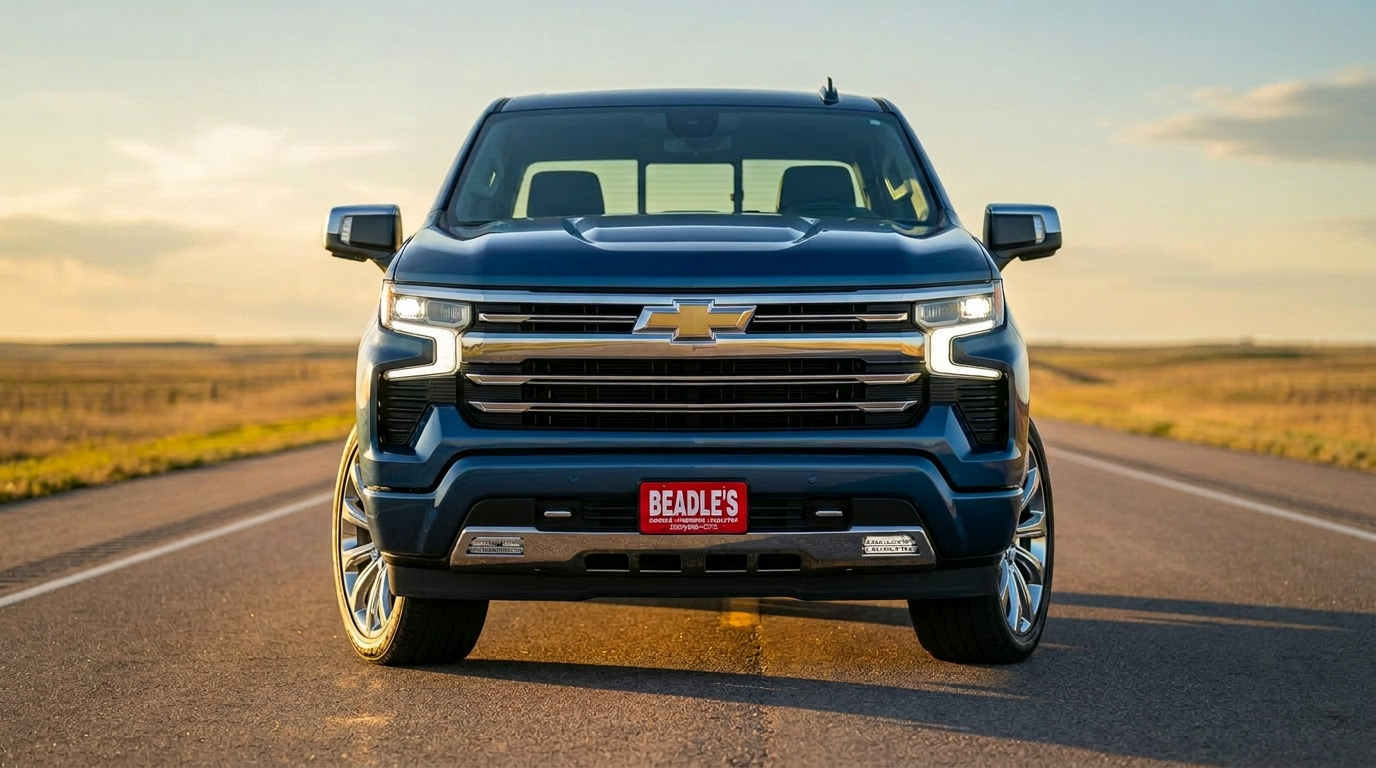
2026 Silverado 1500 vs. Ford F-150 vs. Ram 1500: The Half-Ton Showdown
By Lexy Tabbert, Beadle Chevrolet — April 9, 2026
If you’re shopping a half-ton truck in 2026, you’re almost certainly comparing these three. The Chevrolet Silverado 1500, Ford F-150, and Ram 1500 have traded the top spot in the segment for decades, and for good reason — all three are genuinely capable, well-built trucks that will serve most buyers well for 150,000 miles or more.
This comparison is written to help you choose — not to oversell any one truck. The honest answer is that the right truck depends on what you actually do with it. We sell Silverados, and we believe in them, but the information below covers the real differences so you can make an informed decision before you spend $55,000 or more.
In This Article
- The Diesel Situation: One Truck Still Has It
- Towing Capacity: How the Numbers Actually Compare
- Hands-Free Driving While Towing: A Silverado Exclusive
- Ride Quality: Where Ram Has a Real Edge
- Bed Durability: Steel vs. Aluminum vs. Stamped Steel
- Payload and Infotainment
- The Verdict: Which Truck Wins for You
- Frequently Asked Questions
The Diesel Situation: One Truck Still Has It
This is the most important differentiator in the 2026 half-ton segment, and it isn’t close. The 2026 Chevrolet Silverado 1500 is the only half-ton pickup truck that still offers a diesel engine. Ford discontinued the 3.0L PowerStroke diesel for the F-150 after the 2022 model year. Ram discontinued the 3.0L EcoDiesel for the Ram 1500 after the 2023 model year. If you want a diesel engine in a half-ton truck in 2026, the Silverado 1500 with the 3.0L Duramax is your only option.
That matters for two reasons. First, the Duramax diesel produces 495 lb-ft of torque — significantly more low-end pulling power than any gasoline half-ton engine in the segment. That torque advantage is most noticeable when pulling heavy trailers at highway speeds, climbing grades, or managing a loaded trailer over long distances. Second, diesel fuel economy under load is substantially better than gasoline equivalents. The EPA-estimated diesel highway figure makes a real difference on long South Dakota highway stretches when you’re covering 300 miles with a trailer.
If diesel matters to you — whether for fuel economy, torque, or preference — the comparison ends here. For a full breakdown of how the Duramax stacks up against the Silverado’s gasoline engines, the Duramax diesel guide covers the engine in detail.
Towing Capacity: How the Numbers Actually Compare
Maximum towing ratings across the three trucks:
| Truck | Max Towing* | Engine at Max Rating | Diesel Available? |
|---|---|---|---|
| 2026 Silverado 1500 | 13,300 lbs | 3.0L Duramax diesel | Yes |
| 2026 Ford F-150 | 13,500 lbs | 3.5L PowerBoost V6 Hybrid | No (discontinued) |
| 2026 Ram 1500 | 11,610 lbs | 5.7L HEMI V8 | No (discontinued) |
*Maximum towing when properly equipped in specific configurations. Actual capacity varies by engine, axle ratio, cab/bed configuration, and options. Confirm specifications with dealer before purchase.
On paper, the F-150 leads by 200 lbs at the absolute maximum. In practice, the two trucks are functionally tied for most buyers. If you’re towing a boat trailer, horse trailer, or equipment trailer in the 8,000–12,000 lb range — which covers the majority of what South Dakota buyers haul — the difference between 13,300 and 13,500 lbs is not a real-world factor.
What is a real-world factor: the Silverado achieves its 13,300 lb rating with the diesel engine, meaning the same powertrain that gets you to maximum towing also delivers 495 lb-ft of torque and significantly better fuel economy under load than the F-150’s hybrid powertrain at its maximum rating. The Ram 1500, at 11,610 lbs, is the clear third-place finisher in towing capacity. For detailed towing numbers across all Silverado configurations, the complete Silverado towing guide covers every engine and axle combination.
Hands-Free Driving While Towing: A Silverado Exclusive
The 2026 Silverado 1500 is the only half-ton truck where you can use hands-free highway driving — GM’s Super Cruise system — while actively towing a trailer. Ford’s BlueCruise system is disabled when a trailer is connected. Ram has no equivalent system. This exclusive applies to Silverado LTZ and High Country trims equipped with Super Cruise.
For South Dakota buyers, this has practical relevance. If you’re hauling a horse trailer from Mobridge to Rapid City on I-90 — roughly 280 miles of highway — the ability to use hands-free adaptive cruise control with active lane centering for a portion of that drive reduces fatigue meaningfully. The system monitors driver attention via a camera and requires eyes-on-road, but your hands can be off the wheel on mapped highway segments.
This is a legitimate advantage, not a feature you’d only use in a demo. If your use includes regular long-haul towing on divided highway, it’s worth factoring into your decision at the LTZ or High Country trim level.

Ride Quality: Where Ram Has a Real Edge
This is one category where the Ram 1500 has a genuine, noticeable advantage. The Ram 1500 uses a coil-spring rear suspension — the only half-ton pickup in the segment to do so. The Silverado and F-150 both use traditional leaf-spring rear suspension. The result is that an unladen Ram 1500 rides noticeably smoother on broken pavement and rough roads than either competitor.
For buyers who use their truck primarily as a daily driver, commute long distances on rough secondary roads, or simply prioritize ride comfort, this is worth acknowledging. The Silverado’s ride with the Z71 Off-Road Package or Trail Boss suspension is tuned for off-road use and is firmer than the base truck. The ZR2 with Multimatic DSSV dampers is tuned for maximum off-road performance and trades pavement comfort for off-road capability.
Under load — towing a trailer or hauling a heavy payload — the ride quality difference between the three trucks narrows considerably. The Ram’s coil-spring advantage is most pronounced in an empty, unladen truck. If you’re comparing trucks primarily based on ride quality and your use is mostly highway driving without a trailer, the Ram 1500 earns this category. For buyers who prioritize towing, diesel capability, or off-road performance, it’s a real but secondary consideration.
Bed Durability: Steel vs. Aluminum vs. Stamped Steel
The three trucks use different bed construction methods, and those differences matter for buyers who load and work from the truck bed regularly:
| Truck | Bed Material | Dent Resistance | Rust Risk | Repair Cost |
|---|---|---|---|---|
| Silverado Durabed | Roll-formed high-strength steel | High | Moderate (steel) | Lower |
| F-150 Bed | Military-grade aluminum alloy | Lower (dents easier) | Low (aluminum) | Higher (specialty repair) |
| Ram 1500 Bed | Stamped steel | Moderate | Moderate (steel) | Lower |
The Silverado’s Durabed uses roll-forming — a manufacturing process that produces a stronger, more uniform steel structure than traditional stamping. The result is a bed that holds up better under repeated impact from rocks, tools, hay bales, and equipment than either the F-150’s aluminum bed or the Ram’s stamped steel floor.
The F-150’s aluminum bed has a meaningful weight advantage — it reduces overall truck weight, which contributes to the F-150’s payload advantage. But aluminum dents more easily than roll-formed steel, and aluminum body repair requires specialized equipment that not every body shop carries. In a rural area, that matters. The Ram’s stamped steel is functional but is simply not as strong as roll-formed construction under sustained impact.
For buyers who load gravel, livestock equipment, farm materials, or anything with sharp edges regularly, the Durabed’s steel construction is a practical advantage over the F-150’s aluminum option.
Payload and Infotainment
Payload
The F-150 leads the segment in payload capacity — up to approximately 3,000 lbs in certain configurations, driven in part by the aluminum body reducing curb weight. The Silverado 1500 reaches approximately 2,260 lbs payload in its highest-rated configurations. The Ram 1500 is competitive with the Silverado in this category. If payload — the weight you carry in the bed and cab — is your primary metric, the F-150 holds a genuine edge. For most buyers who tow more than they haul in the bed, this difference is academic, but for buyers loading the bed heavily on a daily basis, it matters.
Infotainment and Technology
All three trucks have closed the technology gap significantly over the past three model years. The 2026 Silverado offers a 13.4-inch Google built-in touchscreen at LT trim and above — the largest standard screen in the segment at that trim level. The F-150 uses a 12-inch SYNC 4 touchscreen. The Ram 1500 uses a 12-inch Uconnect 5 touchscreen. All three offer wireless Apple CarPlay and Android Auto, wireless charging at upper trims, and over-the-air software updates. Technology is no longer a decisive differentiator in the way it was five years ago — all three are genuinely capable infotainment systems.
Where the Silverado stands apart in the technology category is Super Cruise with trailering capability (covered above) and the Google built-in integration that allows in-truck searches and maps without a connected phone — useful in areas with limited cell signal, which covers a significant portion of rural South Dakota.
The Verdict: Which Truck Wins for You
There is no universal answer — the right truck depends on what matters most to you. Here’s the honest breakdown:
| Priority | Best Choice | Reason |
|---|---|---|
| Diesel engine | Silverado 1500 | Only half-ton diesel available in 2026 |
| Hands-free towing on the highway | Silverado 1500 | Super Cruise works while towing; F-150 BlueCruise does not |
| Bed durability | Silverado 1500 | Roll-formed Durabed outperforms aluminum (F-150) and stamped steel (Ram) |
| Maximum payload | F-150 | Aluminum body reduces curb weight; leads segment up to ~3,000 lbs |
| Ride comfort (unladen) | Ram 1500 | Coil-spring rear suspension is smoothest in the segment |
| Maximum towing | F-150 (by 200 lbs) | 13,500 lbs vs. Silverado’s 13,300 lbs — functionally tied in real-world use |
| Overall value and feature balance | Silverado 1500 | Competitive pricing, diesel availability, Durabed, and Super Cruise trailering |
For the majority of South Dakota buyers — ranchers, farmers, outdoor buyers, and families who tow regularly — the Silverado’s diesel availability, Durabed construction, and Super Cruise trailering capability represent meaningful advantages over both competitors. If payload is your primary need and you don’t require diesel, the F-150 is a legitimate choice. If ride comfort on empty roads is the priority and towing is secondary, the Ram earns a look.
Key Takeaways
- The Silverado 1500 is the only half-ton truck with a diesel engine in 2026 — Ram discontinued the EcoDiesel after 2023, Ford discontinued the PowerStroke diesel after 2022
- Maximum towing: F-150 leads at 13,500 lbs when properly equipped vs. Silverado’s 13,300 lbs when properly equipped — a 200-lb difference that is functionally irrelevant for most buyers
- Super Cruise hands-free highway driving is available while towing on the Silverado — F-150 BlueCruise does not function while towing, and Ram has no equivalent
- Ram 1500 wins ride quality with its coil-spring rear suspension — the only half-ton with coil springs; advantage narrows under load
- Silverado’s Durabed (roll-formed high-strength steel) is more dent-resistant than F-150’s aluminum bed and stronger than Ram’s stamped steel
- F-150 leads in payload capacity (up to ~3,000 lbs in some configurations) due to its aluminum body reducing curb weight
- All three trucks now offer competitive 12–13.4-inch touchscreens and Google/Apple integration — infotainment is no longer a clear differentiator
Frequently Asked Questions
Which half-ton truck is more reliable in 2026 — Silverado, F-150, or Ram 1500?
All three are well-built trucks with strong reliability records across multiple model years. Long-term reliability data consistently shows the Silverado and F-150 at or near the top of the segment, with Ram close behind. For South Dakota buyers who put high miles on their trucks, all three have proven track records. The more relevant question is which one suits your specific use — towing weight, diesel need, terrain, and technology priorities — since reliability differences between these trucks are small compared to the feature and capability differences.
Does the 2026 Ram 1500 still offer a diesel engine?
No. Ram discontinued the 3.0L EcoDiesel engine after the 2023 model year. The 2026 Ram 1500 is available only with gasoline engines — a 3.6L V6, a 5.7L HEMI V8, and a 3.0L turbocharged inline-six mild hybrid. If a diesel engine is part of your decision, the 2026 Chevrolet Silverado 1500 with the 3.0L Duramax diesel is the only half-ton option remaining in the segment.
Can the F-150 do hands-free highway driving while towing?
No. Ford’s BlueCruise hands-free driving system does not support active trailer towing. The system disengages when a trailer is connected. The 2026 Chevrolet Silverado 1500 is the only half-ton truck where Super Cruise — GM’s hands-free highway driving system — is available while actively towing a trailer. For buyers who haul long distances on I-90 or I-29 in South Dakota, this is a meaningful real-world difference.
Is the 2026 Silverado 1500 better than the F-150 for towing?
At maximum rated capacity, the F-150 has a slight edge — up to 13,500 lbs when properly equipped in specific configurations versus the Silverado’s 13,300 lbs when properly equipped with the Max Trailering Package and Duramax diesel. In practical terms, both trucks are within 200 lbs at their absolute peaks, and most buyers towing in the 8,000–12,000 lb range will find the two trucks functionally equivalent. The Silverado’s meaningful advantage in this category is the Duramax diesel — the only diesel available in the half-ton segment — which delivers 495 lb-ft of torque and superior fuel efficiency under load.
What is the Durabed and why does it matter?
The Durabed is Chevrolet’s roll-formed high-strength steel truck bed used on the Silverado 1500. Roll-formed steel is stronger and more dent-resistant than the stamped steel beds used on the Ram 1500. The F-150 uses an aluminum alloy bed, which is lighter but more susceptible to denting and harder to repair with standard body shop equipment. For buyers who load heavy equipment, gravel, or farm materials regularly, the Durabed’s steel construction holds up better under daily working conditions.
I get this question a lot — people come in having done research on all three trucks and wanting a tiebreaker. My honest answer is that for most buyers in this part of South Dakota, the Silverado makes sense because of the diesel and the Durabed. Those aren’t things that matter on a test drive; they show up over five years and 80,000 miles. But if you’ve been in a Ram and the ride quality is genuinely important to you, or if maximum payload is a real need for your business, those are legitimate reasons to cross-shop seriously.
The best thing you can do is drive all three. If you want to start with the Silverado, call 605-705-4343 or stop by and I’ll put you in the right configuration for what you’re actually hauling.
For the complete 2026 Silverado 1500 guide — specs, trim levels, engine options, and everything in between — visit the 2026 Silverado 1500 overview.
About the Author
Lexy Tabbert — Beadle Chevrolet, Mobridge, SD
Lexy Tabbert is the Director of Sales and Marketing at Beadle Chevrolet in Mobridge, South Dakota. She covers Chevrolet and GMC vehicles, trim comparisons, and buyer guidance — helping families, ranchers, and ag operators across the region find the right truck and configuration for their needs. Learn more about Lexy.
Connect with us

