






The 2026 Chevrolet Traverse is rated for up to 5,000 lbs of towing capacity — and unlike many three-row SUVs, every trim ships with the Trailering Package as standard equipment. For families around Mobridge pulling a boat to Lake Oahe, hauling a livestock trailer across the reservation, or running a camper out to the Black Hills, that’s a meaningful baseline. This guide covers exactly what the Traverse can tow, what the standard Trailering Package includes, and how to set up your rig correctly.
All towing figures and equipment details here are drawn from the 2026 Chevrolet order guide — not marketing materials or third-party estimates. If a spec isn’t confirmed, it isn’t published here.
On This Page
- How much can the 2026 Traverse tow?
- What does the standard Trailering Package include?
- Does towing capacity change by trim level?
- What can 5,000 lbs actually tow in South Dakota?
- How should I set up the Traverse for towing?
- Should I tow with FWD or AWD on the Traverse?
- Key Takeaways
- Frequently Asked Questions
How Much Can the 2026 Chevrolet Traverse Tow?
The 2026 Chevrolet Traverse has a maximum towing capacity of 5,000 lbs when properly equipped — and every trim comes with the Trailering Package as standard. The Traverse uses a 2.5L turbocharged four-cylinder making 328 horsepower and 326 lb-ft of torque, paired with an 8-speed automatic transmission. That combination handles the 5,000-lb rating with adequate reserve for real-world South Dakota conditions.
| Specification | Figure |
|---|---|
| Maximum Towing Capacity | 5,000 lbs |
| Engine | 2.5L Turbocharged DOHC Inline-4 with SIDI |
| Horsepower / Torque | 328 hp @ 5,500 rpm / 326 lb-ft @ 3,500 rpm |
| Transmission | 8-speed automatic with Electronic Precision Shift |
| Trailering Package | Standard on all trims (LT, Z71, RS, High Country) |
Confirm on Your Window Sticker
Towing ratings are specific to your vehicle’s configuration including drivetrain, options, and payload. The 5,000-lb rating applies when the Trailering Package is equipped — which it is on all trims. Always verify the final towing rating on the window sticker of the specific vehicle you’re purchasing.
What Does the Standard Trailering Package Include?
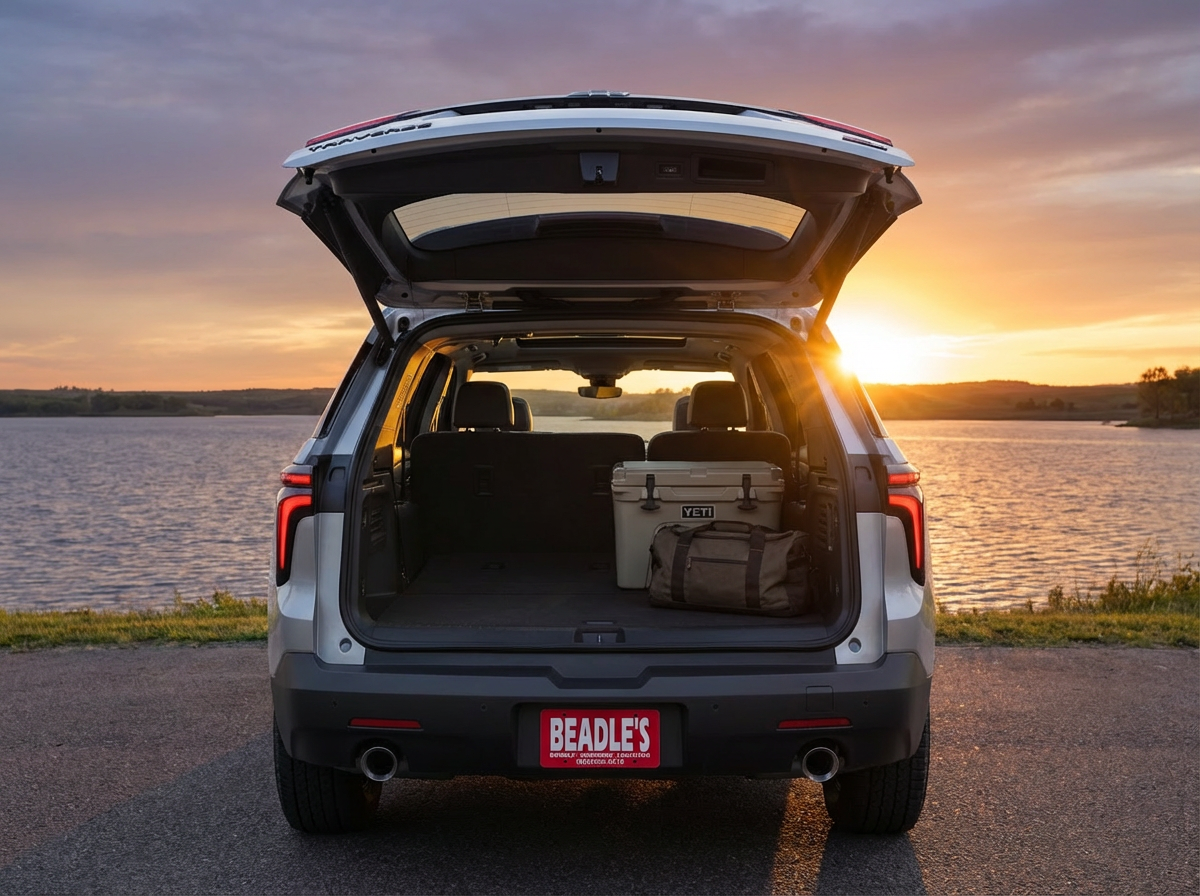
The Trailering Package (RPO V92) is standard equipment on every 2026 Traverse trim — LT, Z71, RS, and High Country. This is not a dealer-added accessory or an upsell; it comes from the factory on every unit. Here’s what the package includes:
Trailering Package Contents (Standard All Trims)
- Trailer hitch receiver (2-inch)
- Trailer wiring harness (7-pin and 4-pin connectors)
- Trailer brake controller provisions
- Engine and transmission cooling upgrades for towing duty
- Trailer sway control (integrated with StabiliTrak)
- Hitch guidance with hitch view camera (via rear camera system)
The 7-pin connector supports trailers with electric brakes — important for larger boat trailers, livestock trailers, and utility trailers that run independent brake systems. The hitch view camera makes aligning to a trailer ball significantly easier when working alone. Both are practical inclusions for the way people actually use this vehicle in western South Dakota.
Does Towing Capacity Change by Trim Level?
No — all four 2026 Traverse trims share the same 5,000-lb maximum towing capacity. The powertrain is identical across LT, Z71, RS, and High Country: same engine, same transmission, same Trailering Package. You do not need to buy a higher trim to get more towing capability.
Where trim does make a difference for towing is in the AWD system. The Z71 comes standard with the Advanced Twin-Clutch AWD and Hill Descent Control — neither of which affect maximum towing capacity, but both of which improve stability and control when launching from a soft boat ramp, recovering on a muddy pasture road, or descending a gravel incline with a loaded trailer. For dedicated towing use on anything other than flat pavement, the Z71’s drivetrain hardware is a practical advantage.
| Trim | Max Towing | AWD | Hill Descent Control |
|---|---|---|---|
| LT | 5,000 lbs | Optional | Not available |
| Z71 | 5,000 lbs | Standard (Advanced Twin-Clutch) | Standard |
| RS | 5,000 lbs | Optional | Not available |
| High Country | 5,000 lbs | Optional | Not available |
What Can 5,000 Lbs Actually Tow in South Dakota?
Five thousand pounds is a practical limit that covers a wide range of the trailers South Dakota families actually use. Here’s what fits comfortably within that rating and what pushes past it.
| Trailer Type | Typical Weight Range | Traverse Rating |
|---|---|---|
| Pontoon / fishing boat (20–22 ft) + trailer | 2,800–4,500 lbs | ✓ Within rating |
| Jet ski / PWC (2-unit) + trailer | 1,500–2,800 lbs | ✓ Within rating |
| Small enclosed cargo trailer | 1,500–3,500 lbs loaded | ✓ Within rating |
| Travel trailer / small camper | 3,500–5,500 lbs | ⚠ Verify weight — may be at or near limit |
| Livestock trailer (1–2 head) + animals | 3,000–6,000+ lbs | ⚠ Depends on load — verify GVWR |
| Fifth-wheel or large gooseneck | 8,000+ lbs | ✗ Exceeds rating |
Know the Total Weight, Not Just the Trailer
Always calculate the total loaded trailer weight — trailer GVWR including cargo, fuel, gear, and animals. A 14-ft aluminum livestock trailer by itself might weigh 1,800 lbs, but with two calves and a load of hay it can easily reach 4,000–5,000 lbs. Know your numbers before you hitch up.
How Should I Set Up the Traverse for Towing?
The 2026 Traverse comes tow-ready from the factory — no aftermarket additions needed for basic towing. Here’s how to make sure you’re set up correctly before every trip.
- Use the 7-pin connector for any trailer with electric brakes — the wiring harness supports both 4-pin and 7-pin. Anything over 3,000 lbs should have trailer brakes; confirm your trailer has them and they are calibrated.
- Activate trailer sway control — this is integrated with StabiliTrak and is active automatically. Do not disable StabiliTrak when towing.
- Use Tow/Haul mode via the drive mode selector. This adjusts transmission shift points and engine braking behavior for trailer loads.
- Distribute tongue weight correctly — aim for 10–15% of total trailer weight on the hitch ball. Too little tongue weight causes sway; too much overloads the rear axle.
- Check payload capacity on the driver door sticker — towing capacity and payload capacity are separate limits. Passengers and cargo in the vehicle count against payload even when towing.
- Use the hitch guidance camera — the Traverse’s rear camera includes a hitch view mode that makes connecting to a trailer significantly easier without a second person.
Should I Tow with FWD or AWD on the Traverse?
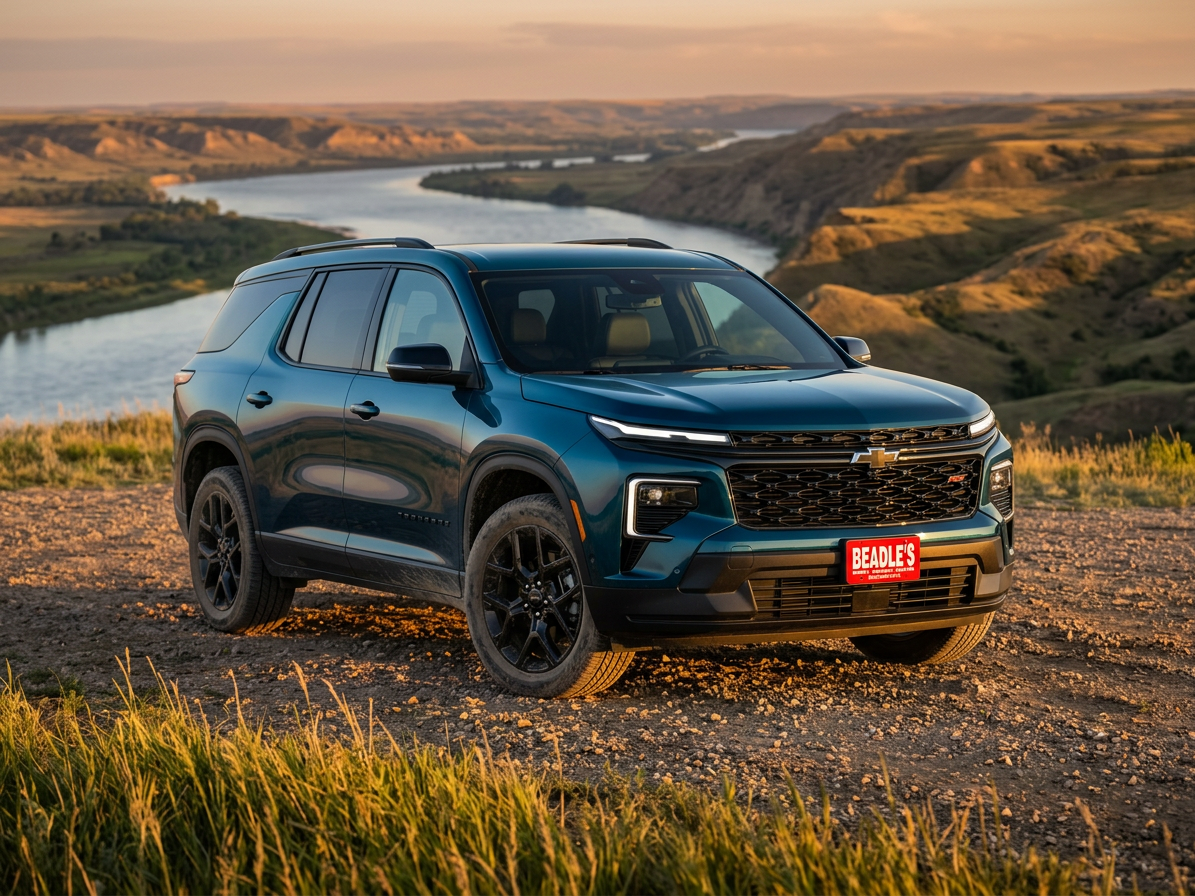
The towing capacity is the same whether you have FWD or AWD — 5,000 lbs either way. But the drivetrain matters for where you’re launching and recovering the trailer, not how much weight you’re pulling.
On paved boat ramps, level campground pads, and highway driving, FWD is fine. Where AWD earns its keep is on soft or uneven surfaces — a sandy Lake Oahe shoreline access, a wet or algae-covered concrete ramp, gravel ranch roads while backing in a livestock trailer, or any incline where wheelspin would leave you stranded. The Z71’s Hill Descent Control adds another layer by actively managing your speed on steep backward descents — particularly useful on steep gravel ramps where trailer brake pressure alone isn’t enough.
If towing is a primary use case and you regularly deal with anything other than ideal paved conditions, the Z71 is the better-equipped truck for that job. For occasional lake trips on maintained ramps with a moderate-weight boat, AWD is a comfort item rather than a necessity. For more on the AWD vs FWD decision for South Dakota driving overall, see the dedicated AWD vs FWD guide.
Key Takeaways
- All 2026 Traverse trims are rated for 5,000 lbs maximum towing — capacity does not increase with a higher trim.
- The Trailering Package (hitch, 7-pin wiring, trailer sway control, hitch camera) is standard on every trim — not an add-on.
- AWD does not increase towing capacity but improves launch/recovery traction on soft or uneven surfaces.
- The Z71 is the only trim with Hill Descent Control — useful for steep ramp recovery with a loaded trailer.
- Always calculate total loaded trailer weight (GVWR) — not just empty trailer weight — before towing.
- Activate Tow/Haul mode and verify trailer brake calibration before every trip.
- Confirm your specific vehicle’s towing rating on the window sticker — it is the authoritative source for your exact configuration.
Frequently Asked Questions
Does the 2026 Traverse come with a hitch from the factory?
Yes. The Trailering Package — which includes the 2-inch hitch receiver and wiring harness — is standard on every 2026 Traverse trim. You do not need to add a dealer-installed or aftermarket hitch on a new Traverse.
Can the 2026 Traverse tow a camper?
It depends on the camper’s loaded weight. The Traverse is rated for up to 5,000 lbs — many smaller travel trailers and pop-up campers fall within this range. Larger travel trailers frequently exceed 5,000 lbs when loaded, so you must verify the specific trailer’s GVWR before towing. If your camper is at or near the limit, factor in your vehicle’s payload capacity as well — passengers and gear inside the Traverse count against that number.
Does the Traverse have trailer brake controller support?
Yes. The standard Trailering Package includes trailer brake controller provisions. For trailers with electric brakes, you can add a compatible brake controller — the vehicle is wired for it from the factory. The 7-pin connector also supports brake signal output.
Can I tow with the FWD Traverse in South Dakota winters?
On plowed roads and paved surfaces, yes — the towing capacity is the same and Chevy’s StabiliTrak trailer sway control remains active. The limitation is launch and recovery on soft, icy, or uneven surfaces — a packed-snow boat ramp or a gravel pasture approach in March can challenge FWD traction with a loaded trailer. For winter towing in mixed conditions, AWD provides meaningful additional grip where it matters.
What is the Traverse’s towing capacity compared to the Chevy Suburban or Silverado?
The Traverse is rated for 5,000 lbs — solid for a three-row family SUV, but less than truck-based vehicles. The Silverado 1500 with a V8 can exceed 13,000 lbs, and the Suburban can reach 8,300 lbs depending on configuration. If your regular towing load runs 6,000 lbs or higher, the Traverse is not the right primary tow vehicle and you should look at something with a higher-rated powertrain.
My Take on the Traverse for Towing
When customers in Mobridge ask me whether the Traverse can handle their trailer, my first questions are always: what are you pulling, and where are you launching from? The 5,000-lb rating covers a lot of the boats on Lake Oahe and the smaller livestock trailers running around the reservation — and the fact that the hitch and wiring come standard means you’re not paying extra just to get it tow-ready.
Where I steer people toward the Z71 is when they’re dealing with mixed-surface launches regularly — a muddy bank, a soft sandy ramp, or a steep gravel approach to a stock pond. Hill Descent Control is not something you appreciate until you need it, and once you’ve used it on a slick ramp, you don’t want to go without it. For families who also need eight passengers and AWD, the Z71 is the only trim that does both.
If you want to see the full 2026 Traverse lineup in context — trims, options, and what comes standard — the 2026 Chevrolet Traverse overview is a good companion read. Or stop by Beadle Chevrolet in Mobridge and we’ll talk through your specific towing needs.
About the Author
Lexy Tabbert — Beadle Chevrolet, Mobridge, SD
Lexy Tabbert covers Chevrolet vehicles, trim comparisons, and buyer guidance for Beadle Chevrolet in Mobridge, South Dakota. Her content is grounded in real buyer conversations with families, ranchers, and ag operators across the Mobridge region and western South Dakota. Learn more about Lexy.

