





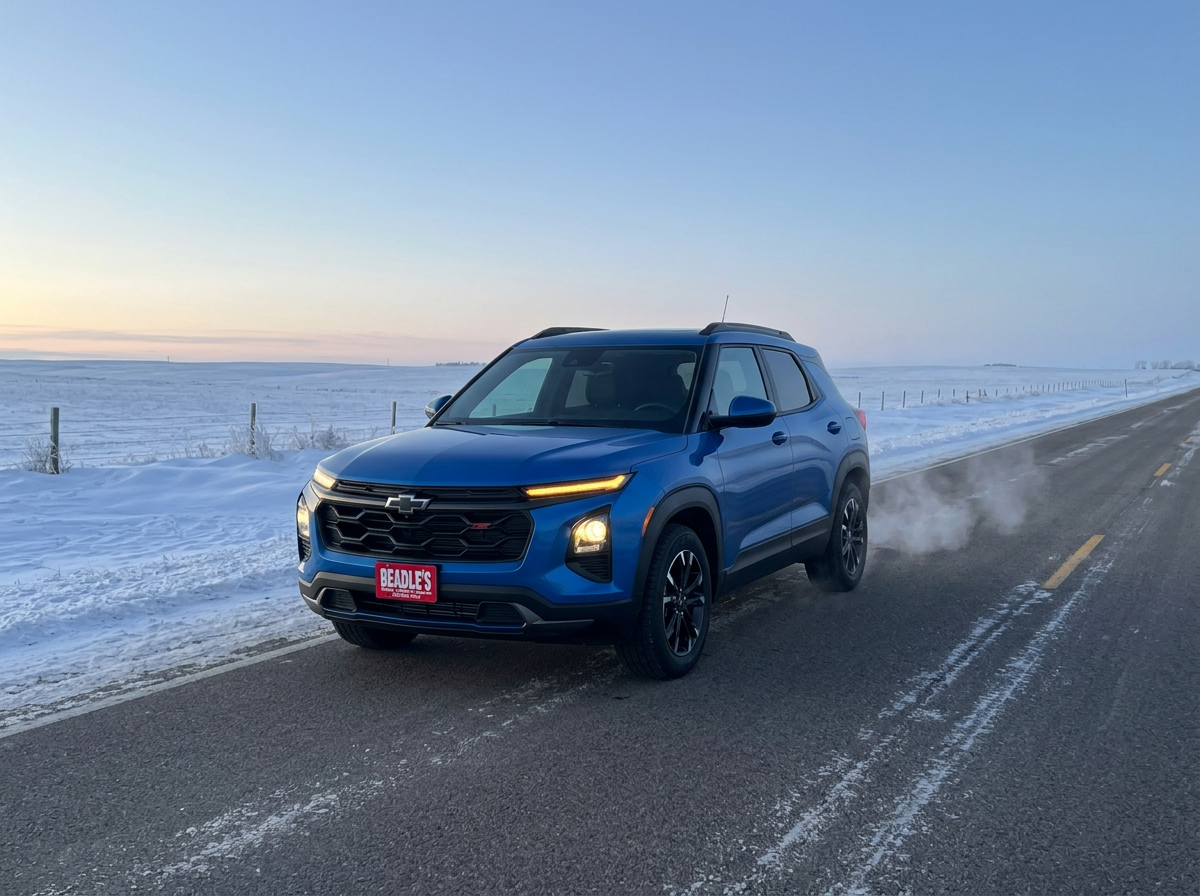
Here’s the question behind the question. Nobody in this part of South Dakota actually asks “is the Trailblazer good in snow?” out of curiosity. They ask because they have to be at work in the next town at 7 AM in January, and they’re deciding whether a small SUV can be trusted with that job — or whether they need to spend more on something bigger.
This is the honest version of that conversation: what the 2026 Trailblazer’s AWD actually does, when front-wheel drive with winter tires is the smarter buy, and when neither is the right answer and you should be looking at a bigger vehicle instead.
Quick Answer
Yes — a 2026 Trailblazer AWD with the Cold Weather Package handles a typical South Dakota winter commute well. Every AWD build pairs the 155-hp 1.3L Turbo with a 9-speed automatic (no CVT), and a block heater is available on every trim. For in-town driving, FWD plus winter tires is the budget-smart alternative.
Is the Chevy Trailblazer Good in Snow?
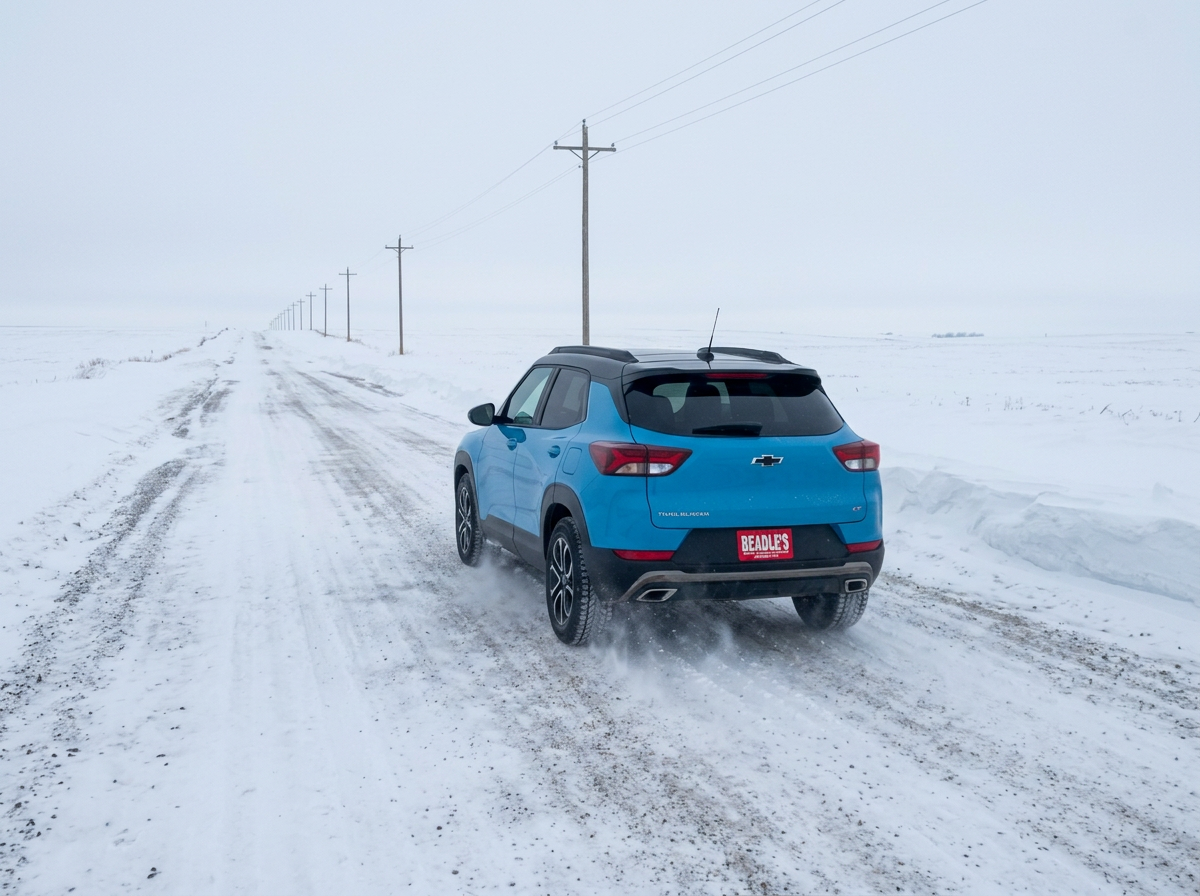
With AWD and decent tires, yes — the Trailblazer is a capable winter commuter for plowed highways and maintained gravel. It isn’t a drift-buster, and no vehicle in this size class is, but for the driving most people around Mobridge actually do in winter, it’s fully capable of the job.
Three things work in its favor. First, the AWD system adds traction where a front-driver spins — pulling away from a snow-packed stop sign, climbing the grade out of the Missouri River valley, merging onto US-12 before the sanding trucks have been through. Second, every AWD Trailblazer carries the stronger 1.3L Turbo, whose 174 lb-ft of torque arrives at just 1,600 rpm — low-end pull that lets you accelerate gently and predictably on slick surfaces instead of flogging the engine. Third, the standard safety suite earns its keep in winter specifically: Forward Collision Alert and automatic emergency braking are watching in exactly the low-visibility, deer-at-dawn conditions where a Highway 12 commuter needs them.
The honest limitation is physics: this is a 3,500-to-4,400-pound-class vehicle with 7.5 inches of minimum ground clearance. On a plowed road that’s irrelevant. In an unplowed farmyard after a ground blizzard, it’s the number that decides whether you’re driving or shoveling.
Trailblazer AWD vs FWD: Is AWD Worth It in South Dakota?
If you commute between towns in winter, AWD is worth it — full stop. If your driving is in-town errands on plowed streets, a front-wheel-drive Trailblazer wearing dedicated winter tires is the honest budget answer, and it will out-brake and out-corner an AWD model on all-seasons.
| Your Winter Looks Like… | Smarter Buy | Why |
|---|---|---|
| Daily highway commute between towns (US-12, SD-20) | AWD | Traction for merging, passing, and crosswind-drifted lanes; 1.3L + 9-speed standard with it |
| Gravel section roads or a rural driveway | AWD | Snow-packed gravel is the lowest-grip surface most of us drive on all year |
| In-town driving on plowed streets, tight budget | FWD + winter tires | Winter tires improve braking and steering — the two things AWD doesn’t help with |
| Mixed: town all week, occasional Aberdeen or Pierre trip | AWD, or FWD + winter tires | Either works — decide by budget and how flexible your travel days are |
Put simply: AWD is worth it if your winter includes highways, gravel, or a schedule that can’t flex around weather. Skip it if you drive plowed town streets and would rather put the difference into dedicated winter tires — that’s not settling, that’s optimizing.
The Winter-Driving Mistake to Avoid
Treating AWD as a substitute for tires. AWD helps you accelerate; it does nothing extra when you brake or steer, because all four wheels brake on every car. The overconfident AWD-on-worn-all-seasons driver is the one we see in the ditch on Highway 12 — not the careful FWD driver on winter rubber. Whatever drivetrain you pick, budget for tires with real tread.
Does the Trailblazer AWD Have a CVT?
No. Every all-wheel-drive 2026 Trailblazer uses a conventional 9-speed automatic transmission. The CVT exists only on front-wheel-drive builds.
This surprises a lot of shoppers, and it defuses the most common durability objection we hear about small SUVs. If you’ve been avoiding the Trailblazer because a friend warned you off CVTs, the configuration you’d actually buy for South Dakota winters — AWD — doesn’t have one. The AWD driveline is always the 155-horsepower 1.3L Turbo paired with the 9-speed; that pairing is fixed, not optional. The full breakdown of both engines, including real-world highway manners, is in our Trailblazer engines guide.
Which Cold-Weather Features Should You Order?
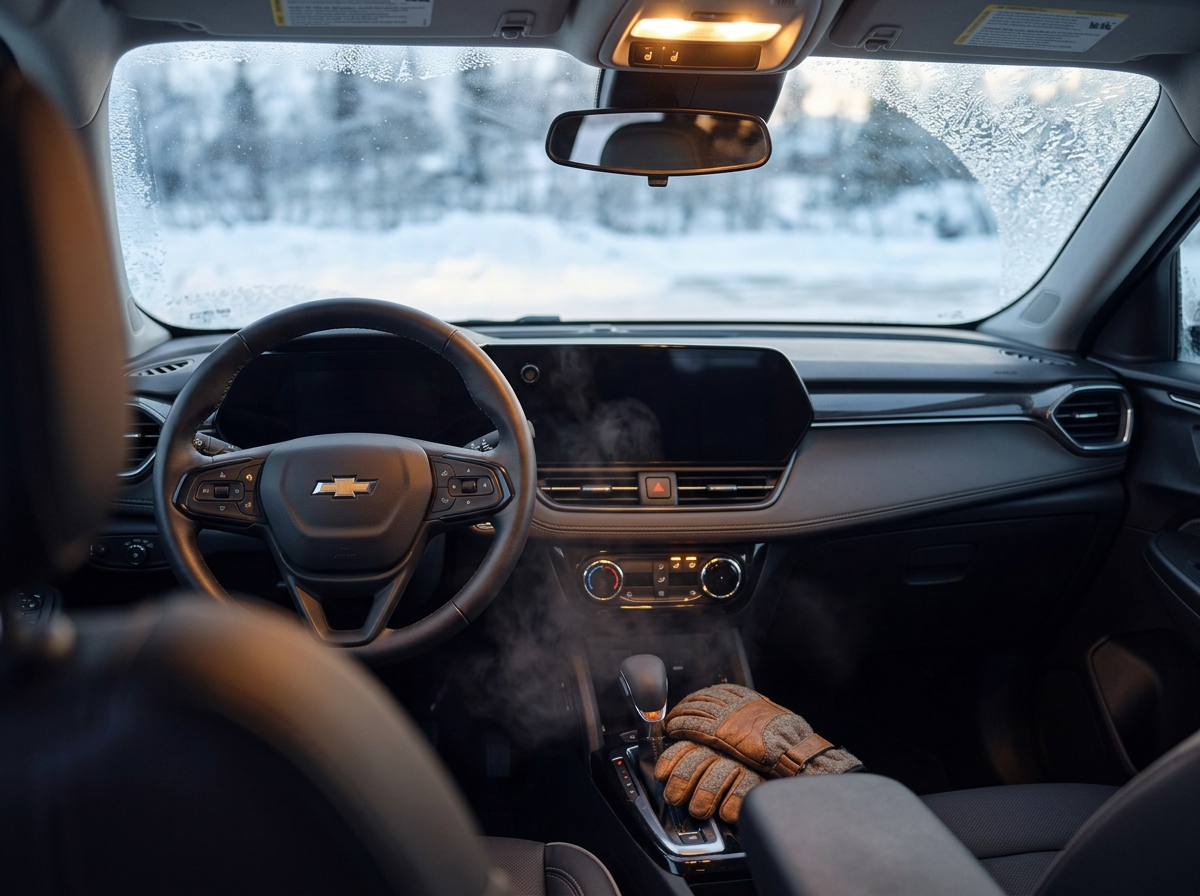
Three items, in priority order: remote start, heated front seats with the heated steering wheel, and the engine block heater. On the LT that means the Cold Weather Package; on the RS and ACTIV the heated equipment is already standard.
Remote start is standard on LT and above and available by package on the LS. The Cold Weather Package (heated front seats plus heated steering wheel) is an LT option — the LS can’t be ordered with heated seats at all, which is worth knowing before you fall in love with the base price. Trim-by-trim access to all of this equipment is mapped out in our LS vs LT comparison.
The block heater is the cheap, unglamorous option people forget until the first -20°F stretch. It’s available on every 2026 Trailblazer trim, and if your vehicle sleeps outside — rural driveway, apartment lot, hospital night shift — order it. Plugged in overnight, the engine starts easier, warms faster, and reaches operating temperature sooner, which matters for both the driveline and your defroster.
Will the Trailblazer Handle -20°F Mornings?
Yes — modern fuel injection, synthetic oil, and a healthy battery start vehicles at -20°F routinely, and the Trailblazer’s available block heater stacks the deck further in your favor.
The practical -20°F routine looks like this: block heater plugged in on a timer for the two or three hours before you leave, remote start five to ten minutes before you walk out, and a battery that gets tested every fall — extreme cold cuts battery cranking power sharply, and a battery that was marginal in October is dead in January. Our service department tests batteries as part of routine service, and that five-minute check prevents most of the no-start calls we get each winter.
One more habit worth keeping from your grandfather’s era: keep the fuel tank above half in deep cold, and keep a winter kit in the cargo area — blanket, flashlight, phone charger, tow strap. The Trailblazer’s 25.3 cubic feet behind the rear seat swallows a winter kit without noticing it’s there. Between towns out here, that’s not paranoia; it’s protocol.
When Should You Get Something Bigger Instead?
Get something bigger if your winter regularly includes unplowed roads, deep drifts, or towing. The Trailblazer’s 7.5 inches of minimum ground clearance and 1,000-pound towing rating (with the 1.3L Turbo and the available Trailering Package) are honest small-SUV numbers — they are not ranch-truck numbers.
The Trailblazer is enough if you drive maintained roads — plowed highways, graded gravel, town streets — and your cargo is people, groceries, and gear. That describes the teacher commuting Selby to Mobridge, the nurse on shift work, and the household’s second vehicle that handles school runs while the pickup does the heavy work. It’s not enough if you’re crossing unmaintained section lines in February, breaking trail to stock tanks, or pulling a livestock trailer — that’s Equinox-and-up territory at minimum, and realistically a truck job. If you’re on the fence about size, our Trailblazer vs Equinox comparison walks the size question through honestly.
What Most Buyers Overlook
The vehicle that gets you through winter is the one you can afford to keep in good tires, fresh wiper blades, and a strong battery. A well-maintained Trailblazer AWD beats a neglected three-quarter-ton every time. Confirm the drivetrain, engine, and cold-weather equipment on the window sticker of any specific unit — FWD and AWD Trailblazers look identical from the outside.
Key Takeaways
- The Trailblazer AWD is a legitimate South Dakota winter commuter for plowed highways and maintained gravel — with the right tires under it.
- Every AWD build gets the 155-hp 1.3L Turbo and a 9-speed automatic. There is no AWD CVT — the CVT is front-wheel-drive only.
- AWD helps you accelerate; it doesn’t help you brake or steer. FWD plus dedicated winter tires is the smarter buy for in-town drivers on a budget.
- Order the Cold Weather Package on the LT (heated seats and steering wheel aren’t offered on the LS) and add the block heater — it’s available on every trim.
- Know the limits: 7.5 inches of minimum ground clearance and a 1,000-lb tow rating (1.3L with the Trailering Package). Drifted section lines and trailers are a bigger vehicle’s job.
- Test the battery every fall and keep a winter kit in the 25.3 cu ft cargo area — between-towns driving here demands it.
Frequently Asked Questions
Is the Chevy Trailblazer good in snow?
With all-wheel drive and good tires, yes. The 2026 Trailblazer AWD handles plowed highways and maintained gravel roads well, helped by the 1.3L Turbo’s low-rpm torque and the standard Chevy Safety Assist suite. Its 7.5 inches of ground clearance means deep drifts and unplowed roads remain a bigger vehicle’s job.
Does the Trailblazer AWD have a CVT?
No. Every all-wheel-drive 2026 Trailblazer pairs the 155-horsepower 1.3L Turbo with a conventional 9-speed automatic transmission. The CVT is used only on front-wheel-drive models.
Is AWD worth it on a Trailblazer in South Dakota?
If you commute between towns or drive gravel in winter, yes. If you drive mostly plowed in-town streets, a front-wheel-drive Trailblazer with dedicated winter tires is the more budget-effective choice — winter tires improve braking and steering, which AWD does not.
Will a Trailblazer start at -20 degrees?
Yes, provided the battery is healthy. An engine block heater is available on every 2026 Trailblazer trim and is worth ordering for any vehicle that parks outside — plugged in overnight, it makes deep-cold starts easier and warms the cabin faster. Have the battery tested each fall.
Do I still need winter tires if I buy the AWD Trailblazer?
For the best winter performance, yes. AWD improves acceleration on slick surfaces, but braking and cornering grip come entirely from the tires. AWD with quality winter or aggressive all-weather tires is the strongest combination for South Dakota conditions.
Quick Answers
Is the Trailblazer good in snow? Yes with AWD and good tires — it’s built for plowed highways and maintained gravel, not deep drifts.
What transmission does the AWD use? A 9-speed automatic — never a CVT.
What engine comes with AWD? Always the 155-hp 1.3L Turbo with 174 lb-ft at 1,600 rpm.
Is FWD ever the smarter buy? Yes — for in-town driving, FWD plus dedicated winter tires beats AWD on all-seasons for braking and steering.
Which trims get heated seats? Standard on RS and ACTIV; Cold Weather Package on LT; not offered on LS.
Is a block heater available? Yes, on every 2026 trim — order it if the vehicle sleeps outside.
How much ground clearance? 7.5 inches minimum — fine for maintained roads, not for breaking trail.
Can it tow in winter? Its rating is 1,000 lbs with the 1.3L Turbo and the available Trailering Package — light trailers only; livestock and equipment are truck work.
Deer at dawn — does the tech help? Forward Collision Alert, automatic emergency braking, and IntelliBeam high beams are standard on every trim.
Keep Researching
- 2026 Chevrolet Trailblazer: The Complete Guide — trims, engines, packages, and winter equipment in one place
- Trailblazer Engines Explained: 1.2L vs 1.3L Turbo — why AWD always gets the stronger engine
- The Trailblazer ACTIV on Gravel — the trim built for section roads and lake access
- 2026 Trailblazer LS vs LT — which trim unlocks the cold-weather equipment
My Take on the Trailblazer as a Winter Vehicle
I sell vehicles in a town where winter is a character reference, so I won’t oversell this one: the Trailblazer is not a blizzard vehicle. Nothing its size is. What it is — configured as an AWD LT with the Cold Weather Package — is a thoroughly competent winter commuter that costs thousands less than the next size up, and for most people asking this question, that’s the actual assignment.
The advice I give at Beadle Chevrolet is the same I’d give my own family: match the vehicle to your real winter, not your worst-case imagination. If your job is US-12 every morning, buy the AWD and good tires and drive to work with confidence. If your winter is five plowed blocks, buy the FWD, put the savings into winter tires, and don’t let anyone talk you out of the smarter math. And on the genuinely bad days — the ones where the DOT pulls the plows — the right vehicle is the one parked in the garage.
Winter capability is one piece of the picture; the full trim, engine, and equipment rundown is in our complete 2026 Chevrolet Trailblazer guide. Or stop by the store in Mobridge and drive one — ideally on a day the weather is doing its worst, because that’s the test that matters here.
About the Author
Lexy Tabbert — Beadle Chevrolet, Mobridge, SD
Lexy Tabbert is the Director of Sales and Marketing at Beadle Chevrolet in Mobridge, South Dakota. She covers Chevrolet and GMC vehicles, trim comparisons, and buyer guidance — helping families, ranchers, and ag operators across the region find the right truck and configuration for their needs. Learn more about Lexy.
Connect with us

