





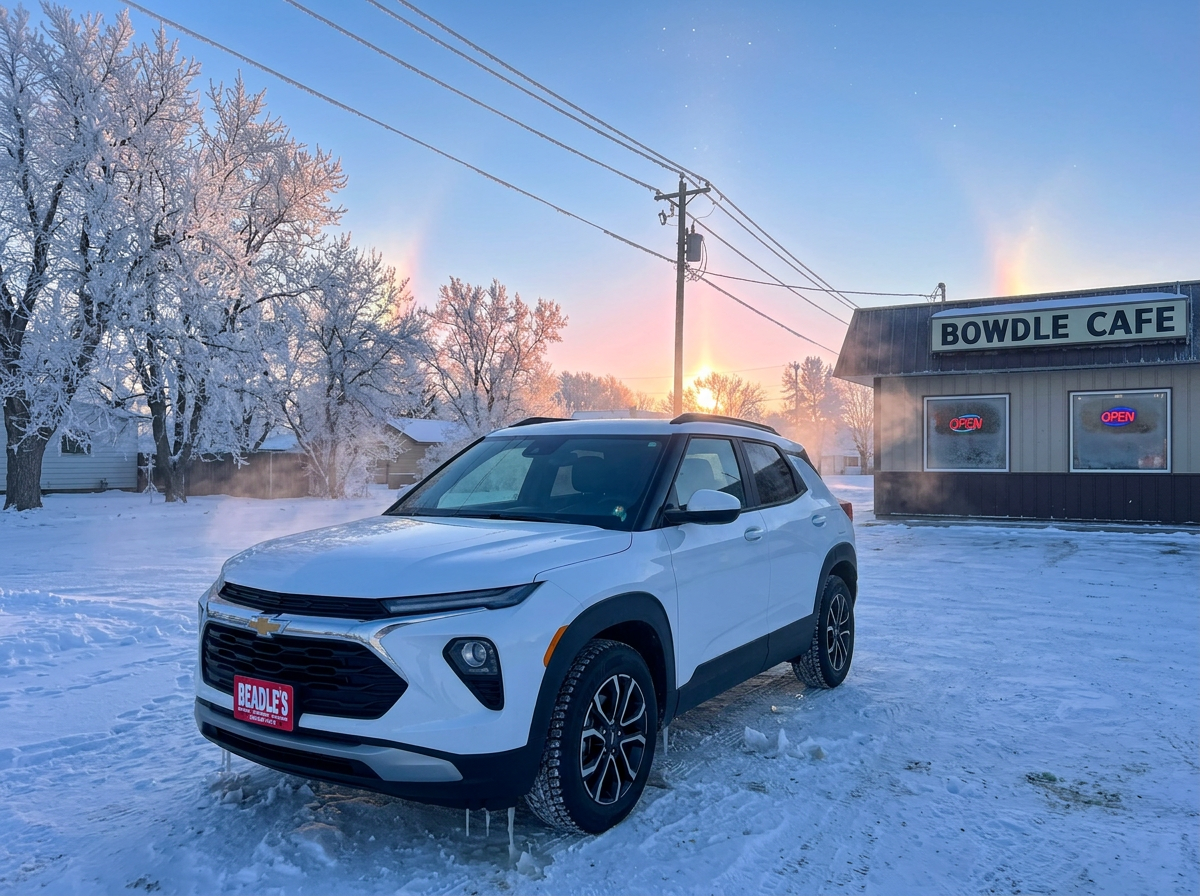
“A three-cylinder? On the highway? Out here?” We hear it weekly at the store, usually from someone whose last vehicle had twice the cylinders. It’s a fair question in a region where the nearest big-box store is a 200-mile round trip — and the answer is more interesting than the cylinder count suggests.
The 2026 Trailblazer offers two turbocharged engines, and which one you get is partly decided for you by the trim and drivetrain you pick. Here’s how the 1.2L and 1.3L Turbo differ, what each really returns at the pump, and why every AWD Trailblazer skips the CVT for a 9-speed automatic.
Quick Answer
The 2026 Trailblazer offers a 137-hp 1.2L Turbo (FWD only, LS and LT) and a 155-hp 1.3L Turbo (standard on RS, ACTIV, and every AWD build). FWD models use a CVT; AWD models always get the 1.3L with a 9-speed automatic. EPA estimates range from 31 mpg combined (1.3L FWD) to 27 combined (AWD).
On This Page
- What’s the Difference Between the 1.2L and 1.3L Turbo?
- Which Trims and Drivetrains Get Which Engine?
- Is a 3-Cylinder Engine Enough for 70-MPH Highway Trips?
- What Gas Mileage Does the 2026 Trailblazer Really Get?
- Does the Trailblazer Take Regular Gas? Is It E85 Compatible?
- Which Engine Should You Choose?
What’s the Difference Between the 1.2L and 1.3L Turbo?
Both are turbocharged three-cylinders from the same ECOTEC family; the 1.3L makes 18 more horsepower, 12 more lb-ft of torque, and delivers that torque earlier in the rev range — 1,600 rpm versus 2,500.
| Spec | 1.2L Turbo | 1.3L Turbo |
|---|---|---|
| Horsepower | 137 @ 5,000 rpm | 155 @ 5,600 rpm |
| Torque | 162 lb-ft @ 2,500 rpm | 174 lb-ft @ 1,600 rpm |
| Drivetrain | FWD only | FWD or AWD |
| Transmission | CVT | CVT (FWD) / 9-speed automatic (AWD) |
| Trims | LS, LT | Optional LS/LT (FWD); standard RS, ACTIV, all AWD |
| Towing eligibility | Not offered | 1,000 lbs with available Trailering Package |
The torque delivery is the difference you feel. Peak torque at 1,600 rpm means the 1.3L pulls from just above idle — the engine is already working in its strong zone when you roll onto the throttle to pass a grain truck, without waiting for a downshift and a climb up the rev band.
Which Trims and Drivetrains Get Which Engine?
Three rules cover every 2026 Trailblazer: the 1.2L is only sold on front-wheel-drive LS and LT models; the RS and ACTIV are 1.3L-only; and every all-wheel-drive build — any trim — is the 1.3L with the 9-speed automatic.
That last rule does a lot of quiet work. Checking the AWD box doesn’t just add driven wheels — it upgrades the engine and swaps the CVT for a conventional 9-speed in the same stroke. It’s why we tell winter-focused buyers that the AWD decision settles the engine question automatically; there is no such thing as a 1.2L AWD Trailblazer. The winter side of that story is covered in our South Dakota winters guide.
Two more order-sheet consequences worth knowing: the available Trailering Package requires the 1.3L on any trim (there’s no factory tow rating for the 1.2L at all), and the LT’s panoramic sunroof also requires the 1.3L. If either is on your list, your engine is chosen.
Is a 3-Cylinder Engine Enough for 70-MPH Highway Trips?
For the 1.3L Turbo, yes — it cruises at South Dakota highway speeds without strain, and its low-rpm torque handles passing and headwinds better than the cylinder count implies. The 1.2L is adequate for lighter duty but is the engine we’d match to town-focused driving, not a weekly Aberdeen run.
Here’s the context the spec sheet doesn’t give you: turbocharging changes what “small engine” means. A turbo three-cylinder isn’t a downsized engine working hard; at cruise it’s a small engine loafing, and when you need power the turbo supplies the airflow a bigger engine would get from displacement. The 1.3L’s 174 lb-ft arrives at 1,600 rpm — for comparison, that’s more torque, delivered earlier, than many of the four-cylinder compacts this region commuted in for decades.
The honest trade-offs: with four adults and a loaded cargo area, the 1.2L will feel the weight on grades, and both engines ask you to plan two-lane passes with the same judgment any compact SUV demands. A 20-mph prairie crosswind costs some fuel economy in any vehicle this size. What you won’t find is the buzzy, strained character older small engines had — Mobridge-to-Pierre in a 1.3L AWD Trailblazer is a relaxed 90 minutes.
What Gas Mileage Does the 2026 Trailblazer Really Get?
EPA estimates for the 2026 Trailblazer: 30 city / 31 highway / 30 combined for the 1.2L FWD, 29 / 33 / 31 for the 1.3L FWD, and 26 / 29 / 27 for the 1.3L AWD.
| Configuration | EPA City / Hwy / Combined | Tank Range (13.2 gal × combined) |
|---|---|---|
| 1.2L Turbo FWD (CVT) | 30 / 31 / 30 mpg | 396 miles |
| 1.3L Turbo FWD (CVT) | 29 / 33 / 31 mpg | 409 miles |
| 1.3L Turbo AWD (9-speed) | 26 / 29 / 27 mpg | 356 miles |
Source
EPA-estimated figures as published for the 2026 model year, retrieved July 17, 2026. Your mileage will vary with speed, wind, temperature, and load — winter cold and prairie headwinds both cut real-world economy in every vehicle. Range figures are straight math (13.2-gallon tank × combined mpg), not a promise.
What the numbers mean here: a 1.3L FWD Trailblazer makes the Mobridge–Aberdeen round trip (roughly 200 miles) on half a tank. Note the interesting wrinkle — the bigger 1.3L is also the more efficient engine on the highway cycle, 33 mpg versus 31. Between its stronger passing power and better highway economy, the 1.3L is simply the better long-distance engine, which is exactly the duty this region assigns.
Does the Trailblazer Take Regular Gas? Is It E85 Compatible?
Both engines run on regular unleaded — no premium requirement — and the 1.2L Turbo is additionally E85 flex-fuel compatible. The 1.3L is not an E85 engine.
In corn country, E85 capability occasionally matters at the pump: when the spread between E85 and regular is wide, flex-fuel owners have a cheaper option, with the trade-off that ethanol carries less energy per gallon and cuts mpg accordingly. Do the cents-per-mile math before assuming E85 is the bargain. As always, confirm the fuel requirements printed inside the fuel door and in the owner’s manual of your specific vehicle before filling with anything other than regular unleaded.
Which Engine Should You Choose?
If you’re buying AWD, the choice is made: 1.3L, 9-speed, done. If you’re buying FWD, choose by your longest regular trip, not your average one.
The 1.2L is worth it if the vehicle lives in town — school runs, groceries, the occasional Selby trip — and you want the lowest cost of entry with E85 flexibility. Skip it if your calendar includes regular highway hauls, four-up travel, any towing, or the sunroof, because all of those point to the 1.3L. The 1.3L is worth it for almost everyone else: highway commuters get better passing response and better highway mpg, and it’s the only path to the Trailering Package’s 1,000-lb rating.
The Spec-Sheet Mistake to Avoid
Assuming every FWD Trailblazer on a lot has the same engine. FWD LS and LT units can carry either the 1.2L or the 1.3L, and they look identical from the outside. Check the window sticker for the engine line on any specific unit — especially if towing eligibility or the sunroof matters to you.
Key Takeaways
- Two turbo three-cylinders: 1.2L (137 hp, 162 lb-ft @ 2,500 rpm) and 1.3L (155 hp, 174 lb-ft @ 1,600 rpm).
- The 1.2L is FWD-only on LS and LT. The RS, ACTIV, and every AWD build run the 1.3L — and AWD always pairs it with a 9-speed automatic, not a CVT.
- EPA estimates: 30/31/30 (1.2L FWD), 29/33/31 (1.3L FWD), 26/29/27 (1.3L AWD) — the 1.3L is both the stronger and the more efficient highway engine.
- Towing requires the 1.3L: 1,000 lbs with the available Trailering Package. There is no tow rating for the 1.2L.
- Both engines take regular unleaded; only the 1.2L is E85 flex-fuel compatible.
- Tank-range math on the 13.2-gallon tank: 396–409 miles FWD, 356 miles AWD at EPA combined figures.
Frequently Asked Questions
What engines does the 2026 Chevy Trailblazer have?
Two turbocharged three-cylinders: a 137-horsepower 1.2L Turbo with 162 lb-ft of torque (FWD only, LS and LT), and a 155-horsepower 1.3L Turbo with 174 lb-ft (available on LS and LT, standard on RS, ACTIV, and every AWD model).
What gas mileage does the 2026 Trailblazer get?
EPA estimates are 30 city / 31 highway / 30 combined for the 1.2L FWD, 29 / 33 / 31 for the 1.3L FWD, and 26 / 29 / 27 for the 1.3L AWD. Real-world results vary with wind, cold, speed, and load.
Is the Trailblazer’s 3-cylinder engine strong enough for highway driving?
The 1.3L Turbo is — it cruises comfortably at 70-plus mph and its 174 lb-ft of torque at 1,600 rpm gives it usable passing power for two-lane highways. The 1.2L is better matched to in-town driving than to regular long-distance highway trips.
Does the Trailblazer take regular gas or E85?
Both engines run on regular unleaded gasoline. The 1.2L Turbo is also E85 flex-fuel compatible; the 1.3L is not. Confirm fuel requirements on the fuel door and in the owner’s manual of your specific vehicle.
Can the Trailblazer tow with the 1.2L engine?
No. The available Trailering Package requires the 1.3L Turbo, and Chevrolet publishes no tow rating for 1.2L models. Properly equipped with the 1.3L and the Trailering Package, the 2026 Trailblazer is rated for 1,000 pounds.
Quick Answers
How much horsepower does the 1.2L make? 137 hp at 5,000 rpm with 162 lb-ft at 2,500 rpm.
How much does the 1.3L make? 155 hp at 5,600 rpm with 174 lb-ft at 1,600 rpm.
Can you get the 1.2L with AWD? No — AWD is always the 1.3L with the 9-speed automatic.
Which builds use the CVT? Front-wheel-drive models only, with either engine.
Best mpg configuration? The 1.3L FWD at 29/33/31 EPA — it beats the smaller 1.2L on the highway.
AWD mpg? 26/29/27 EPA.
Fuel tank size? 13.2 gallons — 356 to 409 miles of range at EPA combined figures, depending on configuration.
Which engine allows towing? Only the 1.3L — 1,000 lbs with the available Trailering Package.
Premium fuel needed? No — regular unleaded for both engines; the 1.2L also accepts E85.
Keep Researching
- 2026 Chevrolet Trailblazer: The Complete Guide — the full trim, engine, and package picture
- Is the Trailblazer Right for South Dakota Winters? — where the AWD/9-speed combination earns its keep
- 2026 Trailblazer LS vs LT — how engine choice interacts with trim and packages
My Take on the Trailblazer’s Engines
The cylinder-count conversation is my favorite one to have at Beadle Chevrolet, because it usually ends with a test drive and a surprised passenger. People expect a three-cylinder to feel like a concession. Then they merge onto US-12, the 1.3L pulls from 1,600 rpm without drama, and the objection quietly retires itself somewhere before the city limits.
My practical advice: buy the 1.3L unless your driving is genuinely in-town. The highway economy is better, the passing power is better, and it keeps the Trailering Package and sunroof on the table. And if you’re buying AWD for winter — which most of our Trailblazer customers are — the decision is already made for you, in your favor.
Engines are one chapter of the story; the rest — trims, colors, packages, and pricing — lives in our complete 2026 Chevrolet Trailblazer guide. Better yet, come drive both engines back-to-back in Mobridge and let the highway settle it.
About the Author
Lexy Tabbert — Beadle Chevrolet, Mobridge, SD
Lexy Tabbert is the Director of Sales and Marketing at Beadle Chevrolet in Mobridge, South Dakota. She covers Chevrolet and GMC vehicles, trim comparisons, and buyer guidance — helping families, ranchers, and ag operators across the region find the right truck and configuration for their needs. Learn more about Lexy.
Connect with us

