





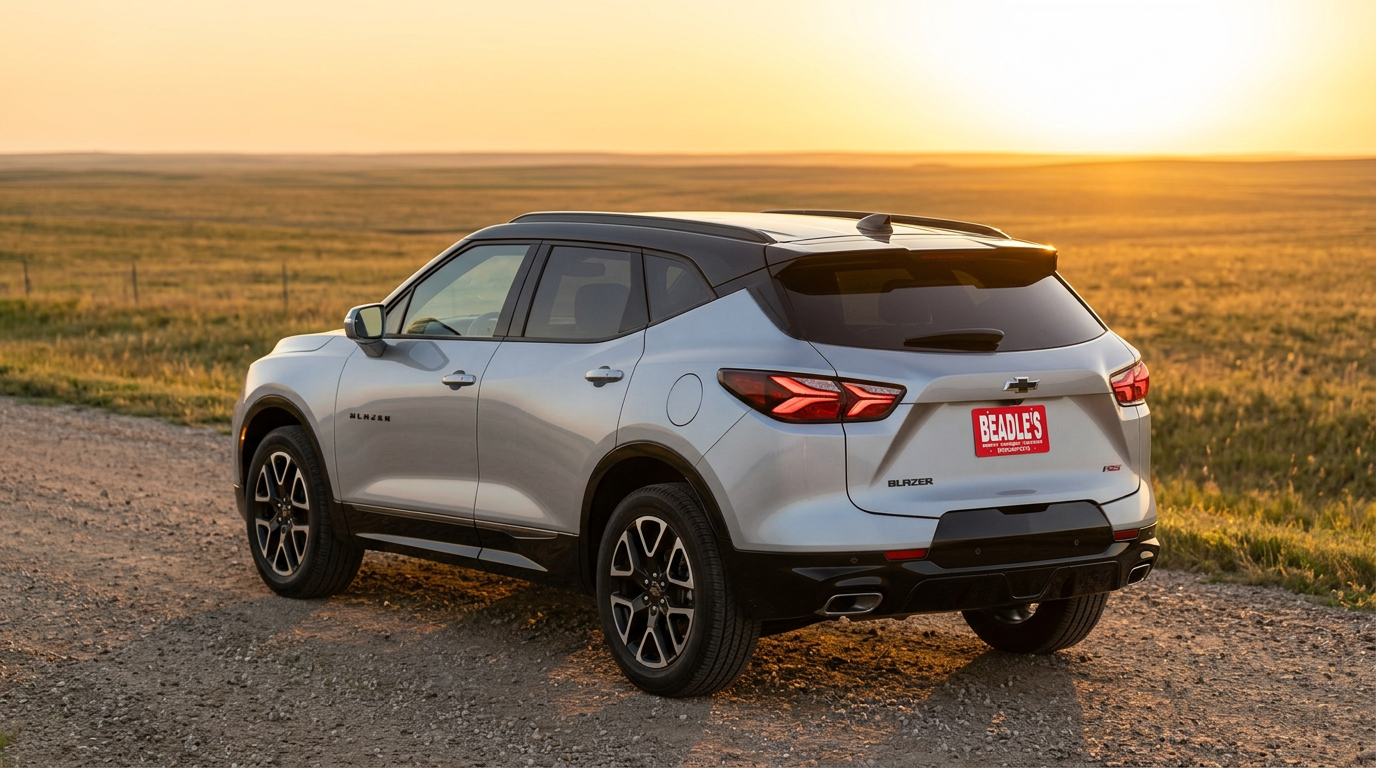
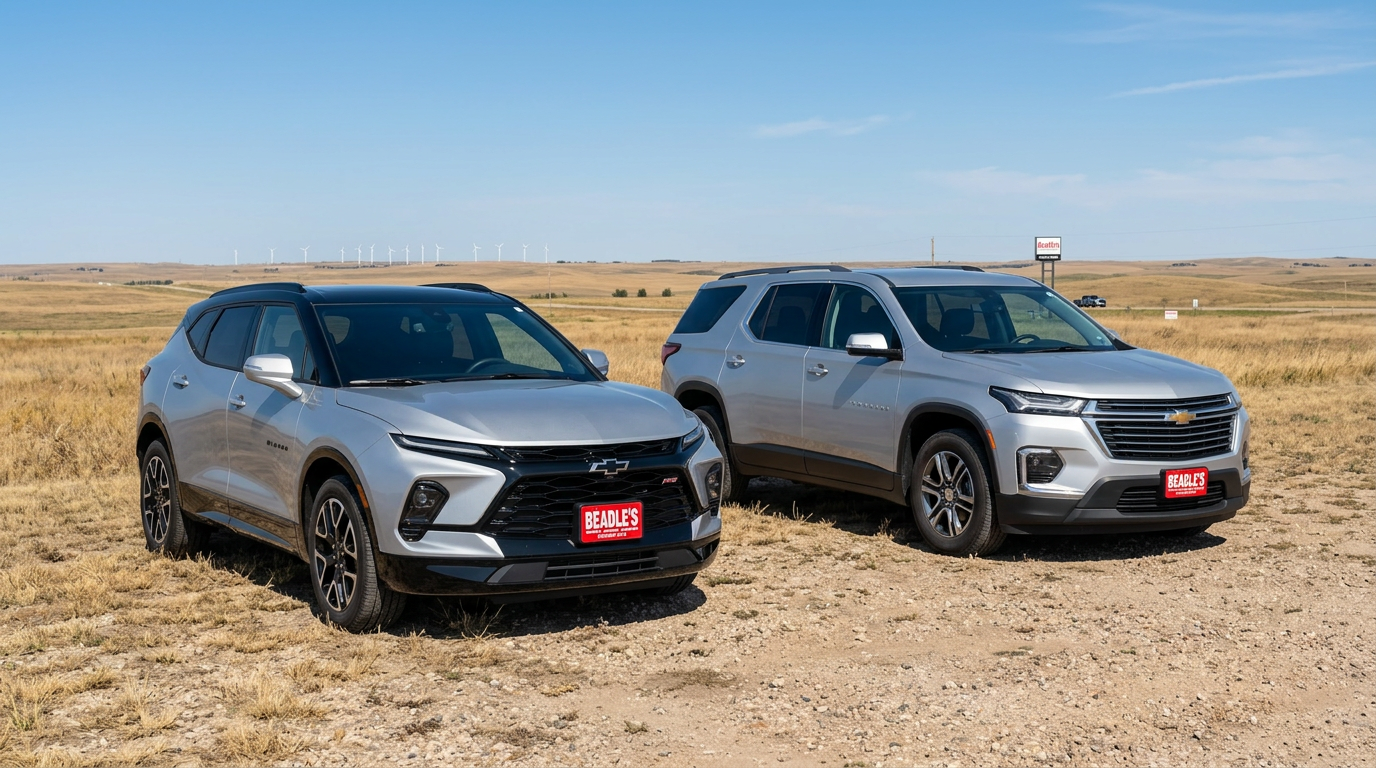
Choosing between the 2026 Chevrolet Blazer and Traverse comes down to your family size, lifestyle, and what adventures await. Both are excellent midsize SUVs from Chevy, but they’re built for different needs. The Blazer delivers agile handling, sleek styling, and a competitive price for couples and small families. The Traverse offers a third row, maximum cargo capacity, and the space to haul your whole crew—plus gear for Lake Oahe weekends or Black Hills getaways.
As the Director of Sales and Marketing at Beadle Chevrolet, I work with Mobridge families every week who are asking this exact question. Let’s break down the specs, the real-world differences, and guide you to the right choice for your life.
On This Page
How Do the Blazer and Traverse Compare on Size?
The Traverse is the larger vehicle in almost every dimension. It’s roughly 8 inches longer (212″ vs 191.88″), sits taller, and has a wider stance. That extra length accommodates the third row of seating and significantly more interior volume.
The Blazer prioritizes agility and style. Its compact footprint makes it easier to maneuver in Mobridge traffic, park at local shops, and navigate tight ranch roads. Ground clearance sits at 7.5–7.6 inches—solid for South Dakota terrain.
For couples, young professionals, or small families without a third child, the Blazer’s size is ideal. You get rugged SUV capability without the bulk.
| Specification | 2026 Blazer | 2026 Traverse |
|---|---|---|
| Length | 191.88″ | ~212″ |
| Wheelbase | 113″ | Longer |
| Ground Clearance | 7.5–7.6″ | 8.3″ |
| Seating | 5 passengers (2 rows) | Up to 8 (3 rows) |
| Passenger Volume | 107.8 cu ft | 131+ cu ft |
| Max Cargo (behind front row) | 64.2 cu ft | 98.5 cu ft |
| Engine Options | 2.0T or V6 | 2.5L Turbo only |
| Towing Capacity | Up to 4,500 lbs | Up to 5,000 lbs |
| Starting MSRP | $34,300 | ~$36,500 |
Which Has More Cargo Space?
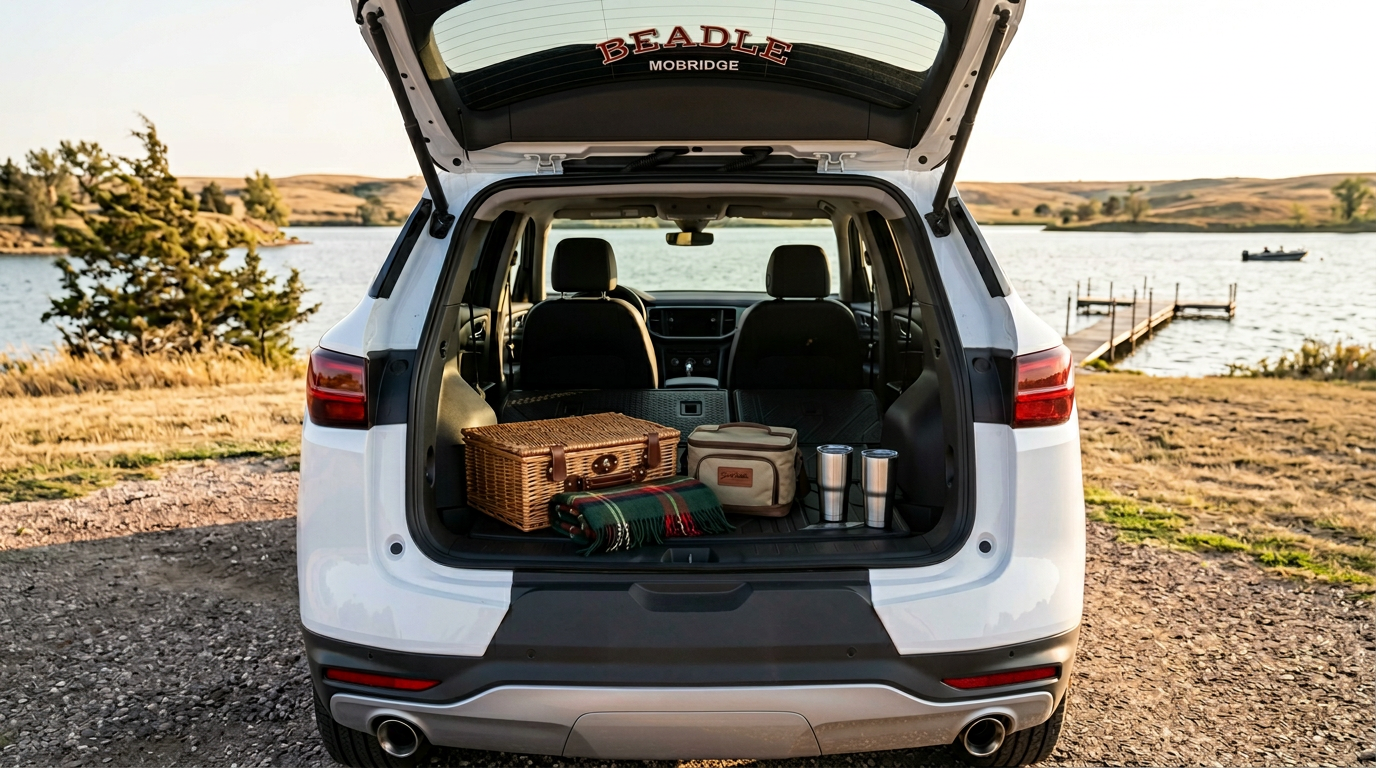
The Traverse wins decisively here. With 64.2 cubic feet behind the second row and 98.5 cubic feet with both rear rows folded, it’s purpose-built for hauling. That matters if you’re loading lumber at the hardware store, camping gear for multiple families, or equipment for Black Hills adventures.
The Blazer offers 30.5 cubic feet behind the rear seat and 64.2 cubic feet with the rear seat folded—plenty for groceries, luggage, and weekend trips. For couples or families with one or two kids, it’s more than adequate. You won’t feel cramped on typical South Dakota road trips.
Think of it this way: Choose the Blazer if cargo is occasional. Choose the Traverse if you regularly max out your trunk and need to fold seats.
How Does Seating Differ (2-Row vs 3-Row)?
This is the biggest functional difference. The Blazer seats five people across two rows. The Traverse seats up to eight with its optional third row—making it the go-to choice for larger families.
For Mobridge school carpools with three kids or more, the Traverse is a game-changer. Third-row access is practical, and rear passengers have genuine headroom. The Blazer’s two-row setup means another child needs a separate vehicle or third-party ride service.
The Blazer’s advantage: adult rear passengers get spacious legroom in a true second row—not the cramped jump seats you’d find in a three-row vehicle. Every seat feels intentional, and cabin comfort is higher because you’re not pushing a third row into a compact footprint.
Visit our 2026 Blazer overview to explore all trim levels and seating configurations, or read our full interior and cargo guide for detailed photos and measurements.
Which Tows More?
The Traverse tows up to 5,000 pounds. The Blazer—especially with the V6 AWD configuration—reaches 4,500 pounds. Both are respectable for recreational use: small trailers, jet skis, or a compact RV.
For most South Dakota owners, the difference is academic. Lake Oahe boat trips? Both handle it. Ranch utility? The Traverse provides more cushion, but the Blazer V6 won’t disappoint.
If towing is a regular, heavy-duty task, upgrade to the Traverse or step up to a full-size Tahoe or Suburban. The Blazer is the agile, fun choice—not the workhorse.
How Do They Compare on Engines and Price?
Engine Options
Blazer: Two choices. The 2.0L Turbo delivers 228 horsepower with excellent fuel economy—ideal if you prioritize efficiency and lighter daily driving. The 3.6L V6 produces 308 horsepower, offering more authority for passing, towing, and spirited driving. Both pair with an 9-speed automatic and come with standard AWD option across all trims.
Traverse: One engine: the 2.5L Turbo with 315 horsepower. It’s a solid middle ground—more power than the Blazer’s 2.0T, but turbocharged (which can mean premium fuel depending on driving habits). The Traverse’s single-engine strategy simplifies choice but removes the efficiency option the Blazer offers.
Pricing
The Blazer starts at $34,300 (before destination) and ranges to $46,500 for fully loaded trims. The Traverse starts around $36,500, making it roughly $2,000–$3,000 more at entry level. That said, the Traverse delivers a third row and maximum cargo out of the box—value proposition depends on your needs.
Budget-conscious shoppers often find great Blazer values on the lower trims. Growing families might justify the Traverse’s slight premium for seven or eight seats and long-term flexibility.
When Should You Choose the Blazer?
Choose the Blazer if:
- You’re a couple or small family (1–2 kids). Five seats is plenty, and the cabin feels premium, not crowded.
- You value fuel economy. The 2.0T turbo sips gas on highway drives to the Black Hills or Nebraska.
- You prioritize handling and agility. The Blazer steers and maneuvers like a sport-tuned crossover, not a family hauler.
- Budget is a factor. Starting at $34,300, it’s the more affordable entry into Chevy SUVs.
- You want modern styling. The Blazer’s sleek lines and bold presence appeal to younger buyers and design-forward shoppers.
- You do light towing or recreational hauling. 4,500 lbs covers boats, trailers, and ATVs without overengineering.
When Should You Choose the Traverse?
Choose the Traverse if:
- You have or plan for three or more kids. The third row is a practical necessity, not a luxury.
- You regularly haul large cargo. 98.5 cu ft fully folded beats the Blazer’s 64.2 by a wide margin.
- You need towing capacity. The extra 500 lbs (up to 5,000 total) and engine torque provide more confidence on South Dakota roads.
- You transport multiple families or groups. School events, Lake Oahe outings, or multi-generational trips are easier with eight seats.
- Versatility is key. The Traverse adapts to cargo mode, passenger mode, or mixed duty without compromise.
- You want a midsize SUV that doesn’t feel compact. The Traverse is spacious and substantial—a real family vehicle, not a crossover dressed up.
For more details on the Traverse, visit our 2026 Traverse overview page.
Key Takeaways
- Size & Agility: Blazer is compact and nimble; Traverse is spacious and substantial. Pick based on your driveway, parking preference, and comfort with proportions.
- Seating: Blazer maxes at 5 (2 rows); Traverse offers up to 8 (3 rows). Non-negotiable if you have three kids or haul multiple families regularly.
- Cargo: Traverse dominates (98.5 cu ft max). Blazer (64.2 cu ft) is adequate for couples and small families—more than enough for typical needs.
- Towing: Both competent. Traverse edges out at 5,000 lbs; Blazer V6 handles 4,500 lbs. Pick Traverse if towing is frequent or loads are heavy.
- Engines: Blazer offers efficiency (2.0T) or power (V6). Traverse is one 2.5L Turbo option—solid and balanced.
- Price: Blazer starts $34,300; Traverse ~$36,500. Budget and feature needs determine value.
- Bottom line: Blazer for couples, small families, and efficiency-seekers. Traverse for larger families, cargo haulers, and those who need maximum flexibility.
Frequently Asked Questions
The Lexy Take: Honest Guidance on Blazer vs Traverse
I sell both of these vehicles every week here at Beadle Chevrolet, and I genuinely love them for different reasons. Here’s my honest take:
If you walk into our showroom with a couple’s mentality—whether you’re newlyweds, empty-nesters, or a DINK household (double income, no kids)—I show you the Blazer. It’s sleek, efficient, and hits the sweet spot between capability and style. You’ll smile every time you drive it. It’s modern, it’s confident, and the price point lets you allocate your budget toward features, warranty, or even a fun camping trip.
If you walk in with three kids in tow, or if you’re planning to expand your family, the Traverse becomes clear. Yes, it’s roomier and more utilitarian. But that third row isn’t a gimmick—it’s liberation. You’re not solving the “where does the third kid sit?” problem anymore. You’re loading up a genuine eight-seat family vehicle. Lake Oahe weekends? Black Hills road trips? Hauling gear for the whole family plus grandparents? The Traverse laughs at those scenarios.
Price matters, too. The Blazer’s $2,000–$3,000 starting advantage might fund your first year of premiums, maintenance, or a roof rack upgrade. Don’t underestimate that flexibility.
At the end of the day, there’s no wrong answer. Both are excellent Chevy SUVs. The question is: what’s your life right now, and what might it look like in five years? Answer that honestly, and the right vehicle becomes obvious. I’m here to help you find it—stop by Beadle Chevrolet in Mobridge, or reach out anytime. Let’s get you into the perfect ride.
About the Author
Lexy Tabbert — Beadle Chevrolet, Mobridge, SD
Lexy Tabbert is the Director of Sales and Marketing at Beadle Chevrolet in Mobridge, South Dakota. She covers Chevrolet vehicles, trim comparisons, and buyer guidance — helping families, ranchers, and ag operators across the region find the right truck and configuration for their needs. Learn more about Lexy.

