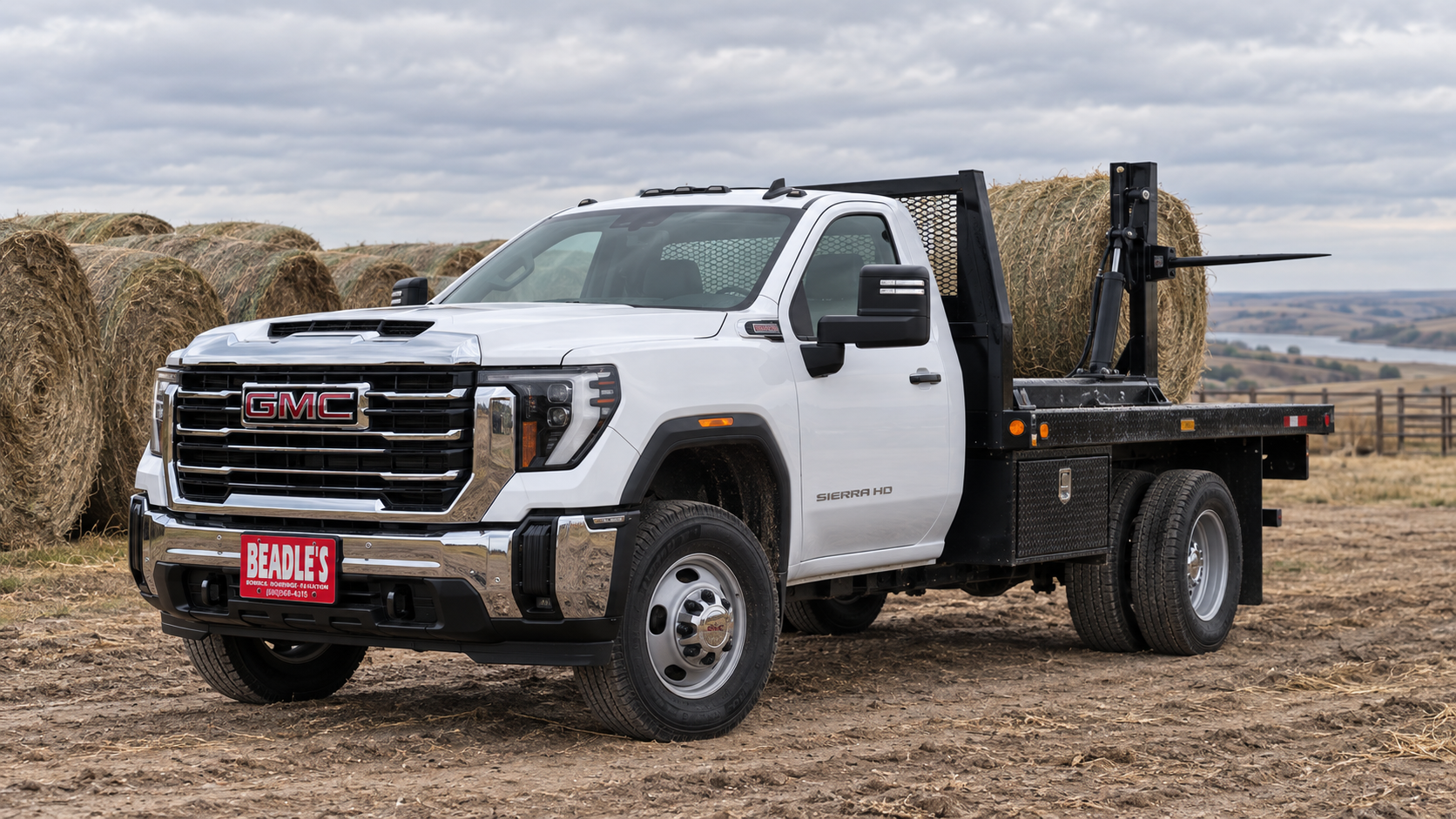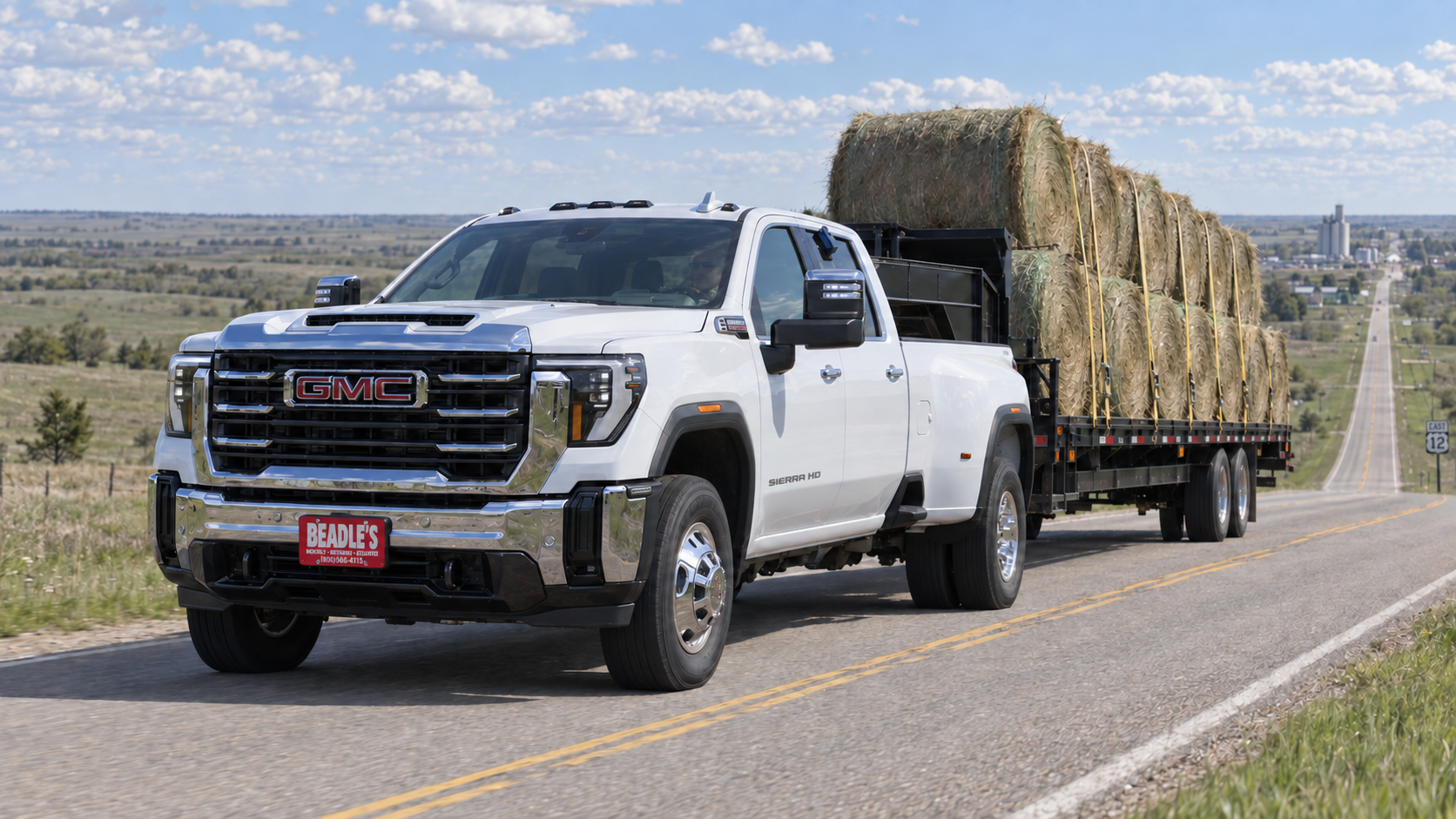





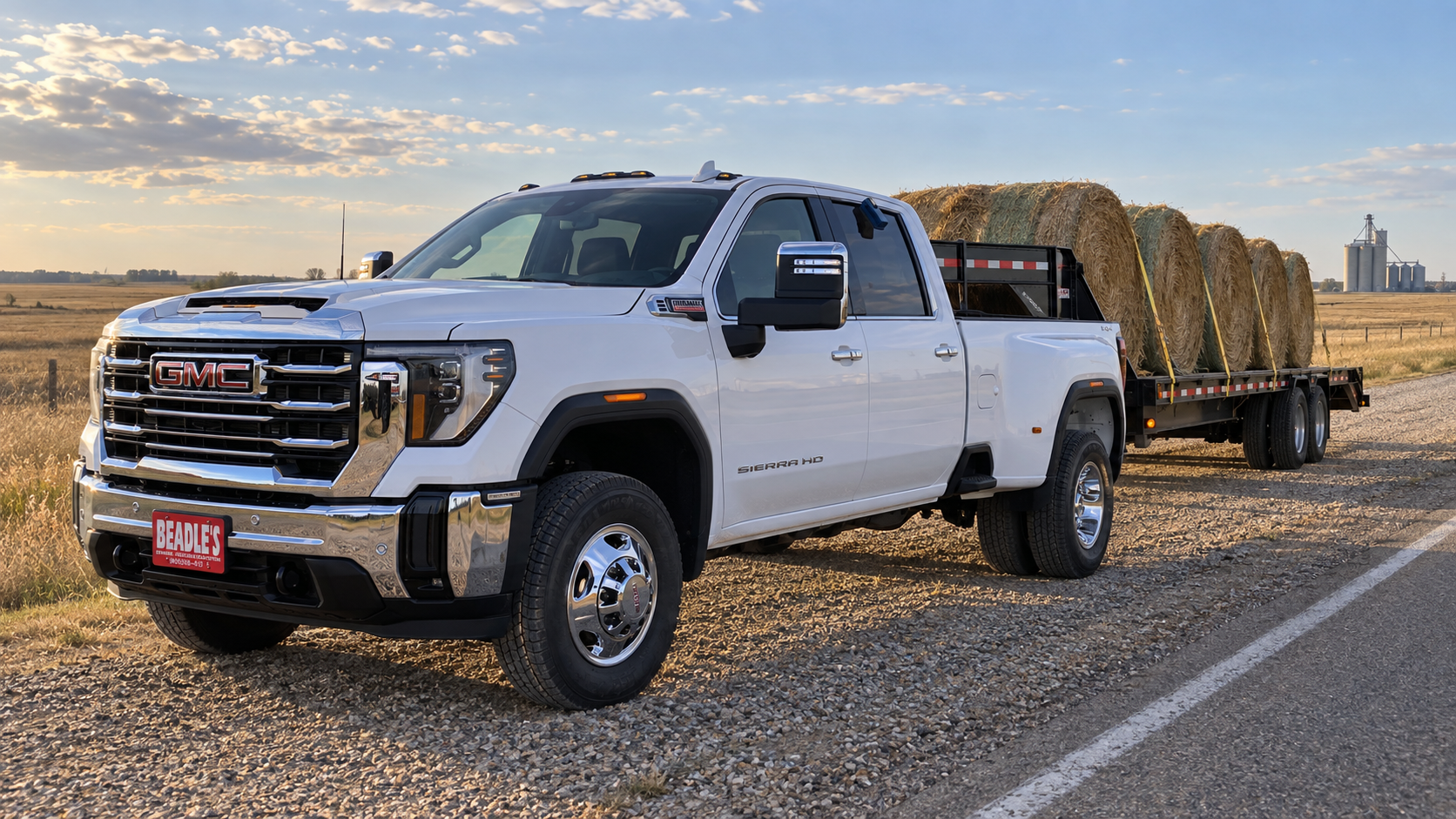
One-ton duallys are the most cross-shopped trucks on our lot, and the conversation almost always starts the same way: somebody has run an F-350 or a Ram 3500 for six or eight years, the trailer got longer, and now they want to know whether a 2026 GMC Sierra 3500 HD is the same truck or a different one. That deserves numbers, not a sales pitch.
Here is the honest version. On a crew cab 4WD dually with a diesel and a long bed, the truck almost everybody in Walworth and Corson counties orders, the Ford prints the highest gooseneck and combination ratings, the Sierra and the Ford are within about 200 pounds of each other on payload, and the Ram sits just under both. Every Ford and Ram figure below is quoted from that manufacturer's published 2026 towing guide as of September 2026, with the configuration attached, and where a maker does not publish a number I say so instead of filling in a blank. Sierra figures are GM's ratings, properly equipped.
On This Page
- Engines and transmissions, by name
- Dually to dually, crew cab to crew cab: the matched table
- The three makers do not measure the same way
- Who owns the headline maximums (and who is buying those trucks)
- Trailering tech: cameras, apps, and backing aids
- Trading a Ford or Ram in at Mobridge
- How to compare three one-ton duallys for your trailer
What Engines and Transmissions Does Each One-Ton Offer?
The 2026 Sierra 3500 HD offers two engines, the Ford F-350 offers four, and the Ram 3500 offers two. Read the list diesel against diesel and base gas against base gas.
| 2026 engine | Horsepower | Torque |
|---|---|---|
| Sierra 3500 HD 6.6L gas V8 | 401 hp | 464 lb-ft |
| Sierra 3500 HD 6.6L Duramax diesel V8 | 470 hp | 975 lb-ft |
| F-350 6.8L gas V8 | 405 hp | 445 lb-ft |
| F-350 7.3L gas V8 | 430 hp | 485 lb-ft |
| F-350 6.7L Power Stroke diesel V8 | 475 hp | 1,050 lb-ft |
| F-350 6.7L High Output Power Stroke diesel V8 | 500 hp | 1,200 lb-ft |
| Ram 3500 6.4L HEMI gas V8 | 405 hp | 429 lb-ft |
| Ram 3500 6.7L Cummins High Output diesel I6 | 430 hp | 1,075 lb-ft |
The Sierra's 464 lb-ft is the strongest torque figure among the three standard gas V8s. The Duramax and Ford's standard Power Stroke are five horsepower apart, and Ford's High Output diesel is the strongest engine in the class on paper; it is the engine behind every Ford number in this post. Ram offers one diesel in the 3500 for 2026, the High Output Cummins.
Transmissions split the field. GMC runs a 10-speed automatic with both engines and Ford a 10-speed TorqShift with all four; Ram pairs an eight-speed TorqueFlite HD with the Cummins and a separate eight-speed with the HEMI. Closer gear spacing keeps a loaded combination in the torque band instead of hunting on the climb out of the river bottom. All three diesels include an exhaust brake, which matters more coming back down, and the Duramax also brings a block heater, a 220-amp alternator, and a 730-cold-cranking-amp battery.
Which One Tows and Carries More, Dually to Dually?
Matched crew cab to crew cab, 4WD to 4x4, diesel to diesel, dually to dually: Ford leads on the published tow and combination ratings, the three are within about 335 pounds of each other on payload, and all three carry a 14,000-pound GVWR. Every figure below is properly equipped, as of September 2026.
| Crew cab, 4WD, diesel, dually, long bed | 2026 Sierra 3500 HD | 2026 Ford F-350 | 2026 Ram 3500 |
|---|---|---|---|
| Diesel in this row | 6.6L Duramax, 3.42 axle | 6.7L H.O. Power Stroke, 4.10 axle | 6.7L Cummins H.O., 3.42 axle |
| Conventional (receiver) towing | 20,000 lb | 28,000 lb | Not published separately; ask us |
| Gooseneck, or maximum trailer weight | 31,000 lb gooseneck | 35,900 lb gooseneck | 33,890 lb, one combined maximum trailer weight |
| Payload | 5,647 lb | 5,850 lb H.O., 5,865 lb standard diesel | 5,530 lb |
| GCWR | 40,000 lb with a gooseneck hitch | 45,600 lb | 42,800 lb |
| GVWR, dually | 14,000 lb | 14,000 lb | 14,000 lb |
| Rear axle rating, dually | 10,400 lb | Not published; ask us | Not published; ask us |
Read the payload row twice, because it decides most purchases here. A gooseneck sets 15 to 25 percent of its weight down in your bed, so payload runs out long before any of these tow ratings do. The Ford carries about 200 pounds more than the Sierra, the Ram about 120 pounds less, and all three land in the same 350-pound band. You are not buying a different class of truck on that spread; you are buying the cab, the cameras, and the service department you want to live with.
The tow ratings are a wider spread and I will not pretend otherwise. Ford's 35,900-pound gooseneck rating and 45,600-pound combination rating are both real and both require the High Output diesel with the 4.10 axle. Check them against what you actually hook to, because a 40-foot tandem-dual stock trailer full of pairs and a 40-foot hay flatbed both run out of your bed before they run out of anybody's tow rating. That math is worked step by step in our dually gooseneck post.
Where these numbers come from
Sierra figures are GM's published 2026 ratings. Ford figures are from the 2026 Super Duty pickup towing guide and Ford's 2026 technical specifications; Ram figures are from the 2026 Ram Heavy Duty payload and towing chart. All are quoted as of September 2026 and change with each revision. On any of the three trucks, the trailering information label in the driver door jamb is the final word.
Are the Three Tow Numbers Even Measured the Same Way?
No, and that is the most useful thing in this post. GM and Ford both publish a separate gooseneck rating for each configuration. Ram publishes one combined maximum trailer weight per configuration and no gooseneck-versus-conventional split at all, so setting a Ram number beside a Ford gooseneck number is not like for like even when both are correct.
Ford goes one step further and prints two hitch numbers where GM prints one: a gooseneck rating and a slightly lower rating for a fifth-wheel hitch on the same truck. Ram prints neither split. The closest thing it publishes to a conventional ceiling is a note that a gooseneck or fifth-wheel hitch is required above 23,000 pounds and that receiver tongue load is capped at 2,300 pounds. That is a threshold, not a rating, which is why that cell above says to ask us.
The Sierra has a wrinkle of its own. Its dually combination rating is 40,000 pounds with a gooseneck hitch. With a fifth-wheel hitch, GM rates that combination at 32,000 pounds, so if you run a plate rather than a ball, plan around that ceiling.
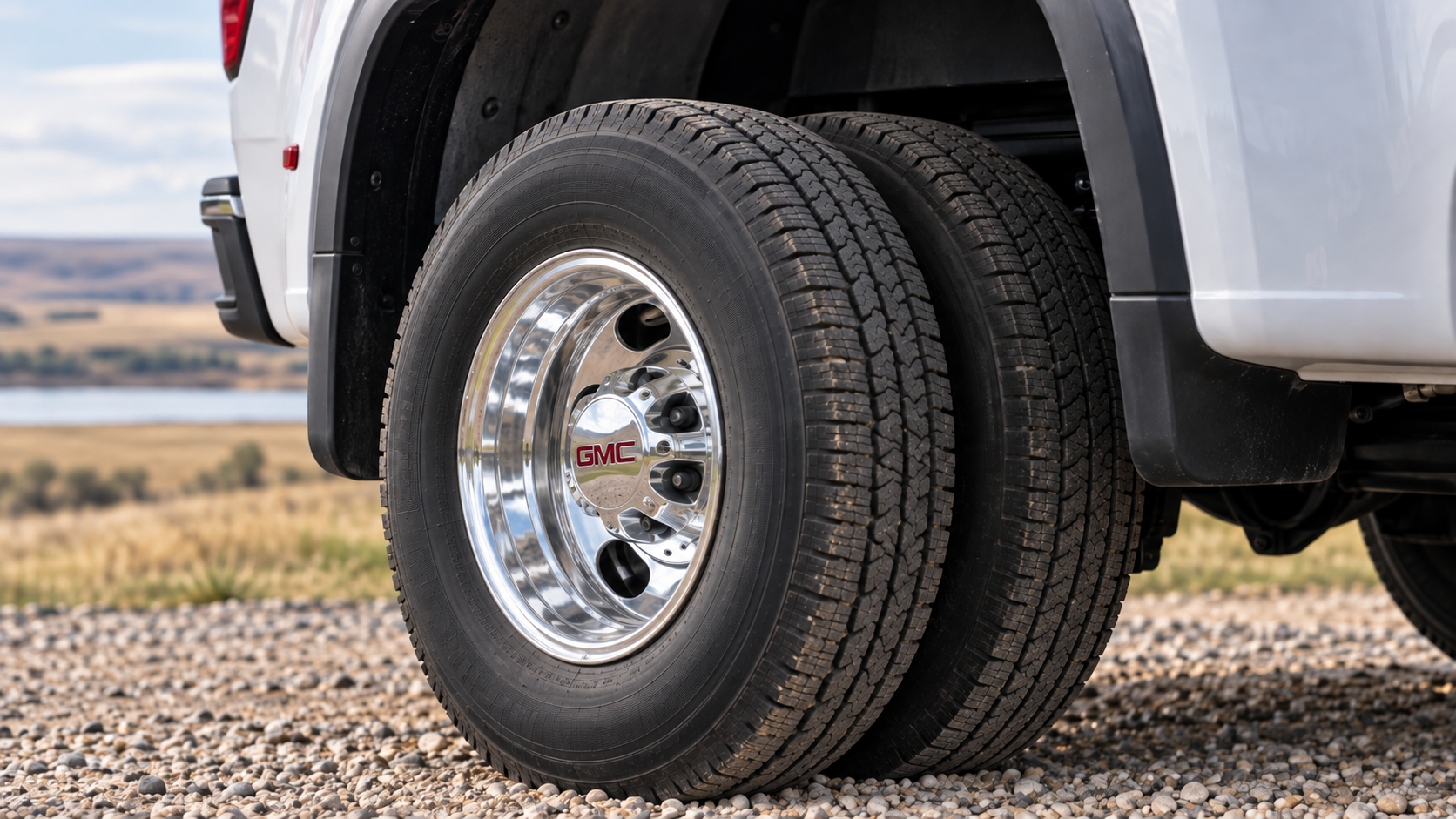
Two more cells I will not invent. Neither Ford nor Ram publishes a dually rear axle weight rating the way GM publishes 10,400 pounds; both point you at the certification label. And neither publishes width across the rear fenders. Ford publishes 105.9 inches mirror to mirror, a different measurement, and Ram publishes no width at all. The Sierra dually body is 96.62 inches across, 14.77 inches wider than a single-rear-wheel Sierra. If shop-door clearance decides this, bring a tape measure and we will measure all three.
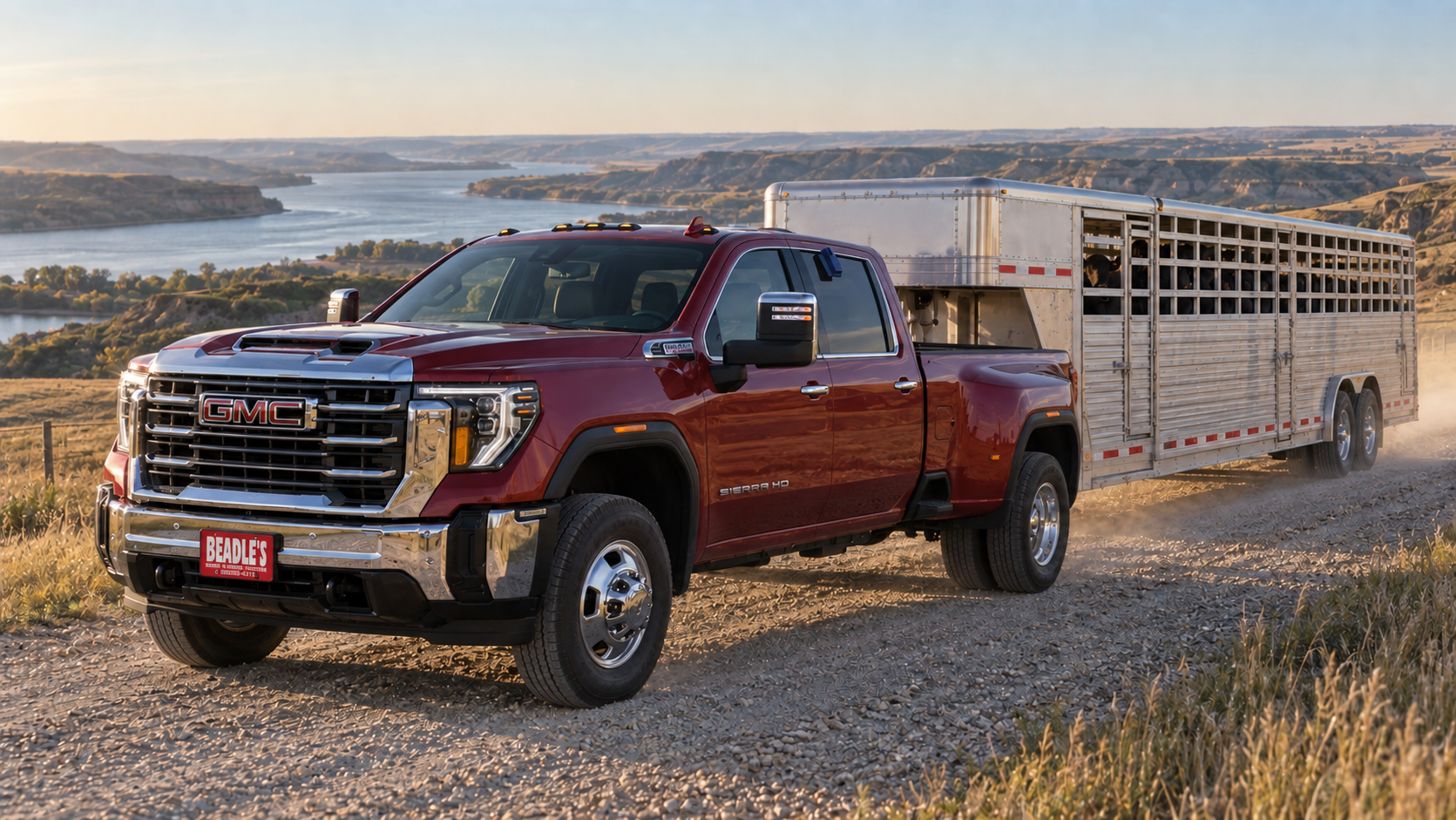
A Sierra 3500 HD crew cab long bed 4WD dually with the Duramax is rated 31,000 pounds gooseneck and 5,647 pounds of payload, properly equipped. The pin weight is what you check first.
Who Owns the Headline Maximums, and Is Anybody Here Buying Those Trucks?
All three headline numbers belong to regular-cab, long-bed duallys that almost nobody in this trade area orders. Know them so you can recognize them in an advertisement, then set them aside.
GM's 2026 maximum for the Sierra 3500 HD, 36,000 pounds gooseneck, belongs to a 2WD Regular Cab long bed dually with the Duramax and the Max Trailering Package, and the same 2WD Regular Cab long bed dually without that package is rated 35,500 pounds. That package is a Pro trim, 2WD, Regular Cab, dually-only option on the 3500 HD, so the crew cab trucks on our lot are rated on their own springs with nothing to add. Ford's maximum is 38,000 pounds gooseneck on a dually Regular Cab 4x2 with the High Output diesel and the 4.10 axle. Ram's is 36,610 pounds on a dually Regular Cab 8-foot bed 4x4 with the Cummins.
The payload headlines work the same way. Ford's highest is 7,774 pounds on a gas dually Regular Cab 4x2 with a heavy-duty payload package; Ram's is 7,590 pounds on a HEMI dually Regular Cab 4x2; GM's is 7,290 pounds on a gas 2WD Regular Cab dually. Three makers, three stripped work trucks, not one back seat among them.
Ask one question at the lot: does that number describe the cab, the drive, the bed, and the engine I am buying? If not, it is not your number. The Sierra's configuration-by-configuration tables are in the 2026 Sierra 3500 HD buyers guide, and the working-combination side of it runs in our harvest-run post.
Which Trailering Tech Actually Helps at the Chute or the Elevator?
All three come with an integrated trailer brake controller, trailer blind-spot coverage, and a camera package, so the question is what each maker chose to be good at. GM's answer is cameras and information. Ford and Ram both add a steering aid for backing.
On the Sierra 3500 HD, every trim gets the trailering package with 7-pin and 4-pin connectors, Hitch Guidance on the rear camera, the integrated brake controller, and the trailering label in the door. ProGrade Trailering is standard on SLT and up and available on SLE, adding Hitch View, a pan-and-zoom camera that lets you drop a ball under a gooseneck coupler by yourself, plus the in-vehicle trailering app with a checklist, a one-person light test, and trailer tire pressure through accessory sensors. Pro Safety Plus adds Trailer Side Blind Zone Alert and, on crew and double cabs, the bed-view camera and HD Surround Vision.
Ford's list on the F-350 is Pro Trailer Backup Assist, a knob you steer the trailer with, plus Pro Trailer Hitch Assist, Trailer Reverse Guidance, an available 360-degree camera package, and On-Board Scales with Smart Hitch, which estimates payload and tongue weight from the truck's own suspension. That last one is genuinely useful and the Sierra has no equivalent. Ram's list is Trailer Reverse Steering Control, Trailer Reverse Guidance, a five-camera surround view, a cargo-view camera, the trailer tow pages app, and trailer tire pressure monitoring.
My read after watching a lot of people back trailers: set a 40-foot fifth-wheel into a tight campsite twice a summer and a steering knob is a real convenience, which Ford and Ram have. Hook and unhook a gooseneck alone in a corral four times a week and you will use Hitch View and HD Surround Vision far more. Back a trailer with all three before you decide.
What Does Trading a Ford or Ram One-Ton In at Mobridge Look Like?
It looks like every other trade at Beadle Chevrolet GMC. We appraise the truck here on the lot, in person, and the number is good whether or not you buy the Sierra. Clean F-350 and Ram 3500 duallys sell fast in this country, so a well-kept one is a trade we want.
Two practical notes. Leave the gooseneck ball, the fifth-wheel plate, and any bed-mounted hardware in the truck until we have talked, because it does not always transfer to the Sierra's factory gooseneck prep, which puts the hitch platform, capped bed holes, and a bed 7-pin connector in the truck on all six trims. And if a bale bed, flatbed, service body, or transfer tank is moving across, say so before we write anything, so the new truck gets the bed, springs, and upfitter wiring that job needs.
The other half of the conquest question is service. A lot of our one-ton buyers switch because the diesel work happens at 2200 US Hwy 12 in Mobridge instead of 90 minutes away. Sales and service are open Monday through Friday 8:00 a.m. to 5:30 p.m. and Saturday 8:00 a.m. to noon. Get the money question out of the way early with our pre-qualification form, and for the three-quarter-ton version of this same comparison, see our Sierra 2500 HD comparison.
How to Compare Three One-Ton Duallys for Your Trailer
Six steps, in this order. The decision usually makes itself by step three.
- Weigh the rig loaded: run the trailer across the elevator scale the way you haul it, then weigh the truck hitched with the trailer axles off the scale to get your pin weight.
- Match the configuration: crew cab to crew cab, 4WD to 4x4, diesel to diesel, dually to dually. Throw out every advertised maximum that belongs to a regular cab.
- Check payload first: pin weight plus people, fuel, tools, and feed against the payload on the label. On a crew cab dually from any of the three, that is the number you run out of.
- Read all three door jambs: write down the conventional rating, the gooseneck rating, the payload, and the GVWR for each specific truck. Brochure figures lose to the label every time.
- Ask which hitch the rating assumes: ball, plate, or receiver. The three makers do not publish the same splits, and the answer can move the ceiling by thousands of pounds.
- Drive the grade and back the trailer: up out of the river bottom on US 12 loaded, back down on the exhaust brake, then into a tight spot on the cameras. Then ask us for current pricing on the Sierra that matches your list.
Quick Overview: Is the Sierra 3500 HD the Right One-Ton for You?
| Worth it if | Skip it and stay with what you have if |
|---|---|
| Your loaded pin weight fits inside 5,647 pounds of payload on a crew cab 4WD dually You hook and unhook a gooseneck alone and want Hitch View and HD Surround Vision You want diesel warranty work done in Mobridge instead of a 90-minute drive You value a 10-speed and a published 10,400-pound rear axle rating You are trading a one-ton that still has clean books and good rubber |
Your trailer needs more than 31,000 pounds of gooseneck rating on a crew cab dually You use a knob-steered backing aid every week and will not give it up On-board scales for pin and payload are a feature you have come to rely on Your current truck is paid for and still inside its own ratings You have not weighed the loaded trailer yet, which means nobody can answer this honestly |
Key Takeaways
- Matched crew cab, 4WD, diesel, dually and properly equipped: the Sierra 3500 HD is rated 31,000 pounds gooseneck and 5,647 pounds of payload, the F-350 35,900 pounds gooseneck and 5,850 pounds, the Ram 3500 33,890 pounds of combined maximum trailer weight and 5,530 pounds.
- Payload separates the three by about 335 pounds, and payload is what a gooseneck consumes, so that spread matters more than the tow headlines.
- Ram publishes one combined trailer weight with no gooseneck split, so its number and a Ford gooseneck number are not the same measurement.
- Neither Ford nor Ram publishes a dually rear axle rating or a fender width; GM publishes 10,400 pounds and 96.62 inches. Ask us and we will read or measure the rest in person.
- Every headline maximum in the class belongs to a regular-cab work truck. Compare the configuration you are buying and let the trailering label in the driver door jamb settle it.
Frequently Asked Questions
Does a Sierra 3500 HD dually tow more than an F-350 dually?
Not on the matched configuration. As of September 2026, on a crew cab 4x4 diesel dually, Ford publishes 35,900 pounds gooseneck with its High Output diesel and the 4.10 axle, against 31,000 pounds for a Sierra 3500 HD crew cab long bed 4WD Duramax dually, properly equipped. Check whether your loaded pin weight fits the payload before you let that decide it, because on all three trucks payload runs out first.
Why does Ram publish only one trailer weight instead of a gooseneck rating?
That is how Ram's 2026 heavy duty chart is built: one maximum trailer weight per configuration, no conventional-versus-gooseneck split, no separate fifth-wheel line. It does note that a gooseneck or fifth-wheel hitch is required above 23,000 pounds and that receiver tongue load is capped at 2,300 pounds. A Ram figure and a Ford gooseneck figure are not measured the same way, so compare them carefully.
How close are the three on payload for a crew cab dually?
Very close. On a crew cab 4WD diesel dually: 5,647 pounds for the Sierra 3500 HD, 5,850 pounds for an F-350 with the High Output diesel and 5,865 with the standard diesel, and 5,530 pounds for a Ram 3500, all as of September 2026 and all at a 14,000-pound GVWR. That is a 335-pound band across the class, and the label in the driver door jamb of the specific truck is what governs.
Will Beadle take my Ford or Ram one-ton on trade?
Yes, and we want it. Used F-350 and Ram 3500 duallys move well in this part of the state, so we appraise them here on the lot, in person, and the offer stands whether or not you buy the Sierra. Bring the service records and the second key, and leave any bed-mounted hitch hardware in place until we have talked it over. Call or text 605-845-7277 and we will have the appraisal ready when you get here.
My Take on the One-Ton Dually Comparison
I am not going to tell you the F-350 and the Ram 3500 are bad trucks, because they are not, and half the trailers that pull into our lot are behind one. Ford prints the highest published tow and combination ratings in this class and I quoted them here without shaving them. What I will tell you is that the number that changes somebody's mind is almost never the tow rating. It is payload, it is where the truck gets serviced, and it is how the cameras worked the first time they hooked a gooseneck alone.
On the truck people here order, the three sit inside a few hundred pounds of each other where it counts, all three carry 14,000 pounds of GVWR, and the Sierra is the one with the 10-speed, a published 10,400-pound rear axle rating, and a diesel shop 15 minutes from the sale barn. On our lot as this is written we have two SLT crew cab long bed duallys and a Denali single rear wheel, all Duramax, so bring a tape measure and your own scale ticket.
The full configuration tables are in the 2026 GMC Sierra 3500 HD buyers guide. Or bring your trailer to Beadle Chevrolet GMC at 2200 US Hwy 12 in Mobridge, or call or text 605-845-7277, and we will hook it to one and read the label together. We are open Monday through Friday 8:00 a.m. to 5:30 p.m. and Saturday 8:00 a.m. to noon.
About the Author
Lexy Tabbert — Beadle Chevrolet, Mobridge, SD
Lexy Tabbert is the Director of Sales and Marketing at Beadle Chevrolet in Mobridge, South Dakota. She covers Chevrolet and GMC vehicles, trim comparisons, and buyer guidance — helping families, ranchers, and ag operators across the region find the right truck and configuration for their needs. Learn more about Lexy.