



Blog

All Mobridge Chevrolet Dealer
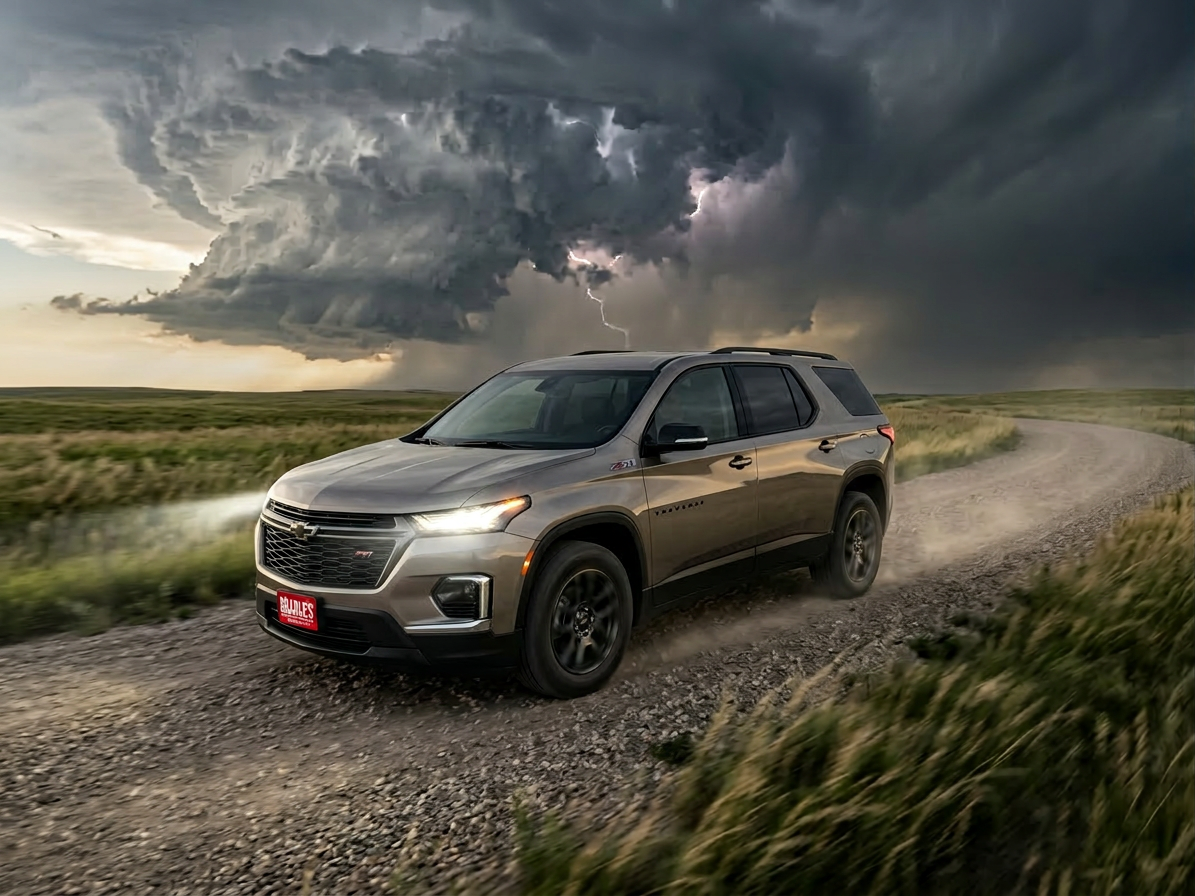
2026 Chevrolet Traverse AWD on South Dakota winter road near Mobridge

2026 Chevrolet Traverse AWD vs FWD: Which Drivetrain Makes Sense in South Dakota?

If you're buying a Traverse in South Dakota, the AWD question deserves a straight answer — not a "it depends" that leaves you guessing. This guide makes the case for when AWD on the 2026 Traverse is a genuine necessity, when it's a meaningful comfort, and when FWD is the right call. It also covers the difference between the standard AWD available on LT, RS, and High Country versus the Advanced Twin-Clutch AWD exclusive to the Z71. All drivetrain details and availability are confirmed from the 2026 Chevrolet order guide. Search Available Traverse Inventory Get Pre-Qualified On This Page What AWD systems does the 2026 Traverse offer? What is the actual difference between AWD and FWD in winter? Do South Dakota drivers actually need AWD? Is the Z71's Advanced Twin-Clutch AWD worth it over standard AWD? When is FWD the right choice on the Traverse? What does AWD cost in real terms — price and fuel economy? Key Takeaways Frequently Asked Questions What AWD Systems Does the 2026 Traverse Offer? The 2026 Traverse offers two distinct all-wheel-drive systems, and they are not the same. Knowing the difference matters when you're comparing trims. AWD System Available On How It Works Standard AWD LT (optional), RS (optional), High Country (optional) Distributes torque front-to-rear based on traction demand. FWD biased under normal conditions, transfers power rearward when front wheels slip. Advanced Twin-Clutch AWD (G99) Z71 (standard, AWD-only trim) Adds independent rear torque vectoring between left and right rear wheels. Can send torque to individual rear wheels — more precise traction control on uneven surfaces. Standard AWD handles the vast majority of South Dakota winter driving conditions well. Advanced Twin-Clutch AWD adds a level of precision that becomes relevant in off-pavement situations — soft surfaces, significant side-to-side traction differences, or steep loose-gravel scenarios. For most road-only South Dakota driving, standard AWD is sufficient. For gravel roads, soft ramps, and ranch use, the Z71's system is more capable. What Is the Actual Difference Between AWD and FWD in Winter? AWD distributes engine power to all four wheels — so when a front wheel loses traction on ice or snow, torque can shift to the rear wheels to maintain forward movement. FWD sends power only to the front wheels; if a front wheel spins, the system has fewer options to maintain momentum. The important clarification is what AWD does not do: it does not improve braking. Stopping distance on ice is determined by your tires, not your drivetrain. An AWD vehicle on all-season tires stops no shorter than a FWD vehicle on the same tires. AWD improves going — acceleration, launch traction, and sustained forward movement on slick surfaces. Once you're moving, tire quality matters more than drivetrain. AWD vs FWD: What Each Actually Improves AWD advantage: Launch traction from a stop on snow or ice AWD advantage: Sustained forward momentum on slick grades or loose surfaces AWD advantage: Reduced wheelspin when accelerating at highway entry speeds in winter Not improved by AWD: Braking distance on ice — tires determine this Not improved by AWD: Cornering grip on ice — again, tire dependent FWD advantage: Lower vehicle price, slightly better fuel economy, lighter weight Do South Dakota Drivers Actually Need AWD? For most drivers in the Mobridge area and the broader northwest South Dakota region: yes, AWD is a genuine benefit — not just a comfort feature. The combination of extended cold winters, significant snowfall, uneven road maintenance on rural routes, and gravel section-line roads creates conditions where AWD provides real-world advantage on a regular basis, not just occasionally. South Dakota winters routinely bring: blowing snow that drifts across rural roads before they can be cleared, hard-packed ice on gravel roads that can persist for weeks, and unplowed farm and ranch approaches that are part of daily routines. A family driving from Mobridge to Selby or McLaughlin in February on a county road that hasn't been fully cleared yet will experience conditions that FWD handles less confidently than AWD. This is meaningfully different from asking the same question in a Sun Belt state, or even in eastern South Dakota where more urban infrastructure means better road clearing. In the Mobridge region specifically, the case for AWD is stronger than the national-average answer to this question would suggest. AWD Is Not a Substitute for Winter Tires If your primary winter driving concern is icy stopping distances and cornering, dedicated winter tires will outperform AWD on all-seasons. The best winter setup is AWD or FWD on dedicated winter tires. AWD on all-seasons is the common configuration — it handles most SD winters fine, but drivers should understand that braking improvements come from tires, not drivetrain. Is the Z71's Advanced Twin-Clutch AWD Worth It Over Standard AWD? For most South Dakota road driving — including winter conditions on paved or well-maintained gravel — the standard AWD available on the LT, RS, and High Country handles the job well. The Z71's Advanced Twin-Clutch AWD provides additional capability that becomes relevant in specific scenarios. The technical difference: standard AWD transfers torque front-to-rear based on overall axle demand. Advanced Twin-Clutch AWD can independently direct torque to the left or right rear wheel — so if one rear wheel is spinning on ice or mud, the system can send power to the wheel that has grip, rather than waiting for overall axle slip to trigger a response. This is more precise and faster-reacting on uneven surfaces. Scenario Standard AWD Z71 Twin-Clutch AWD Snowy paved roads Handles well Handles well Gravel roads — dry Handles well Handles well Mixed ice / gravel surface Adequate More precise response Soft / muddy terrain Limited capability Meaningfully more capable Wet or algae-covered boat ramp Marginal Better launch / recovery Steep gravel descent with trailer No Hill Descent Control Hill Descent Control standard The Z71 also includes Hill Descent Control — unavailable on any other Traverse trim — which is an active assist system for controlled speed on steep descents. On a gravel approach to a pasture or stock pond, or a steep ramp in soft conditions with a boat or livestock trailer, Hill Descent Control provides active braking management that standard AWD cannot replicate. When Is FWD the Right Choice on the Traverse? FWD is a legitimate choice for Traverse buyers whose driving profile keeps them on well-maintained roads the majority of the time. Not every South Dakota driver's situation requires AWD — and FWD saves both upfront cost and ongoing fuel cost. FWD Is the Right Call When: You drive primarily within town — paved, maintained roads with regular snow removal Your route is flat — hills and grades significantly increase the benefit of AWD in winter You can avoid driving in the worst conditions — flexibility to stay home or wait out the storm Fuel economy is a significant priority — AWD carries a fuel economy penalty Budget is a constraint and you're willing to accept the trade-off A Traverse owner who lives and works in Mobridge proper, drives on plowed city streets and US-12, and rarely travels rural county roads in winter conditions can absolutely run FWD without significant compromise. The same person who runs 25 miles of gravel each day to reach a ranch in January cannot. What Does AWD Cost in Real Terms — Price and Fuel Economy? AWD on the 2026 Traverse adds cost at purchase and carries a fuel economy penalty versus the FWD equivalent. The exact price delta depends on trim — AWD is an option on LT, RS, and High Country, and is standard (not optional) on the Z71. Confirm current pricing with Beadle Chevrolet, as MSRP and incentive structures change. Drivetrain City (EPA est.) Highway (EPA est.) FWD 20 mpg 27 mpg AWD 19 mpg 24 mpg EPA estimates. Actual fuel economy varies by driving conditions, load, and driving style. Verify on window sticker. The highway fuel economy difference — 27 vs 24 mpg — is meaningful on long South Dakota drives. At 15,000 miles per year with 60% highway driving, the AWD configuration will use roughly 75–100 more gallons of fuel annually at current prices. Over five years, that's a real cost that partially offsets the AWD capability benefit for drivers who don't frequently encounter the conditions that AWD improves. Key Takeaways The 2026 Traverse offers standard AWD (LT, RS, High Country — optional) and Advanced Twin-Clutch AWD (Z71 — standard only). AWD improves launch traction and sustained forward movement on snow and ice — it does not improve braking or cornering grip on ice. For most Mobridge-area drivers who travel rural county roads and gravel in winter, AWD is a genuine benefit, not just a comfort feature. The Z71's Advanced Twin-Clutch AWD is more capable than standard AWD on uneven or off-pavement surfaces, and is the only trim with Hill Descent Control. FWD is appropriate for drivers who stay on well-maintained paved roads and can avoid worst-condition driving. AWD carries a fuel economy penalty: FWD is rated 20/27 city/hwy, AWD is rated 19/24 city/hwy (EPA estimates). Tire quality affects winter braking and cornering more than drivetrain selection — AWD on all-seasons is not equivalent to FWD on dedicated winter tires for stopping distance. Frequently Asked Questions Can I get the 2026 Traverse in FWD with any trim? Yes — FWD is the standard drivetrain on LT, RS, and High Country. All three offer AWD as an available option. The Z71 is AWD-only; FWD cannot be ordered on a Z71. Is AWD worth it on the Traverse in South Dakota? For most drivers in the Mobridge and northwest South Dakota area: yes. The combination of extended winters, gravel roads, and rural driving makes AWD genuinely useful on a regular basis — not just occasionally. For drivers who stay on plowed paved roads and can avoid the worst conditions, FWD is a workable choice that saves on purchase price and fuel cost. What is the difference between the Z71 AWD and the AWD on other Traverse trims? The Z71 uses the Advanced Twin-Clutch AWD system (RPO G99), which can independently direct torque to each rear wheel. Standard AWD on LT, RS, and High Country transfers torque front-to-rear based on overall traction demand but does not vector between individual rear wheels. The Z71 system is more capable on uneven or soft surfaces and is paired exclusively with Hill Descent Control, which is not available on any other Traverse trim. Does AWD hurt the Traverse's fuel economy significantly? There is a measurable difference: FWD is EPA-rated at 20 city / 27 highway, AWD is rated at 19 city / 24 highway. The highway penalty of 3 mpg is the most noticeable for South Dakota drivers who cover longer distances regularly. At 15,000 miles annually, this works out to roughly 75–100 additional gallons of fuel per year depending on your city/highway split. Will AWD help on a South Dakota gravel road in winter? Yes, meaningfully. Hard-packed ice and snow on gravel county roads is one of the scenarios where AWD provides the most benefit — it reduces wheelspin during acceleration and helps maintain forward momentum on grades. For drivers who run gravel roads regularly in winter, AWD is one of the more useful hardware investments. The Z71 with Advanced Twin-Clutch AWD adds further capability on the most challenging gravel surfaces. My Take on AWD for the Mobridge Area I'll be straightforward: in this part of South Dakota, I'd lean toward AWD for most buyers. It's not that FWD can't get you through a typical winter — it can, especially if you're on plowed roads and you drive attentively. But the conditions out here aren't typical. A Tuesday morning in February on a county gravel road after an overnight blizzard is a different proposition than a cleared state highway, and AWD makes that morning easier. The Z71 specifically makes sense for families who also need AWD and want the capability for ranch roads, boat ramps, or anything that takes them off maintained pavement with any regularity. It's the only trim where you get AWD standard, Hill Descent Control, and the option to configure 8-passenger seating — which is a combination no other Traverse trim offers. If you're still working through the trim decision alongside the AWD question, the 2026 Chevrolet Traverse overview has the full lineup breakdown in one place. Or stop by Beadle Chevrolet in Mobridge — we can pull up what's in stock and talk through what fits your situation specifically. Search Available Traverse Inventory Get Pre-Qualified Contact Beadle Chevrolet About the Author Lexy Tabbert — Beadle Chevrolet, Mobridge, SD Lexy Tabbert covers Chevrolet vehicles, trim comparisons, and buyer guidance for Beadle Chevrolet in Mobridge, South Dakota. Her content is grounded in real buyer conversations with families, ranchers, and ag operators across the Mobridge region and western South Dakota. Learn more about Lexy.
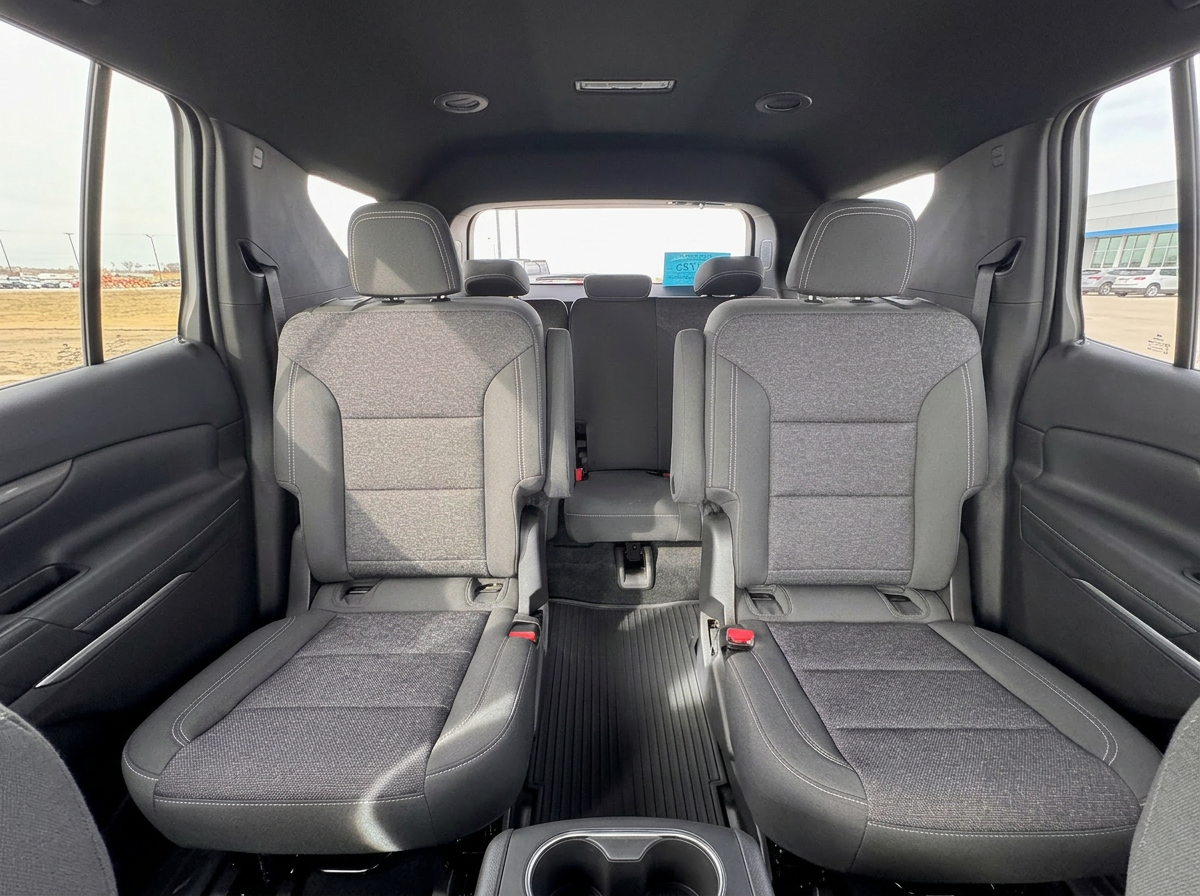
2026 Chevrolet Traverse three-row interior seating Mobridge South Dakota

How Many People Does the 2026 Traverse Actually Seat? The 7 vs 8 Passenger Answer

The 2026 Chevrolet Traverse is built around its three-row, people-first interior — but the details matter more than the headline. The difference between 7-passenger and 8-passenger configurations comes down to trim selection, not just a box to check. Third-row access depends on the Smart Slide second-row system. And cargo space is genuinely competitive — but only if you know how to use it. This guide covers how the Traverse interior actually works for South Dakota families. Seating configurations, measurements, and feature availability referenced here are drawn from official 2026 Chevrolet order guide data. Search Available Traverse Inventory Get Pre-Qualified On This Page What is the difference between 7-passenger and 8-passenger seating? Which trims offer 8-passenger seating? How usable is the third row for adults? What is Smart Slide and how does it work? How much cargo room does the 2026 Traverse have? What interior technology and comfort features come standard? Key Takeaways Frequently Asked Questions What Is the Difference Between 7-Passenger and 8-Passenger Seating? The difference is the second row. The 7-passenger Traverse uses second-row captain's chairs — two individual seats with a center console and walk-through aisle between them. The 8-passenger configuration replaces the captain's chairs with a three-person bench seat, adding a seat in the middle of the second row. Configuration Row 1 Row 2 Row 3 Total 7-Passenger 2 (bucket) 2 (captain's chairs) 3 (bench) 7 8-Passenger 2 (bucket) 3 (bench) 3 (bench) 8 Beyond the seat count, there are practical trade-offs. The captain's chair configuration provides a walk-through center aisle — helpful for buckle a child into the third row without going around the vehicle. It also gives each second-row passenger their own armrest and personal space. The bench seat trades that individual comfort and center access for an extra seat and more flexibility when mixing kids and adults. Which Is Better for Your Family? Choose captain's chairs (7-passenger) if: Your family has five or fewer people regularly, you want the walk-through aisle for easy third-row access, or you prefer individual second-row comfort and armrests. Choose the bench seat (8-passenger) if: You regularly transport more than seven people, you need the flexibility of a middle second-row seat, or you're carpooling with other families and need the extra position. Which Traverse Trims Offer 8-Passenger Seating? This is one of the most commonly misunderstood facts about the 2026 Traverse. The 8-passenger bench seat is not available across all trims — it is available only on the LT and Z71. The RS and High Country are 7-passenger only; the bench seat cannot be added regardless of packages or options. Trim 7-Passenger 8-Passenger LT ✓ Available ✓ Available Z71 ✓ Available ✓ Available RS ✓ Standard ✗ Not available High Country ✓ Standard ✗ Not available Lock In Your Seating Needs Before Choosing a Trim If eight seats are a requirement, the RS and High Country are off the table entirely. Many shoppers fall in love with the RS's appearance or the High Country's interior and then discover the bench seat isn't available — at which point the trim choice has to be reconsidered. Know this before you start configuring. How Usable Is the Third Row for Adults? The 2026 Traverse third row is one of the more usable in its class — genuinely viable for adults on shorter trips, not just a child-only emergency row. The 2024 redesign that carries into the 2026 model brought increased third-row legroom compared to the previous generation, with more headroom from a revised roofline. For practical purposes: adults in the 5'8"–5'10" range can sit in the third row without their knees touching the second-row seat back on most configurations, depending on second-row positioning. Taller adults will find it tight on longer trips. As a school-run seat, sports-event overflow row, or two-hour trip option for teenagers, it functions well. As a primary seat for adults on a four-hour interstate drive, captain's chairs in row two remain more comfortable. The third row also features its own HVAC vents — useful in South Dakota winters and summers when rear passengers are separated from the front climate zone. Third-row passengers are not isolated from temperature control. What Is Smart Slide and How Does It Work? Smart Slide is Chevrolet's name for the second-row seat mechanism that allows access to the third row without manually folding the seat. In the 7-passenger captain's chair configuration, you pull a handle on the outboard second-row seat and it slides forward on its track — creating a walk-through path to the third row without needing to remove anything or wrestle with seat backs. In practice, this matters most when you're loading kids, grandparents, or anyone who isn't easily nimble into the third row. One handle pull and the path is open. In the 8-passenger bench seat configuration, third-row access requires moving through the center of the bench — there's no Smart Slide mechanism on a bench seat, so the center aisle approach is the only option. Smart Slide vs Bench Seat Third-Row Access Captain's chairs + Smart Slide: One-handle access, defined entry path, seat returns to position automatically Bench seat (8-passenger): Center entry path only, no dedicated folding mechanism, less defined entry point How Much Cargo Room Does the 2026 Traverse Have? The 2026 Traverse offers meaningful cargo space at every configuration point — behind the third row, behind the second row, and with all rear seats folded. The 2024 redesign improved overall cargo flexibility with a flatter fold and more organized rear storage. Configuration Cargo Volume Behind third row (all seats up) 22.6 cu ft Behind second row (third row folded) 57.8 cu ft Maximum (all rear seats folded) 97.6 cu ft Cargo figures are approximate. Confirm on window sticker for your specific vehicle. The behind-third-row figure of 22.6 cu ft is competitive for the class when all three rows are occupied — enough for a family's luggage on a weekend trip to the Black Hills. When you fold the third row, the 57.8 cu ft behind the second row is practical for larger hauls: hardware store runs, sports equipment, camp gear, or groceries for a household of six. With all rear seats folded flat, the Traverse's 97.6 cu ft approaches small cargo van territory — useful for moving furniture, hauling grain sacks, or loading up after a Costco trip in Bismarck or Rapid City. What Interior Technology and Comfort Features Come Standard? Even on the base LT, the 2026 Traverse is meaningfully equipped inside. The standard interior package is one of the more complete in its price range — you're not stripping features to get the entry price. Standard Interior Features — All Trims 17.7" diagonal touchscreen with Google built-in Wireless Apple CarPlay and wireless Android Auto Wireless phone charging pad Heated front seats Heated steering wheel Tri-zone automatic climate control Remote start Power-adjustable driver's seat USB ports front and rear Upper trims add: ventilated front seats (High Country), heated second-row seats (High Country), massaging front seats (High Country), and the 15-speaker Bose premium audio system (High Country). The RS adds its own interior color treatment and sport-styled cabin details. The Z71 keeps the same interior content as the LT but adds the off-road exterior and drivetrain hardware. The 17.7" touchscreen is a significant upgrade from the previous generation — it's a large-format display by any standard, and the Google built-in system (not just Android Auto via projection) means apps, navigation, and voice commands run natively without needing a connected phone. Key Takeaways 8-passenger bench seating is available only on LT and Z71 — not available on RS or High Country regardless of packages. 7-passenger captain's chairs offer Smart Slide third-row access; bench seat does not. Third-row usability is genuine for adults on shorter trips — not just a child-overflow seat. Cargo behind the third row: 22.6 cu ft. Behind second row: 57.8 cu ft. Full fold: 97.6 cu ft. Heated front seats, heated steering wheel, tri-zone climate, and the 17.7" touchscreen are standard on every trim including the base LT. Massaging seats, ventilated seats, second-row heat, and Bose audio are High Country exclusives. If 8-passenger seating is a must, lock that requirement in before choosing any other trim features. Frequently Asked Questions Can I get an 8-passenger Traverse in the RS trim? No. The 8-passenger bench seat configuration is not available on the RS or High Country trims. Only the LT and Z71 offer the optional bench seat. If 8-passenger capacity is a requirement, the RS is not an option regardless of what packages you add. Is the Traverse third row comfortable for teenagers? Yes, for most teenagers. The third row has adequate headroom and legroom for most teen-age passengers — more so than many competitors in this segment. Adults in the 5'6"–5'10" range fit reasonably well on shorter trips. On longer drives, the third row is more suitable for younger passengers or as an occasional seat for adults. The 2024 redesign improved rear passenger space over the previous generation. Does the Traverse have heated seats in the second row? Heated second-row seats are available on the High Country trim. On LT, Z71, and RS, second-row seats are not heated — only the front seats are heated as standard equipment across all trims. Can I fold the third row flat without removing anything? Yes. The third row folds flat without removing headrests or seat sections — a single pull mechanism on each side folds the seat into the floor. The fold is genuinely flat, which makes the full cargo area useful without items rolling on a raised seat back. This is one area where the 2024-generation redesign made a practical improvement over earlier Traverse models. Does the 2026 Traverse have a sunroof or panoramic roof? A dual-panel panoramic sunroof is available on upper Traverse trims. Availability varies by trim and package — confirm on the window sticker of the specific vehicle you're considering, as panoramic roof availability depends on the option configuration of that unit. My Take on the Traverse Interior The question I get most often about the Traverse interior is the 7-versus-8-passenger decision, and my answer is almost always: figure out whether you actually need eight seats before you pick a trim. If the answer is yes — even occasionally — you're looking at the LT or Z71. The RS is a great-looking truck, but it won't ever hold eight people. For families in Mobridge running kids to activities across the region, carpooling for school events, or taking extended family out to Lake Oahe, the LT with captain's chairs and the bench seat available gives you real flexibility. The Smart Slide makes daily third-row loading genuinely easy — one handle pull, child goes in, seat slides back. That's not a small thing when you do it every day. For a complete picture of how the interior fits into the full 2026 Traverse lineup — including trim-by-trim feature differences — the 2026 Chevrolet Traverse overview is a good companion resource. Stop by Beadle Chevrolet in Mobridge and we'll get you inside one so you can see the space for yourself. Search Available Traverse Inventory Get Pre-Qualified Contact Beadle Chevrolet About the Author Lexy Tabbert — Beadle Chevrolet, Mobridge, SD Lexy Tabbert covers Chevrolet vehicles, trim comparisons, and buyer guidance for Beadle Chevrolet in Mobridge, South Dakota. Her content is grounded in real buyer conversations with families, ranchers, and ag operators across the Mobridge region and western South Dakota. Learn more about Lexy.
2026 Chevrolet Traverse safety technology Beadle Chevrolet Mobridge SD

What Safety Tech Comes Standard on the 2026 Traverse — and What Costs Extra

The 2026 Chevrolet Traverse comes standard with Chevy Safety Assist — a six-feature active safety suite that includes automatic emergency braking, lane keep assist, and forward collision alert on every single trim, including the base LT. Above that foundation, upper trims add the Driver Confidence Package with rear cross-traffic braking, a Rear Camera Mirror, and — on the High Country — available Super Cruise hands-free driver assistance. This guide covers exactly what's included, what each system does, and which features require a specific trim. Safety system content here reflects official 2026 Chevrolet order guide data. Features are trim-specific where noted — if a feature appears on a particular trim, that's confirmed, not assumed. Search Available Traverse Inventory Get Pre-Qualified On This Page What is Chevy Safety Assist and what does it include? How does automatic emergency braking actually work? What does the Driver Confidence Package add? What is Super Cruise and which Traverse trim offers it? Which safety features are available on each trim? How do these systems perform in South Dakota driving conditions? Key Takeaways Frequently Asked Questions What Is Chevy Safety Assist and What Does It Include? Chevy Safety Assist is a bundled set of six active safety technologies that comes standard on every 2026 Traverse — LT, Z71, RS, and High Country. You do not need to buy a higher trim or add a package to get these features. They are active from the moment you drive off the lot. Chevy Safety Assist — Standard All Trims Forward Collision Alert — warns you when you're approaching a vehicle ahead too quickly Automatic Emergency Braking — applies brakes automatically if a collision is imminent and you haven't responded Front Pedestrian Braking — detects pedestrians in your path and applies braking if needed Lane Keep Assist with Lane Departure Warning — alerts you when you drift from your lane and provides steering assistance to return to lane Following Distance Indicator — displays your following distance in seconds, not just a warning when it's already too late IntelliBeam Automatic High Beams — activates and deactivates high beams automatically based on oncoming traffic These six systems work as a baseline layer — they're active by default and don't require any setup. IntelliBeam is particularly useful on South Dakota's rural highway network, where the transition from dark two-lane roads to oncoming traffic can happen with very little warning. How Does Automatic Emergency Braking Actually Work? Automatic Emergency Braking (AEB) uses radar and camera sensors at the front of the vehicle to monitor the gap between you and vehicles ahead. If the system detects an imminent collision and you haven't braked, it applies full braking force automatically — faster than a human can physically react. It is not cruise control and it is not a substitute for attentive driving; it is a last-resort intervention. The 2026 Traverse version also includes Front Pedestrian Braking, which extends the detection to people in the vehicle's path — relevant in town environments around school zones, crosswalks, and parking lots. The system operates at city and highway speeds. At very low speeds (parking maneuvers), the rear camera and sensors handle obstacle detection rather than the front AEB system. What AEB Cannot Do AEB cannot stop the vehicle in all conditions or from all speeds. In severe weather — blowing snow, heavy rain, or ice — sensor performance can be reduced. AEB is a safety layer, not a replacement for keeping adequate following distance and driving attentively in poor conditions. Chevy's own documentation recommends treating these systems as supplemental, not primary, protection. What Does the Driver Confidence Package Add? Above the Chevy Safety Assist baseline, the Driver Confidence Package adds a second layer of camera and sensor technology focused on low-speed maneuvering, blind zones, and rear collision scenarios. On the 2026 Traverse, the Driver Confidence Package is available on the LT, standard on the RS, and standard on the High Country. It is also available on the Z71. Feature What It Does Rear Automatic Braking Applies brakes automatically while reversing if an obstacle is detected behind you Rear Cross-Traffic Alert Detects vehicles approaching from the side while reversing out of a parking space or driveway Blind Zone Steering Assist Provides corrective steering input if you attempt a lane change while a vehicle is in your blind spot Rear Camera Mirror Displays a wide-angle camera view in the rearview mirror — eliminates obstructions from passengers, cargo, or a loaded trailer Key Card (2026 new feature) Credit card-sized backup key — new for 2026, included in Driver Confidence Package The Rear Camera Mirror is one of the most practically useful additions in this package. When the Traverse is loaded with three rows of passengers, sports gear, and a cargo area full of supplies, the conventional mirror view is almost useless. Switching the rearview mirror to the camera feed gives you a clean 180-degree view regardless of what's behind the seats. What Is Super Cruise and Which Traverse Trim Offers It? Super Cruise is Chevrolet's hands-free driver assistance system for compatible limited-access highways. It allows the driver to remove their hands from the steering wheel on mapped highway segments — the vehicle maintains lane position, speed, and following distance automatically. It is available on the High Country trim only; it is not offered on LT, Z71, or RS. Super Cruise uses a combination of LiDAR map data, GPS, cameras, and a driver attention system. The attention system uses a small camera in the steering column to monitor the driver's eye direction — if you look away from the road for too long, the system issues alerts and eventually transfers control back to the driver. It is not fully autonomous; you must remain alert and ready to take control. Super Cruise in South Dakota Context South Dakota's major highway corridors — I-90, US-83, US-212 — are included in GM's compatible highway network. For a three-hour drive from Mobridge to Rapid City or south toward Pierre and Sioux Falls, Super Cruise meaningfully reduces fatigue on long, straight, lightly trafficked stretches. It is not available on gravel roads, in construction zones without clear lane markings, or on any non-mapped highway segment. Super Cruise Is Not Autopilot Super Cruise does not make the vehicle autonomous. It is a hands-free assist system on specific road types. The driver must remain attentive and is legally responsible for the vehicle at all times. It will deactivate if conditions change — weather, road markings, or driver attention loss. Which Safety Features Are Available on Each Traverse Trim? Here's the full breakdown of safety feature availability by trim — so you know exactly what you're getting before you buy. Safety Feature LT Z71 RS High Country Forward Collision Alert STD STD STD STD Automatic Emergency Braking STD STD STD STD Lane Keep Assist / Lane Departure Warning STD STD STD STD IntelliBeam Auto High Beams STD STD STD STD Rear Camera Mirror OPT OPT STD STD Blind Zone Steering Assist OPT OPT STD STD Rear Automatic Braking OPT OPT STD STD Super Cruise — — — OPT STD = Standard equipment. OPT = Available via Driver Confidence Package. — = Not available on this trim. How Do These Safety Systems Perform in South Dakota Driving Conditions? South Dakota presents conditions that push camera and radar-based safety systems in ways that mild-climate drivers don't encounter. Here's how the Traverse's safety suite holds up in the conditions that matter locally. Blowing snow and whiteout conditions: Camera systems can lose effectiveness when lenses are snow-covered. Radar-based systems like Forward Collision Alert are generally more robust in low-visibility weather than camera-only systems, but no active safety system is fully reliable in whiteout conditions. The system's limitation in severe weather is not unique to Chevrolet — it's a shared characteristic of all current-generation camera and radar systems. Rural two-lane highways: The Lane Keep Assist and Forward Collision Alert are calibrated for this environment. IntelliBeam is especially useful on dark rural routes where the only oncoming light for miles is a vehicle approaching at highway speed. The system activates high beams when the road is clear and dims them automatically — no more forgetting to dim for oncoming traffic at 11 PM on US-83. Wildlife collision risk: Deer and other large animals are not detected by the current Traverse AEB and pedestrian braking systems. These systems are calibrated for vehicles and humans — not animals. In high-deer-activity areas around dawn and dusk, your own visual attention and speed management remain the primary protection. Gravel roads: Active safety systems function normally on gravel. StabiliTrak and trailer sway control remain active. The Z71's Hill Descent Control, while not a traditional safety system, provides meaningful control on loose gravel descents — which is a real scenario on ranch approaches and section-line roads in the Mobridge area. Key Takeaways Chevy Safety Assist — six active safety features including automatic emergency braking — is standard on every 2026 Traverse trim with no package required. The Driver Confidence Package adds Rear Camera Mirror, Blind Zone Steering Assist, and Rear Automatic Braking — available on LT and Z71, standard on RS and High Country. Super Cruise hands-free driver assistance is available only on the High Country trim. IntelliBeam automatic high beams are standard all trims — a practical benefit on South Dakota's rural highway network. Camera and radar systems can be affected by blowing snow and severe weather — they are a supplemental safety layer, not a substitute for attentive driving. AEB detects vehicles and pedestrians — it is not calibrated to detect deer or other large animals. Super Cruise operates on compatible mapped highways only — including I-90 and US-83 in South Dakota — and requires driver attention at all times. Frequently Asked Questions Does the 2026 Traverse LT come with automatic emergency braking? Yes. Automatic Emergency Braking is part of Chevy Safety Assist, which is standard on every 2026 Traverse trim including the base LT. You do not need to add a package or buy a higher trim to get it. Can I get Super Cruise on the Traverse Z71 or RS? No. Super Cruise is available only on the High Country trim of the 2026 Traverse. It is not offered as an option on the LT, Z71, or RS regardless of what packages are added. What is the Rear Camera Mirror and do I need it? The Rear Camera Mirror replaces the conventional rearview mirror display with a wide-angle camera feed from the rear of the vehicle. When you have passengers in all three rows, cargo blocking the window, or a trailer behind you, the camera view is dramatically clearer than the conventional mirror. It's standard on RS and High Country; available via the Driver Confidence Package on LT and Z71. For families who regularly carry a full load or tow trailers, it's a worthwhile addition. Will the Traverse's safety systems work in a South Dakota blizzard? Performance can be reduced. Camera systems may be obstructed by snow accumulation on lenses. Radar-based detection (Forward Collision Alert, AEB) is generally more robust in precipitation than camera-only systems, but Chevrolet — like all manufacturers — recommends treating active safety systems as supplemental in severe weather, not as primary protection. The vehicle will alert you if a sensor is obstructed. Does the 2026 Traverse have blind spot monitoring? Yes, but it depends on trim. Blind Zone Steering Assist (which includes blind spot alert and steering correction if you attempt a lane change with a vehicle in your blind spot) is part of the Driver Confidence Package — available on LT and Z71, standard on RS and High Country. The base Chevy Safety Assist bundle does not include blind spot monitoring. My Take on the Traverse's Safety Features What stands out to me about the 2026 Traverse safety package is that the baseline is genuinely useful — not a stripped-down list of features you'd never actually notice. Automatic emergency braking, lane keep assist, and IntelliBeam on the base LT means families leaving Mobridge for a long drive to Rapid City or Pierre aren't without protection just because they bought the entry trim. The Driver Confidence Package is the upgrade I'd recommend most often — especially the Rear Camera Mirror. Once you've driven with three rows of people and a cargo area full of gear, the conventional mirror view is almost useless. The camera feed changes that entirely. If you're considering the LT, it's worth adding that package. On the RS and High Country it's already there. Super Cruise is a genuine benefit if long highway drives are part of your regular life — but it's a High Country feature only. If you're weighing the High Country specifically for Super Cruise, the 2026 Chevrolet Traverse overview has a full comparison of what else the High Country brings to help you decide if the full package is worth it. Come by Beadle Chevrolet in Mobridge and we'll walk you through what's available on the vehicles we have in stock. Search Available Traverse Inventory Get Pre-Qualified Contact Beadle Chevrolet About the Author Lexy Tabbert — Beadle Chevrolet, Mobridge, SD Lexy Tabbert covers Chevrolet vehicles, trim comparisons, and buyer guidance for Beadle Chevrolet in Mobridge, South Dakota. Her content is grounded in real buyer conversations with families, ranchers, and ag operators across the Mobridge region and western South Dakota. Learn more about Lexy.
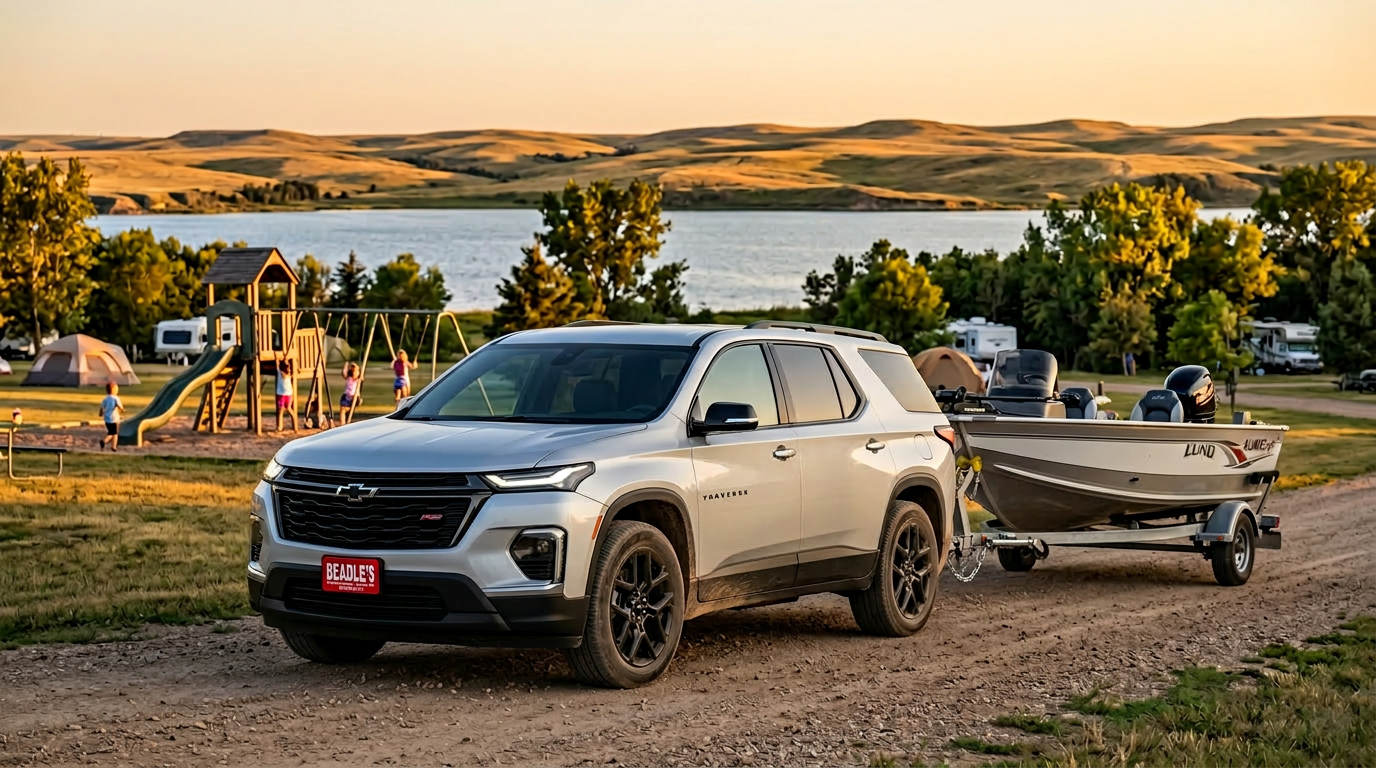
2026 Chevrolet Traverse towing near Mobridge South Dakota

2026 Chevrolet Traverse Towing Guide: A Mom Car That Can Pull

The 2026 Chevrolet Traverse is rated for up to 5,000 lbs of towing capacity — and unlike many three-row SUVs, every trim ships with the Trailering Package as standard equipment. For families around Mobridge pulling a boat to Lake Oahe, hauling a livestock trailer across the reservation, or running a camper out to the Black Hills, that's a meaningful baseline. This guide covers exactly what the Traverse can tow, what the standard Trailering Package includes, and how to set up your rig correctly. All towing figures and equipment details here are drawn from the 2026 Chevrolet order guide — not marketing materials or third-party estimates. If a spec isn't confirmed, it isn't published here. Search Available Traverse Inventory Get Pre-Qualified On This Page How much can the 2026 Traverse tow? What does the standard Trailering Package include? Does towing capacity change by trim level? What can 5,000 lbs actually tow in South Dakota? How should I set up the Traverse for towing? Should I tow with FWD or AWD on the Traverse? Key Takeaways Frequently Asked Questions How Much Can the 2026 Chevrolet Traverse Tow? The 2026 Chevrolet Traverse has a maximum towing capacity of 5,000 lbs when properly equipped — and every trim comes with the Trailering Package as standard. The Traverse uses a 2.5L turbocharged four-cylinder making 328 horsepower and 326 lb-ft of torque, paired with an 8-speed automatic transmission. That combination handles the 5,000-lb rating with adequate reserve for real-world South Dakota conditions. Specification Figure Maximum Towing Capacity 5,000 lbs Engine 2.5L Turbocharged DOHC Inline-4 with SIDI Horsepower / Torque 328 hp @ 5,500 rpm / 326 lb-ft @ 3,500 rpm Transmission 8-speed automatic with Electronic Precision Shift Trailering Package Standard on all trims (LT, Z71, RS, High Country) Confirm on Your Window Sticker Towing ratings are specific to your vehicle's configuration including drivetrain, options, and payload. The 5,000-lb rating applies when the Trailering Package is equipped — which it is on all trims. Always verify the final towing rating on the window sticker of the specific vehicle you're purchasing. What Does the Standard Trailering Package Include? The Trailering Package (RPO V92) is standard equipment on every 2026 Traverse trim — LT, Z71, RS, and High Country. This is not a dealer-added accessory or an upsell; it comes from the factory on every unit. Here's what the package includes: Trailering Package Contents (Standard All Trims) Trailer hitch receiver (2-inch) Trailer wiring harness (7-pin and 4-pin connectors) Trailer brake controller provisions Engine and transmission cooling upgrades for towing duty Trailer sway control (integrated with StabiliTrak) Hitch guidance with hitch view camera (via rear camera system) The 7-pin connector supports trailers with electric brakes — important for larger boat trailers, livestock trailers, and utility trailers that run independent brake systems. The hitch view camera makes aligning to a trailer ball significantly easier when working alone. Both are practical inclusions for the way people actually use this vehicle in western South Dakota. Does Towing Capacity Change by Trim Level? No — all four 2026 Traverse trims share the same 5,000-lb maximum towing capacity. The powertrain is identical across LT, Z71, RS, and High Country: same engine, same transmission, same Trailering Package. You do not need to buy a higher trim to get more towing capability. Where trim does make a difference for towing is in the AWD system. The Z71 comes standard with the Advanced Twin-Clutch AWD and Hill Descent Control — neither of which affect maximum towing capacity, but both of which improve stability and control when launching from a soft boat ramp, recovering on a muddy pasture road, or descending a gravel incline with a loaded trailer. For dedicated towing use on anything other than flat pavement, the Z71's drivetrain hardware is a practical advantage. Trim Max Towing AWD Hill Descent Control LT 5,000 lbs Optional Not available Z71 5,000 lbs Standard (Advanced Twin-Clutch) Standard RS 5,000 lbs Optional Not available High Country 5,000 lbs Optional Not available What Can 5,000 Lbs Actually Tow in South Dakota? Five thousand pounds is a practical limit that covers a wide range of the trailers South Dakota families actually use. Here's what fits comfortably within that rating and what pushes past it. Trailer Type Typical Weight Range Traverse Rating Pontoon / fishing boat (20–22 ft) + trailer 2,800–4,500 lbs ✓ Within rating Jet ski / PWC (2-unit) + trailer 1,500–2,800 lbs ✓ Within rating Small enclosed cargo trailer 1,500–3,500 lbs loaded ✓ Within rating Travel trailer / small camper 3,500–5,500 lbs ⚠ Verify weight — may be at or near limit Livestock trailer (1–2 head) + animals 3,000–6,000+ lbs ⚠ Depends on load — verify GVWR Fifth-wheel or large gooseneck 8,000+ lbs ✗ Exceeds rating Know the Total Weight, Not Just the Trailer Always calculate the total loaded trailer weight — trailer GVWR including cargo, fuel, gear, and animals. A 14-ft aluminum livestock trailer by itself might weigh 1,800 lbs, but with two calves and a load of hay it can easily reach 4,000–5,000 lbs. Know your numbers before you hitch up. How Should I Set Up the Traverse for Towing? The 2026 Traverse comes tow-ready from the factory — no aftermarket additions needed for basic towing. Here's how to make sure you're set up correctly before every trip. Use the 7-pin connector for any trailer with electric brakes — the wiring harness supports both 4-pin and 7-pin. Anything over 3,000 lbs should have trailer brakes; confirm your trailer has them and they are calibrated. Activate trailer sway control — this is integrated with StabiliTrak and is active automatically. Do not disable StabiliTrak when towing. Use Tow/Haul mode via the drive mode selector. This adjusts transmission shift points and engine braking behavior for trailer loads. Distribute tongue weight correctly — aim for 10–15% of total trailer weight on the hitch ball. Too little tongue weight causes sway; too much overloads the rear axle. Check payload capacity on the driver door sticker — towing capacity and payload capacity are separate limits. Passengers and cargo in the vehicle count against payload even when towing. Use the hitch guidance camera — the Traverse's rear camera includes a hitch view mode that makes connecting to a trailer significantly easier without a second person. Should I Tow with FWD or AWD on the Traverse? The towing capacity is the same whether you have FWD or AWD — 5,000 lbs either way. But the drivetrain matters for where you're launching and recovering the trailer, not how much weight you're pulling. On paved boat ramps, level campground pads, and highway driving, FWD is fine. Where AWD earns its keep is on soft or uneven surfaces — a sandy Lake Oahe shoreline access, a wet or algae-covered concrete ramp, gravel ranch roads while backing in a livestock trailer, or any incline where wheelspin would leave you stranded. The Z71's Hill Descent Control adds another layer by actively managing your speed on steep backward descents — particularly useful on steep gravel ramps where trailer brake pressure alone isn't enough. If towing is a primary use case and you regularly deal with anything other than ideal paved conditions, the Z71 is the better-equipped truck for that job. For occasional lake trips on maintained ramps with a moderate-weight boat, AWD is a comfort item rather than a necessity. For more on the AWD vs FWD decision for South Dakota driving overall, see the dedicated AWD vs FWD guide. Key Takeaways All 2026 Traverse trims are rated for 5,000 lbs maximum towing — capacity does not increase with a higher trim. The Trailering Package (hitch, 7-pin wiring, trailer sway control, hitch camera) is standard on every trim — not an add-on. AWD does not increase towing capacity but improves launch/recovery traction on soft or uneven surfaces. The Z71 is the only trim with Hill Descent Control — useful for steep ramp recovery with a loaded trailer. Always calculate total loaded trailer weight (GVWR) — not just empty trailer weight — before towing. Activate Tow/Haul mode and verify trailer brake calibration before every trip. Confirm your specific vehicle's towing rating on the window sticker — it is the authoritative source for your exact configuration. Frequently Asked Questions Does the 2026 Traverse come with a hitch from the factory? Yes. The Trailering Package — which includes the 2-inch hitch receiver and wiring harness — is standard on every 2026 Traverse trim. You do not need to add a dealer-installed or aftermarket hitch on a new Traverse. Can the 2026 Traverse tow a camper? It depends on the camper's loaded weight. The Traverse is rated for up to 5,000 lbs — many smaller travel trailers and pop-up campers fall within this range. Larger travel trailers frequently exceed 5,000 lbs when loaded, so you must verify the specific trailer's GVWR before towing. If your camper is at or near the limit, factor in your vehicle's payload capacity as well — passengers and gear inside the Traverse count against that number. Does the Traverse have trailer brake controller support? Yes. The standard Trailering Package includes trailer brake controller provisions. For trailers with electric brakes, you can add a compatible brake controller — the vehicle is wired for it from the factory. The 7-pin connector also supports brake signal output. Can I tow with the FWD Traverse in South Dakota winters? On plowed roads and paved surfaces, yes — the towing capacity is the same and Chevy's StabiliTrak trailer sway control remains active. The limitation is launch and recovery on soft, icy, or uneven surfaces — a packed-snow boat ramp or a gravel pasture approach in March can challenge FWD traction with a loaded trailer. For winter towing in mixed conditions, AWD provides meaningful additional grip where it matters. What is the Traverse's towing capacity compared to the Chevy Suburban or Silverado? The Traverse is rated for 5,000 lbs — solid for a three-row family SUV, but less than truck-based vehicles. The Silverado 1500 with a V8 can exceed 13,000 lbs, and the Suburban can reach 8,300 lbs depending on configuration. If your regular towing load runs 6,000 lbs or higher, the Traverse is not the right primary tow vehicle and you should look at something with a higher-rated powertrain. My Take on the Traverse for Towing When customers in Mobridge ask me whether the Traverse can handle their trailer, my first questions are always: what are you pulling, and where are you launching from? The 5,000-lb rating covers a lot of the boats on Lake Oahe and the smaller livestock trailers running around the reservation — and the fact that the hitch and wiring come standard means you're not paying extra just to get it tow-ready. Where I steer people toward the Z71 is when they're dealing with mixed-surface launches regularly — a muddy bank, a soft sandy ramp, or a steep gravel approach to a stock pond. Hill Descent Control is not something you appreciate until you need it, and once you've used it on a slick ramp, you don't want to go without it. For families who also need eight passengers and AWD, the Z71 is the only trim that does both. If you want to see the full 2026 Traverse lineup in context — trims, options, and what comes standard — the 2026 Chevrolet Traverse overview is a good companion read. Or stop by Beadle Chevrolet in Mobridge and we'll talk through your specific towing needs. Search Available Traverse Inventory Get Pre-Qualified Contact Beadle Chevrolet About the Author Lexy Tabbert — Beadle Chevrolet, Mobridge, SD Lexy Tabbert covers Chevrolet vehicles, trim comparisons, and buyer guidance for Beadle Chevrolet in Mobridge, South Dakota. Her content is grounded in real buyer conversations with families, ranchers, and ag operators across the Mobridge region and western South Dakota. Learn more about Lexy.
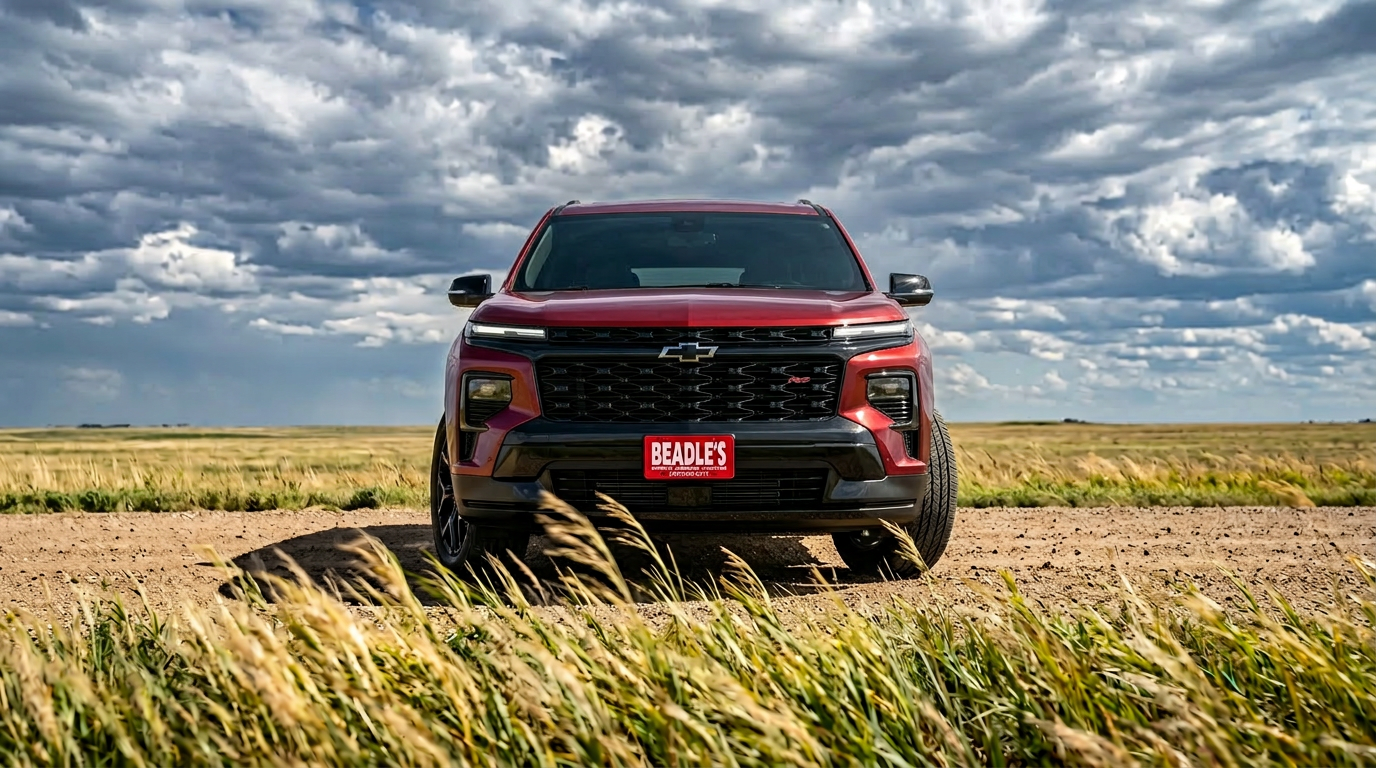
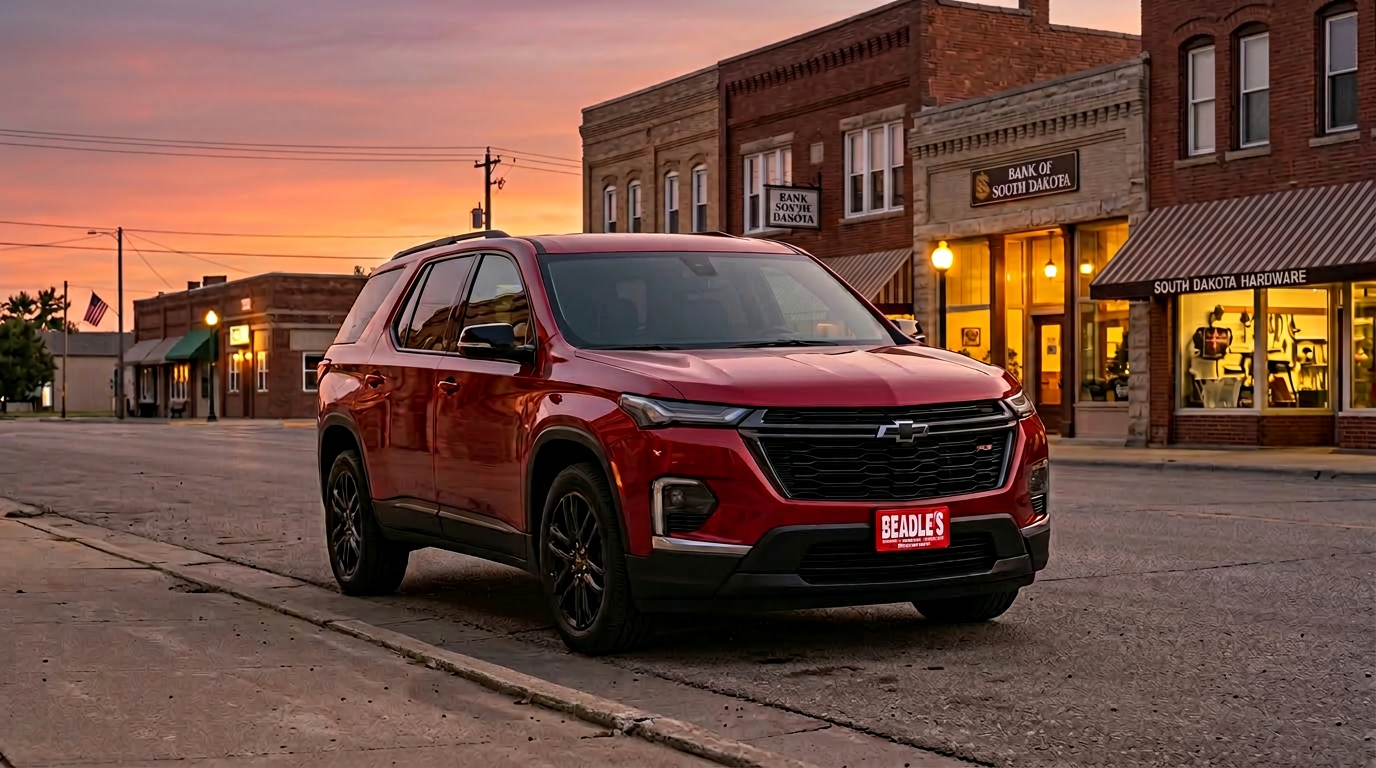
2026 Chevrolet Traverse trim levels at Beadle Chevrolet Mobridge SD

2026 Traverse Trim Comparison: Get It All, Stay In Budget

Choosing between the LT, Z71, RS, and High Country on the 2026 Chevrolet Traverse comes down to more than price — each trim has a distinct personality, and a few differences matter a lot depending on where you drive and how you use the vehicle. This guide breaks down what each trim actually includes, where the real value is, and which one makes the most sense for South Dakota families and drivers. All specs referenced here are drawn from official 2026 Chevrolet order guide data — not from marketing summaries or third-party listings. If you're comparing trims before visiting Beadle Chevrolet in Mobridge, this is the resource to start with. Search Available Traverse Inventory Get Pre-Qualified On This Page What are the four 2026 Traverse trim levels? What does every 2026 Traverse include as standard? Is the Z71 worth it for South Dakota drivers? What does the RS trim add — and what does it give up? Is the High Country worth the price? LT vs Z71 vs RS vs High Country: which should you buy? Key Takeaways Frequently Asked Questions What Are the Four 2026 Chevrolet Traverse Trim Levels? The 2026 Traverse is offered in four trims: LT, Z71, RS, and High Country. Every trim shares the same 328-horsepower 2.5L turbocharged engine, 8-speed automatic transmission, and standard Trailering Package — so the powertrain is not a differentiator. What separates them is drivetrain, technology, seating configuration, and interior character. Trim Drivetrain Seating Character LT FWD standard / AWD available 7 or 8 passengers Well-equipped entry, best value base Z71 AWD standard (Advanced Twin-Clutch) 7 or 8 passengers Off-road and all-conditions capable RS FWD standard / AWD available 7 passengers only Sport-styled, tech-forward, blacked-out trim High Country FWD standard / AWD available 7 passengers only Luxury-focused, premium materials, Super Cruise available One detail that surprises many shoppers: the 8-passenger bench seat configuration is available only on the LT and Z71. If your family needs that third-row bench and you're considering the RS or High Country, that option won't be available regardless of what packages you add. What Does Every 2026 Traverse Include as Standard Equipment? Across all four trims, the 2026 Traverse comes with a substantial standard package. The shared foundation is one of the strongest in the three-row SUV segment — even the LT is genuinely well-equipped. Standard on All Four Trims 2.5L Turbocharged DOHC Inline-4 — 328 hp / 326 lb-ft 8-speed automatic transmission with Electronic Precision Shift Trailering Package — up to 5,000 lbs towing capacity 17.7" diagonal touchscreen with Google built-in Wireless Apple CarPlay and wireless Android Auto Chevy Safety Assist — forward collision alert, automatic emergency braking, lane keep assist, lane departure warning, following distance indicator, IntelliBeam automatic high beams Heated front seats and heated steering wheel Remote start Wireless phone charging Tri-zone automatic climate control 4-wheel antilock disc brakes That list makes the LT a legitimate starting point rather than a stripped-down base model. If you're buying primarily for family utility and you don't have a strong preference for one of the upper trim's specific features, the LT delivers a complete vehicle at the entry price. Is the Z71 Worth It for South Dakota Drivers? For most South Dakota drivers — especially those northwest of the Missouri River — the Z71 makes a compelling case on its own terms. It's the only Traverse trim where AWD isn't optional; it comes standard with the Advanced Twin-Clutch AWD system (G99), which is a more sophisticated all-wheel-drive setup than the standard AWD available on other trims. The Z71 also adds Hill Descent Control — standard only on this trim — which is a genuine benefit on ranch approaches, gravel roads after spring thaw, or any steep unpaved grade. When you're pulling a stock trailer off a pasture road in wet conditions, having the drivetrain actively manage your descent is not a luxury, it's a practical tool. Z71-Exclusive Feature Why It Matters in South Dakota Advanced Twin-Clutch AWD (standard) More precise torque distribution per wheel — better traction on mixed snow/gravel than open-diff AWD Hill Descent Control Controlled speed on steep unpaved descents — ranch roads, boat ramps, pasture approaches Z71 suspension and skid plate Additional ground clearance and underbody protection for gravel and rough terrain 8-passenger seating available Only AWD trim that allows the bench seat — useful for larger families who also need AWD Worth Knowing The Z71 is AWD-only — you cannot order it in FWD. If you want AWD and the Z71's off-road credentials, there's no configuration to avoid it. For families who spend time on Lake Oahe boat ramps or gravel section-line roads, that's exactly the point. Worth it if: You want all-season confidence built in from the start, you use unpaved roads regularly, or you want 8-passenger capacity with AWD. Skip it if: You're in a town environment and AWD isn't a priority — the LT with optional AWD covers the same ground at a lower entry price. What Does the RS Trim Add — and What Does It Give Up? The RS is the style-forward trim in the Traverse lineup. It introduces a distinctive blacked-out exterior treatment — dark-finish wheels, dark badging, and a sport-tuned suspension — alongside driver technology upgrades that step above the LT. If the Traverse's default look feels too traditional, the RS changes that equation without moving into the High Country's price range. The RS adds or upgrades over LT: sport-tuned suspension, 20-inch gloss-black aluminum wheels, blacked-out exterior badges and trim, RS-specific interior color treatment, and the Driver Confidence Package with features like Rear Camera Mirror, Super Cruise readiness, and the new 2026 Key Card. AWD is available but not standard on the RS — you add it as an option. Important: 8-Passenger Is Not Available on the RS The RS trim does not offer the 8-passenger bench seat configuration — it's exclusively 7-passenger captain's chairs. If your family needs eight seats, the RS is off the table regardless of what packages or options you add. The LT or Z71 are the trims to consider for 8-passenger capacity. Worth it if: You want a sharper exterior appearance, you don't need 8-passenger seating, and the sport-tuned suspension appeals to you. Skip it if: You need a bench seat, you want the more purposeful AWD of the Z71, or the visual upgrades aren't worth the price step over the LT. Is the High Country Worth the Price? The High Country is Chevrolet's luxury-tier Traverse, and it earns that designation with genuine premium content — not just badge-level changes. The headline feature is available Super Cruise, Chevrolet's hands-free driver assistance system for compatible highways. For long stretches across South Dakota — I-90, US-83, or the Black Hills routes — Super Cruise is a real fatigue reducer on multi-hour drives. Beyond Super Cruise, High Country adds: premium leather seating surfaces, second-row heated and ventilated seats, massaging front seats, a 15-speaker Bose premium audio system, adaptive cruise control with stop-and-go, and the most comprehensive Driver Confidence Package in the lineup including the 2026 Key Card and Rear Camera Mirror as standard. The interior material quality takes a clear step up from the lower trims — stitching, surface treatment, and ambient lighting are all noticeably different. High Country Key Additions Over RS Super Cruise hands-free driver assistance (available) Massaging front seats Heated and ventilated second-row seats 15-speaker Bose premium audio Premium perforated leather seating surfaces Adaptive cruise control with stop-and-go and lane centering High Country-exclusive interior color and trim treatment Like the RS, the High Country is 7-passenger only — no bench seat option. AWD is available but not standard. Worth it if: Long-distance highway driving is part of your regular use, interior comfort matters to you, or you want the best technology Chevrolet offers in this lineup. Skip it if: You need 8-passenger capacity or you want the Z71's AWD and off-road hardware — those two needs can't be met by the High Country. LT vs Z71 vs RS vs High Country: Which 2026 Traverse Should You Buy? The right answer depends on three questions: Do you need AWD built in? Do you need 8-passenger capacity? And how important is the interior and technology tier? Here's how each trim slots into different buyer profiles. Buyer Profile Best Trim Why Family of 8, gravel roads, towing Z71 Only AWD trim with 8-passenger option + Hill Descent Control Best value, complete SUV LT (with AWD option) Full standard package, 8-passenger available, AWD optional Style-conscious, tech-forward RS Blacked-out appearance, sport suspension, Driver Confidence Package Long-haul highway, premium comfort High Country Super Cruise, massaging seats, Bose audio, premium interior Family of 8, AWD not needed LT (FWD + bench seat) Lowest cost of entry with 8-passenger bench seat available The trim choice also shapes which options are available to you — certain packages exist only on specific trims. For a complete breakdown of how each model year's trim and option structure fits together, the 2026 Chevrolet Traverse overview covers the full lineup in detail. Key Takeaways All four trims share the same 328-hp engine, 8-speed automatic, and 5,000-lb towing capacity — powertrain is not a differentiator. The Z71 is the only trim with AWD standard, Advanced Twin-Clutch AWD, and Hill Descent Control — and the only AWD trim that offers 8-passenger seating. 8-passenger bench seat is only available on LT and Z71 — not offered on RS or High Country regardless of packages added. The RS focuses on appearance and sport character; the High Country focuses on interior quality and highway technology. Super Cruise hands-free driver assistance is available only on the High Country trim. Every 2026 Traverse includes heated front seats, a 17.7" touchscreen, wireless CarPlay and Android Auto, and Chevy Safety Assist — even on the base LT. Confirm final configuration on the window sticker of your specific vehicle — option availability can vary by production run. Frequently Asked Questions Can I get the 2026 Traverse Z71 in FWD? No. The Z71 is AWD-only — the Advanced Twin-Clutch AWD system is standard and cannot be deleted. If you want FWD, the LT, RS, or High Country are the trims to consider, all of which offer FWD as the standard drivetrain with AWD as an available option. Does the 2026 Traverse RS come with 8-passenger seating? No. The RS trim is 7-passenger only — the second-row bench seat (which enables the 8-passenger configuration) is not offered on the RS or High Country. Only the LT and Z71 support the 8-passenger bench seat option. Is Super Cruise available on the Z71 or RS? No. Super Cruise hands-free driver assistance is available only on the High Country trim of the 2026 Traverse. It is not offered as an option on the LT, Z71, or RS. Does the 2026 Traverse LT come with heated seats? Yes. Heated front seats and a heated steering wheel are standard on all 2026 Traverse trims, including the LT. You do not need to move to a higher trim to get heated seats. What AWD system does the Z71 have compared to other Traverse trims? The Z71 uses the Advanced Twin-Clutch AWD system (RPO G99), which provides more precise torque distribution between rear wheels compared to the standard AWD available on LT, RS, and High Country. The Advanced Twin-Clutch system can send torque individually to left and right rear wheels, which improves traction on uneven surfaces, gravel, and mixed winter conditions — a meaningful difference for off-pavement driving in South Dakota. Which 2026 Traverse trim is best for towing in South Dakota? All 2026 Traverse trims include the Trailering Package and are rated for up to 5,000 lbs towing capacity — towing capacity doesn't vary by trim. For towing on mixed terrain, gravel roads, or boat ramps, the Z71 adds Hill Descent Control and the Advanced Twin-Clutch AWD, which improve stability when launching and recovering a trailer. For dedicated towing use, the Z71 is the most capable configuration. For a full look at towing setup and capacity, the Traverse towing guide covers everything in detail. My Take on the 2026 Traverse Trim Lineup When customers come into Beadle Chevrolet and ask me which Traverse trim to look at, my first two questions are always: does your family need eight seats, and do you put the vehicle on gravel roads regularly? Those two answers alone narrow the field considerably. If the answer to either is yes, the conversation usually starts with the Z71 — it's the only trim that can genuinely do both. For families in Mobridge and the surrounding area who primarily drive on paved roads and don't need 8-passenger capacity, the LT with optional AWD is a strong value choice — it comes with everything most families actually use day-to-day. The RS is for people who've decided they want a sharper look; it's not more capable than the LT, it's just more distinctive. And the High Country earns its price if long highway drives are in your regular rotation — Super Cruise on US-83 down to Pierre or across to Rapid City is a genuine comfort difference on a three-hour drive. If you want to see how each trim fits into the full 2026 Traverse lineup — including specs, packages, and available options — the 2026 Chevrolet Traverse overview is the best place to start. Or stop by Beadle Chevrolet in Mobridge — we're happy to walk you through what's on the lot and what makes sense for how you actually drive. Search Available Traverse Inventory Get Pre-Qualified Contact Beadle Chevrolet About the Author Lexy Tabbert — Beadle Chevrolet, Mobridge, SD Lexy Tabbert covers Chevrolet vehicles, trim comparisons, and buyer guidance for Beadle Chevrolet in Mobridge, South Dakota. Her content is grounded in real buyer conversations with families, ranchers, and ag operators across the Mobridge region and western South Dakota. Learn more about Lexy.

Contact Us

Fill out this form below and we'll contact you shortly
*Required Fields