





Blog / Mobridge Chevrolet Dealer

Blog

All Mobridge Chevrolet Dealer
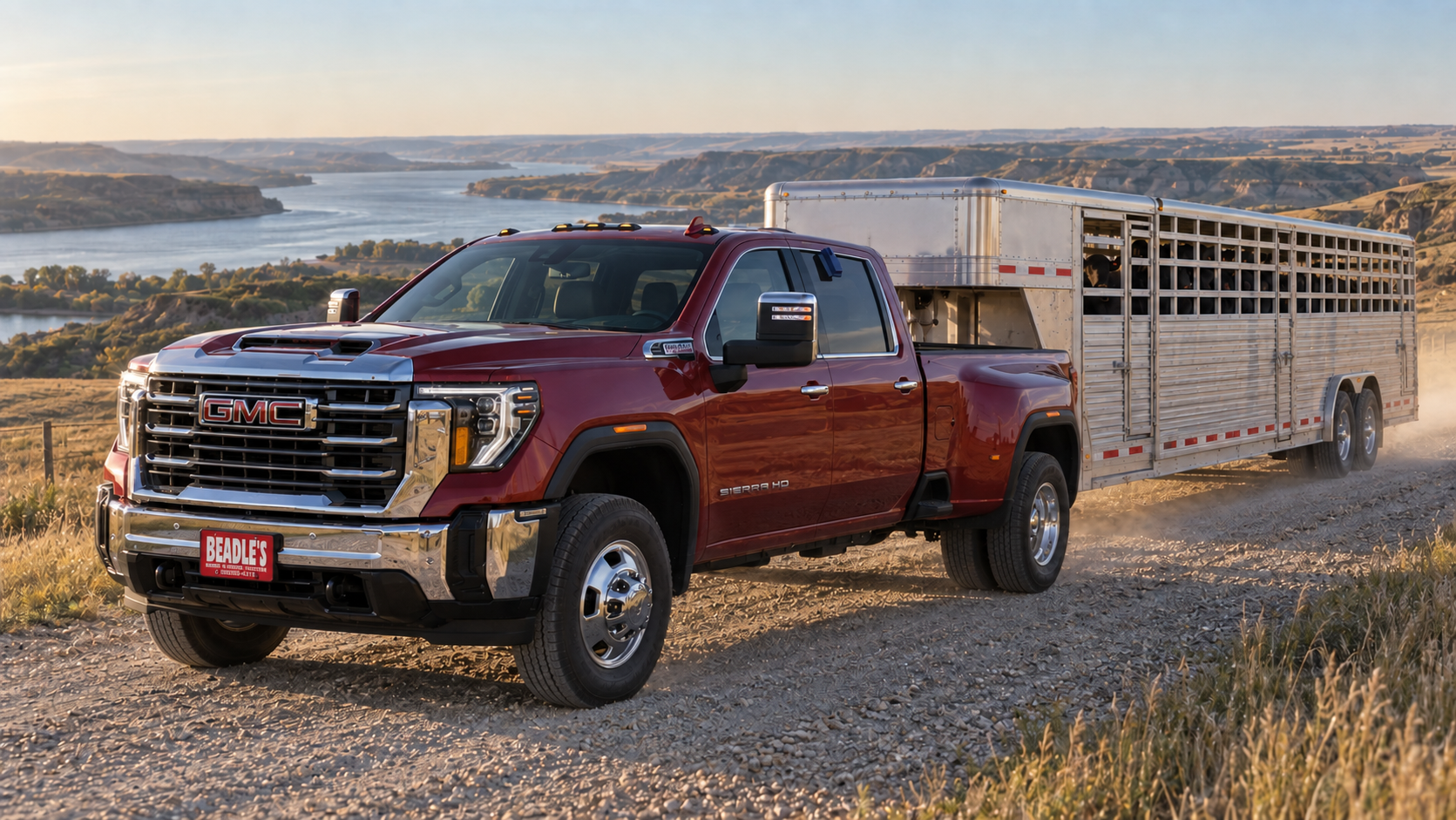
2026 GMC Sierra 3500 HD SLT dually pulling a tandem-dual aluminum gooseneck stock trailer loaded with cattle through the river breaks near Mobridge, South Dakota

How Much Can the 2026 Sierra 3500 HD Tow With a Gooseneck? Dually Math for Tandem-Dual Stock Trailers and 40-Foot Flatbeds

Search the 2026 GMC Sierra 3500 HD and the internet hands you one big number. Then you stand in front of a Crew Cab dually on our lot and the door-jamb label says something several thousand pounds lower, and the obvious question follows: which one is the lie. Neither of them. They are two different trucks, and the difference between them is the whole reason this post exists. Short answer for the truck most outfits here buy: a Crew Cab long bed 4WD dually with the Duramax is rated to pull 31,000 pounds on a gooseneck and carry 5,647 pounds of payload, properly equipped. That is enough truck for a loaded 40-foot tandem-dual stock trailer or a 40-foot flatbed stacked two-high with big rounds. What it is not is unlimited, and the thing that runs out first is almost never the tow rating. View Sierra 3500 HD Inventory Get Pre-Qualified On This Page Which truck owns the biggest gooseneck number What the crew cab dually is actually rated for A stock trailer and a hay flatbed, worked as illustrations Where the single-rear-wheel line sits What has to be in the bed before you hook up How to check a gooseneck load against your truck Which Truck Owns the Biggest Gooseneck Number? The 36,000-pound figure belongs to exactly one truck: a 2WD Regular Cab long bed dually with the Duramax and the Max Trailering Package, properly equipped, and without that package the same 2WD Regular Cab dually is rated 35,500 pounds. It is a real rating and we will order one for an outfit that wants it. It is also the wrong truck for almost everybody who reads this. The Max Trailering Package is a Pro, two-wheel-drive, Regular Cab, dually-only option on the 3500 HD, so the crew cab trucks on our lot are rated on their own springs rather than on that package. A Regular Cab seats three, two-wheel drive is a hard sell in a county of gravel section lines and February calving, and the Pro is a vinyl-floor work truck. The number is honest. The truck behind it is a spec-sheet specialist, not the one in your yard. One distinction before the tables. A gooseneck couples to a ball in the bed floor, which is what every stock trailer and hay flatbed in Walworth County rides on. A fifth-wheel couples to a kingpin and a plate, which is what the camper rides on. Every figure in this post is a gooseneck rating. On a dually with a fifth-wheel hitch the combination rating is 32,000 pounds, and that is the ceiling a big camper works under. The rest of this post is about the trucks people actually sign for. The full matrices, gas and diesel, single rear wheel and dually, every cab, sit in the towing section of our 2026 Sierra 3500 HD buyers guide. What Is the Crew Cab Dually Actually Rated For? A Crew Cab long bed 4WD dually with the Duramax is rated 31,000 pounds on a gooseneck and 20,000 pounds on a conventional ball hitch, properly equipped, and carries 5,647 pounds of payload. Order it in two-wheel drive and the gooseneck rating goes to 31,440 pounds with 5,920 pounds of payload, because the truck itself weighs less. Here is the dually side of the 2026 lineup with the Duramax. 2026 Sierra 3500 HD dually, Duramax Gooseneck Payload Crew Cab long bed 4WD 31,000 lb 5,647 lb Crew Cab long bed 2WD 31,440 lb 5,920 lb Double Cab long bed 4WD 31,270 lb 5,807 lb Double Cab long bed 2WD 31,580 lb 6,114 lb Denali Crew Cab long bed 4WD 30,800 lb see the door-jamb label Denali Ultimate Crew Cab long bed 4WD 30,700 lb 5,290 lb Three things to take from that. The spread from the top dually to the bottom is barely 900 pounds, so trim is not where the capability lives. Payload does move with trim, and the Denali Ultimate gives up better than 350 pounds of it to its own equipment. GM does not publish a Denali payload figure at all, so on that trim the label in the door is the only honest answer. There is a fourth number that governs everything above: the combination rating. A Duramax dually is rated at 40,000 pounds for the loaded truck and the loaded trailer together with a gooseneck hitch, against 30,000 pounds for a single-rear-wheel Duramax. On a long haul that ceiling arrives before the tow rating does, and the illustrations below show exactly where. If you are looking at the 6.6L gas V8 instead, the same Crew Cab long bed 4WD dually is rated 17,800 pounds on a gooseneck and carries 6,378 pounds of payload, properly equipped. It is the better bed-load truck and the weaker trailer truck, and for most gooseneck work around here that trade goes to the diesel. Will It Pull a 40-Foot Stock Trailer or a 40-Foot Hay Flatbed? Yes to both on a Crew Cab long bed 4WD Duramax dually, and in both cases the tow rating is the easy part. Here are the two loads worked the way we work them at the desk. The trailer, cattle, and bale weights below are illustrations, not your numbers, and a scale ticket beats every estimate on this page. Illustration one: a 40-foot tandem-dual aluminum gooseneck stock trailer. Say the trailer weighs 10,500 pounds empty and you load 14,000 pounds of cattle. That is 24,500 pounds behind the truck, comfortably inside the 31,000-pound rating. Now the pin: at 20 percent, that load puts 4,900 pounds on the truck. Against 5,647 pounds of payload that leaves 747 pounds for the driver, a passenger, the fuel you are carrying, and whatever is in the bed. Two adults and a full tank and you are at the line. The dually is legal and it is not roomy, which is exactly the point people miss. Illustration two: a 40-foot gooseneck flatbed of hay. Say the flatbed weighs 8,000 pounds and you stack 16 big rounds at 1,400 pounds each. That is 30,400 pounds, inside the 31,000-pound rating by 600 pounds. A flatbed loaded evenly carries more of its weight on its own axles, so call the pin 15 percent, or 4,560 pounds, which leaves better than 1,000 pounds of payload. Then check the combination: that truck loaded runs near 13,400 pounds against a 14,000-pound GVWR, and truck plus trailer lands near 39,200 pounds against the 40,000-pound ceiling. It fits. It fits by about the weight of four people. Neither illustration says the truck is too small. They say the same thing the three-quarter-ton taught a lot of people the hard way: with a gooseneck, payload and the combination rating decide the trip, and the tow rating is the number you check last. That is why a two-hundred-dollar trip to the elevator scale is the cheapest equipment you will ever buy. The same math on the Sierra 2500 HD is what sends most of these buyers up to the one-ton in the first place. A 40-foot flatbed stacked two-high is where the combination rating, not the tow rating, decides whether the load is legal. Where Does the Single-Rear-Wheel Line Sit, and When Is It Enough? A single-rear-wheel Sierra 3500 HD with the Duramax runs from 21,000 to 22,420 pounds on a gooseneck depending on cab, bed, and drive, properly equipped. The best crew cab number is 22,070 pounds on a 2WD long bed; the 4WD long bed most people order is 21,460 pounds, and the 4WD standard bed is 21,600. The 22,420-pound figure is the 2WD Regular Cab single-rear-wheel truck with the Duramax, the single-rear-wheel maximum for 2026. Payload is where the two trucks really part company. A Crew Cab long bed 4WD single-rear-wheel Duramax carries 4,195 pounds, against 5,647 on the dually. Run illustration one back through that truck and a 4,900-pound pin is over payload before the driver gets in, even though the trailer is 3,000 pounds inside the tow rating. That is the whole argument for dual rear wheels in one line, and it is worked out at length in the single rear wheel versus dually post. Two more notes on the single-rear-wheel trucks. Conventional bumper-pull towing is 20,000 pounds with the Duramax on every configuration except the Regular Cab, which stops at 14,500 pounds with either engine, so a Regular Cab is a gooseneck truck or it is not much of a towing truck at all. And if your loaded gooseneck lives under 20,000 pounds with a pin that clears 4,195, a single-rear-wheel 3500 HD is a better truck to live with the rest of the week. If that describes you, it is worth reading the 2500 HD versus 3500 HD comparison before you spend one-ton money. What Has to Be in the Bed Before You Hook Up? The prep, and then the ball. The Gooseneck and Fifth Wheel Prep Package is available on all six trims and adds a hitch platform with a tray to take the ball, stamped holes in the bed floor with removable caps, and a 7-pin connector in the bed wall. It also brings the spray-on bedliner with it. The gooseneck ball and safety-chain kit is a dealer-installed item we add before delivery. The pin-weight rule, in GM's own words GM puts the recommended gooseneck and kingpin load at 15 to 25 percent of the trailer weight, and tongue load on a bumper-pull at 10 to 15 percent. A loaded stock trailer with the cattle standing forward sits at the top of that band; an evenly stacked flatbed sits near the bottom. Every rating GM publishes assumes a standard-equipped truck with a driver and the required trailering gear, so options, passengers, and cargo come out of your margin, and the trailering information label in the driver door jamb is the last word on the truck you buy. The trailering hardware is already standard. Every 2026 Sierra 3500 HD carries the trailering package with the hitch and the 7-pin and 4-pin connectors, an integrated trailer brake controller, Hitch Guidance on the rear camera, trailer sway control, and the information label itself. SLT and up add ProGrade Trailering with Hitch View and the in-vehicle trailering app, which runs a light check, tracks trailer mileage, and supports the trailer tire pressure sensors; SLE gets the same content through its Preferred package. Two dually-specific items. Power trailering mirrors are required when a Pro dually is ordered with the Convenience Package, and you want them anyway on a truck that is 96.62 inches across the fenders. And the camera set that matters at a loading chute or an elevator dock, Bed View plus HD Surround Vision and the trailer camera provisions, comes in the safety package on the SLE and SLT and as standard content further up the ladder. Those cameras earn their money on a deck, which is the subject of the hotshot and harvest post. How to Check a Gooseneck Load Against Your Sierra 3500 HD Five steps, one trip to the scale, and you will know your real margin for as long as you own the trailer. Read the label: open the driver door and find the trailering information label. Write down the gooseneck rating, the payload, and the combination rating for that truck, not the one from the website. Weigh the loaded trailer: run the rig across the elevator scale loaded the way you actually haul, in the season you actually haul it. That total is your trailer weight. Weigh the pin: weigh the truck alone, then weigh it hitched with the trailer loaded and only the truck on the platform. The difference is your pin weight, and it will land between 15 and 25 percent on most gooseneck trailers. Add the cab and the bed: pin weight plus driver, passengers, fuel, tools, mineral, and anything bolted to the truck, compared to the payload on the label. If that is over, the truck is over, whatever the tow rating says. Check the combination and set the brakes: loaded truck plus loaded trailer against the combination rating, then set the trailer brake gain with the trailer loaded on a quiet stretch of gravel before the first run down Highway 12. Is the Crew Cab Dually the Right Gooseneck Truck for You? Worth it if Skip it (look at single rear wheel) if Your loaded gooseneck runs 20,000 pounds or more and you haul it weekly Your pin weight alone is past 4,195 pounds You run a tandem-dual stock trailer or a 40-foot flatbed loaded heavy You want margin on the combination rating for a long haul A bale bed, flatbed, or deck is going on the truck Your loaded trailer and pin weight both clear the single-rear-wheel numbers with room left You pull a bumper-pull trailer, where the Duramax is rated 20,000 pounds either way The truck is also the family truck and spends most weeks empty Your shop door or parking spot will not take 96.62 inches plus mirrors You want the AT4 or a standard-bed crew cab Key Takeaways A Crew Cab long bed 4WD Duramax dually is rated 31,000 pounds on a gooseneck with 5,647 pounds of payload, properly equipped; in 2WD it is 31,440 pounds and 5,920. The biggest 2026 figure belongs to a 2WD Regular Cab long bed dually with the Duramax and the Max Trailering Package, a Pro-only, dually-only option nobody here orders. Payload and the 40,000-pound combination rating decide a gooseneck trip long before the tow rating does. A single-rear-wheel Duramax runs 21,000 to 22,420 pounds on a gooseneck with 4,195 pounds of payload on the Crew Cab long bed 4WD. Weigh the loaded trailer and the pin once at the elevator, then check both against the trailering information label in the driver door jamb. Frequently Asked Questions How much can a 2026 Sierra 3500 HD dually tow with a gooseneck? With the Duramax, properly equipped: 31,000 pounds on a Crew Cab long bed 4WD, 31,440 in 2WD, 31,270 and 31,580 on the Double Cab long bed in 4WD and 2WD, 30,800 on a Denali and 30,700 on a Denali Ultimate. Every one of those assumes the long bed and the 14,000-pound GVWR that dual rear wheels require, and the label in your door jamb governs the specific truck. What is the combination weight rating of a Sierra 3500 HD Duramax? With a gooseneck hitch it is 30,000 pounds on a single-rear-wheel truck and 40,000 pounds on a dually. The 2WD Regular Cab dually is rated higher, 43,500 pounds, or 43,900 with the Max Trailering Package. The 6.6L gas V8 is rated 26,000 pounds. That number covers the loaded truck and the loaded trailer together, and on a long haul it is usually the first ceiling you reach. Can the gas 6.6L V8 pull a gooseneck stock trailer? It can, within its rating. A Crew Cab long bed 4WD dually with the 401-horsepower gas V8 is rated 17,800 pounds on a gooseneck, properly equipped, and carries 6,378 pounds of payload, which is better than 700 pounds more than the Duramax version of the same truck. So the gas engine is the stronger bed-load truck and the weaker trailer truck, and it will work harder on the Selby and Aberdeen grades than 975 lb-ft of diesel torque does. Does the Sierra 3500 HD come with a gooseneck hitch installed? It comes with the prep, not the ball. The Gooseneck and Fifth Wheel Prep Package, available on all six trims, adds the hitch platform with a ball tray, stamped and capped holes in the bed floor, and a 7-pin connector in the bed wall, and it includes the spray-on bedliner. The ball and safety-chain kit is a dealer-installed accessory, and we can have it in the truck before you take delivery. My Take on Gooseneck Towing With the Sierra 3500 HD The number that sells a truck is rarely the number that matters. I have never once had a customer come back over a tow rating; I have had plenty come back after a scale ticket showed the pin was heavier than they thought. So when somebody asks me how much the Sierra 3500 HD will pull, my honest answer is a question: what does your trailer weigh loaded, and what is on the pin. For a cow-calf outfit moving pairs and fats with a tandem-dual trailer, or a hay operation stacking 40 feet of flatbed, a Crew Cab long bed 4WD Duramax dually with the gooseneck prep is the right truck, and 31,000 pounds is more rating than that work asks for. Spend the money on the prep package, the brake controller settings, and a trip to the scale, not on chasing a bigger figure that belongs to a truck you would not want to drive to Aberdeen. All the towing and payload tables, both engines, every cab and both rear-wheel setups, are in the 2026 GMC Sierra 3500 HD buyers guide, and the payload and weight ratings are laid out in the payload section. Or bring your scale ticket to Beadle Chevrolet GMC at 2200 US Hwy 12 in Mobridge, or call or text 605-845-7277, and we will match it to a truck on the lot. View Sierra 3500 HD Inventory Get Pre-Qualified Contact Beadle Chevrolet GMC About the Author Lexy Tabbert — Beadle Chevrolet, Mobridge, SD Lexy Tabbert is the Director of Sales and Marketing at Beadle Chevrolet in Mobridge, South Dakota. She covers Chevrolet and GMC vehicles, trim comparisons, and buyer guidance — helping families, ranchers, and ag operators across the region find the right truck and configuration for their needs. Learn more about Lexy.
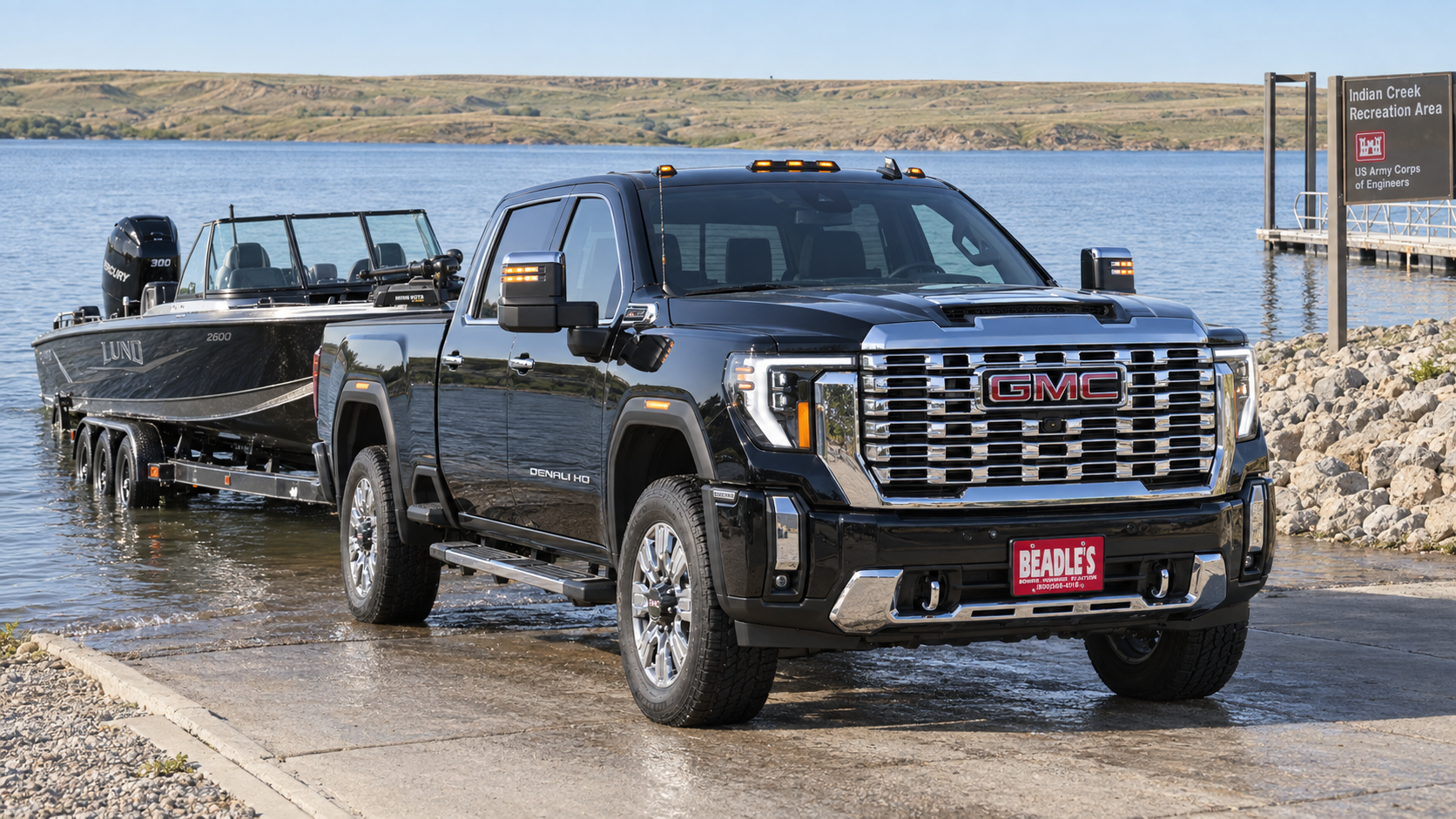
2026 GMC Sierra 2500 HD Denali backing a walleye boat down the ramp at Indian Creek on Lake Oahe near Mobridge, South Dakota

Towing a Fifth-Wheel or Big Boat to Lake Oahe: What the 2026 Sierra 2500 HD Can Handle

The conversation usually starts with a new trailer, not a new truck. Somebody buys the 40-foot toy hauler they have wanted for ten years, or trades the 18-foot walleye boat for something with a cabin, and the half-ton is suddenly not enough. Then they are in our showroom in May asking whether a 2026 GMC Sierra 2500 HD will pull it to Indian Creek and, more to the point, over to the Black Hills in July. Short answer: yes, with room to spare on the boat and some honest math on the fifth-wheel. A Crew Cab standard bed 4WD Sierra 2500 HD with the Duramax is rated for 19,100 pounds on a fifth-wheel, and 21,600 pounds with the Max Trailering Package, properly equipped. The Denali and AT4 most lake buyers order sit a little under that. What decides it is pin weight against payload, and whether you ordered the cameras that make a 40-foot trailer easy to back down a wet ramp. View Sierra 2500 HD Inventory Get Pre-Qualified On This Page Fifth-wheel ratings for the trucks people actually buy A 40-foot toy hauler and a big boat, weighed honestly Backing in at Indian Creek and West Whitlock: the camera suite The Trailering App, trailer tire pressure, and the Black Hills weekend Which trim and package to order for this life How to launch and load a big boat with the Sierra 2500 HD What Are the Fifth-Wheel Ratings for the Trucks People Actually Buy? The lake and camper buyers around Mobridge almost all order a Crew Cab with the standard 6-foot-9 bed, 4WD, and the Duramax, in AT4, Denali, or Denali Ultimate trim. On those trucks the fifth-wheel rating runs from 17,200 to 19,100 pounds with the standard prep, and from 19,300 to 21,600 pounds with the Max Trailering Package, properly equipped. The spread comes from wheels and equipment, not the engine, which is the same 470-horsepower, 975 lb-ft Duramax in every one. 2026 Sierra 2500 HD Crew Cab standard bed 4WD Fifth-wheel, Duramax Fifth-wheel, Duramax + Max Trailering Max payload, Duramax Pro, SLE, SLT 19,100 lb 21,600 lb 3,463 lb AT4 17,300 lb 20,800 lb 3,235 lb AT4X 17,300 lb not available 3,111 lb Denali 17,600 lb 19,900 lb 3,096 lb Denali Ultimate 17,200 lb 19,300 lb ask us for the label Two notes on that table. The AT4X cannot be ordered with the Max Trailering Package, so 17,300 pounds is its fifth-wheel ceiling, and the AEV Edition drops to 14,800. Superb hunting truck, wrong Sierra for a big fifth-wheel. And the gas V8 is not shut out: a Crew Cab standard bed 4WD with the 6.6L gas is rated 18,380 pounds fifth-wheel with more payload than the diesel, though it cannot take the package. Fifth-wheel and gooseneck share the same rating on this truck; only the hitch differs. Every configuration, including the long beds, is in the towing section of our 2026 Sierra 2500 HD buyers guide, and what the package physically changes is in the Max Trailering Package post. Whatever you read here, the trailering information label in the driver door jamb of the specific truck is the final word. Will It Handle a 40-Foot Toy Hauler and a Big Boat? The boat is easy. The toy hauler is where the truck earns its keep, and where the honest answer depends on the trim. A fifth-wheel carries a bigger share of its weight on the pin than a bumper-pull carries on the ball, and every pound on the pin comes out of payload. Two examples, worked the way we work them at the desk. The weights are illustrations; a scale ticket beats every brochure and every forum. Example one, for illustration: a 40-foot fifth-wheel toy hauler. Say it weighs 14,000 pounds loaded, with a side-by-side in the garage and a full fresh-water tank. That is inside the 17,600-pound Denali rating without the package and well inside 19,900 pounds with it. Now the pin: fifth-wheels commonly put 20 to 25 percent of their loaded weight on the truck, so call it 2,800 to 3,500 pounds. A Denali Crew Cab Duramax has 3,096 pounds of payload before anyone sits down. On a 20 percent pin you have about 300 pounds left for two people and a cooler; at 25 percent you are over before you leave the driveway. The same trailer behind an SLT with 3,463 pounds of payload has 660 pounds of margin at 20 percent. This is why we ask about the pin, not the length. Example two, for illustration: a big walleye boat. Say a 21-foot deep-V with a 300-horsepower outboard weighs 5,500 pounds on its tandem-axle trailer with fuel and gear, and puts about 550 pounds on the ball. That is a fraction of the 18,500-pound conventional rating on a Crew Cab Duramax, and the tongue weight barely dents the payload. Even a 28-foot cabin boat at 10,000 pounds on a triple-axle trailer is comfortable behind this truck. The 2500 HD exists so the boat and the camper can both be behind the same truck in the same summer. The combined weight check GCWR is the loaded truck and loaded trailer together: 27,500 pounds on a Crew Cab Duramax with 18-inch or larger wheels, 30,000 pounds with the Max Trailering Package. A 14,000-pound toy hauler behind a truck loaded to 11,000 pounds is 25,000 pounds, inside either number. Where GCWR bites is the 18,000-pound triple-axle hauler, which is the trailer the package was built for. How Does the Camera Suite Help Backing In at Indian Creek and West Whitlock? The truck does the backing; you do the steering. The trailer rides down the ramp behind the truck the way it always has, but the cameras take the guesswork out of the two moments that ruin a morning: lining up the hitch alone, and seeing what is behind a 40-foot trailer. Hitch View is standard on SLT and up and available on the SLE with the Preferred Package; it puts a zoomable view of the ball or the bed on the 13.4-inch screen so you can hook up without a spotter. Hitch Guidance on the rear camera is standard on every trim. For the ramp itself, HD Surround Vision gives you a top-down view of the truck and the front of the trailer, which is what you want when Indian Creek is busy in June and the lane markers are under a foot of water. The Trailer Camera Provisions let you add an accessory rear trailer camera; with it mounted on the back of the camper or boat trailer, the system can show the view behind the trailer and, on a compatible setup, blend the trailer out of the picture so it looks as if you are seeing straight through it. That is the Transparent Trailer view people ask about. It needs the accessory camera, so ask us to quote it with the truck rather than assuming it is in the box. On the SLE and SLT, HD Surround Vision, the Bed View camera, and the Trailer Camera Provisions come with the Sierra HD Pro Safety Plus package on Crew and Double Cab trucks, along with Trailer Side Blind Zone Alert and Rear Cross Traffic Alert. The AT4, Denali, and Denali Ultimate sit above the SLT on the equipment ladder; we will confirm the camera content on the window sticker of the truck you want, and the Technology Package adds the Rear Camera Mirror. Then the ramp surface. West Whitlock and Walworth Bay both grow a slick film on the concrete below the waterline by July. Put the truck in 4WD low before you back down, not after the rear tires start spinning, and let the automatic locking rear differential and hill start assist do their work on the pull out. A Denali Crew Cab Duramax with a fifth-wheel toy hauler on US 12, the first leg of most Black Hills trips out of Mobridge. What Does the In-Vehicle Trailering App Do on a Black Hills Weekend? It replaces the walk-around you were going to skip. The In-Vehicle Trailering App, standard on SLT and up and part of the SLE Preferred Package, stores a profile for each trailer, runs a pre-departure checklist, tests the trailer lights from the driver seat, tracks maintenance by trailer mileage, and flags electrical faults. With the accessory sensors installed, it also shows trailer tire pressure and temperature on the screen, the feature the people who tow every summer weekend tell us they use most. The sensors are an accessory, so ask us to add them. Now the drive. Mobridge to the Black Hills is a long day with a fifth-wheel, and it is why most of our lake buyers order the Duramax even though they tow a fraction of the year. Its 975 lb-ft of torque arrives at 1,600 rpm, so the 10-speed holds a tall gear on the grades instead of hunting, and the exhaust brake that comes with the engine holds the rig back on the descents so you are not riding the trailer brakes. The integrated trailer brake controller is standard on every trim; set the gain with the trailer loaded before you leave town. The 36-gallon Crew Cab tank means fewer stops. Trailer sway control is built into StabiliTrak on every Sierra 2500 HD, and Trailer Side Blind Zone Alert extends the warning down the full length of the trailer, which matters when a semi passes you on US 83 toward Pierre. None of it replaces a pin-weight check, but it turns a stressful drive into an ordinary one. Which Trim and Package Should You Order for This Life? For a fifth-wheel toy hauler and a boat, order a Crew Cab standard bed 4WD Duramax with the Max Trailering Package, then pick the cabin you want to spend twelve hours in. The package raises the fifth-wheel rating by 2,300 pounds on a Denali and 3,500 pounds on an AT4, lifts GCWR to 30,000 pounds, takes GVWR to 11,900 pounds, and brings the spray-on bedliner and the fifth-wheel prep with it. The packages section of the buyers guide lists everything that goes with it. Denali is the cabin most of these buyers end up in: Forge perforated leather in Jet Black or Atmosphere and Brownstone, the 13.4-inch screen with Google built-in, Bose 7-speaker audio, 20-inch ultra-bright wheels, and the Denali Reserve Package if you want the power sunroof and the 15-inch head-up display. It is rated 19,900 pounds fifth-wheel with the package. Denali Ultimate is the Duramax-only answer to the spouse who wants comfort for the drive: Alpine Umber full-grain leather, open-pore wood, 16-way massage seats, 12-speaker Bose, and the head-up display standard. It is rated 19,300 pounds fifth-wheel with the package, 600 pounds under the Denali. AT4 is the pick if the same truck spends October on pheasant two-tracks west of the river. It has the X31 off-road suspension, 20-inch high-gloss black wheels, Jet Black leather with Kalahari accents, and the highest fifth-wheel rating of the three with the package at 20,800 pounds. The AT4-versus-Denali post goes deeper on that choice. If you are cross-shopping, the Sierra versus F-250 and Ram 2500 comparison lays the fifth-wheel and payload numbers side by side. Whatever trim you land on, add the trailer camera and tire sensors before delivery. How to Launch and Load a Big Boat With the Sierra 2500 HD Six steps for a busy ramp at Indian Creek or West Whitlock. Prep in the lot: pull the transom straps, load the cooler, put the plug in, and run the light test from the Trailering App while you are still on level ground and out of everybody's way. Select 4WD low: shift into low range before you start down the ramp, not once the tires are wet, and confirm the trailer brake gain is set for this trailer. Back with the cameras: use HD Surround Vision to line the trailer up with the lane and the rear or accessory trailer camera to watch the water line. Small steering inputs; stop when the fenders are just under. Float the boat: set the parking brake, then unhook the winch strap and safety chain and let your partner idle it off to the courtesy dock. Never unhook before the truck is stopped and braked. Pull out steady: release the brake, let hill start assist hold the rig for the moment it takes, and climb the ramp under light throttle in low range. Shift back out on dry pavement. Reverse it to load: back in to the same depth, winch the boat on until the bow eye touches the stop, hook the safety chain, and pull to the top of the ramp before you strap the transom and pull the plug. Is the Sierra 2500 HD the Right Truck for Your Fifth-Wheel and Boat? Worth it if Skip it (look at the 3500 HD) if Your loaded fifth-wheel weighs under about 17,000 pounds, or under 19,900 pounds behind a Denali with the Max Trailering Package Your pin weight plus the people in the cab stays under the payload on the label The same truck pulls a boat, hauls the family, and goes to work Monday Your toy hauler pins over 3,000 pounds loaded and you want the Denali Ultimate You are shopping a 45-foot triple-axle hauler at 18,000 pounds or more You are within 10 percent of both the fifth-wheel rating and the payload on every trip Key Takeaways A Crew Cab standard bed 4WD Duramax Sierra 2500 HD is rated 19,100 pounds fifth-wheel, or 21,600 pounds with the Max Trailering Package, properly equipped; the Denali is 17,600 and 19,900, the AT4 17,300 and 20,800. A fifth-wheel puts 20 to 25 percent of its weight on the pin, and the Denali's 3,096-pound payload runs out before its tow rating does on a heavy toy hauler. A big walleye boat is easy for this truck; use 4WD low on a slick ramp and let the cameras line up the trailer. Transparent Trailer view and trailer tire pressure both need accessory hardware; order them with the truck. The AT4X cannot take the Max Trailering Package; for a big fifth-wheel, order an AT4, Denali, or Denali Ultimate with it. Frequently Asked Questions Does the Sierra 2500 HD come with a fifth-wheel hitch? It comes with the prep, not the hitch. The Gooseneck and Fifth-Wheel Prep Package adds the hitch platform with a ball tray, capped holes in the bed floor, and a 7-pin connector in the bed wall, and it is included with the Max Trailering Package. The fifth-wheel hitch itself is an accessory that bolts to that platform; we can install it before delivery. What is the highest fifth-wheel rating on a 2026 Sierra 2500 HD? 22,390 pounds, properly equipped, on a Regular Cab 2WD long bed with the Duramax and the Max Trailering Package. Among the Crew Cabs lake buyers actually order, the standard bed 4WD Pro, SLE, or SLT is rated 21,600 pounds with the package, the AT4 20,800, the Denali 19,900, and the Denali Ultimate 19,300. Does the Sierra 2500 HD have Transparent Trailer view? It can. The truck needs the Trailer Camera Provisions, which come with the Sierra HD Pro Safety Plus package on the SLE and SLT and are available up the trim ladder, plus an accessory rear trailer camera mounted on the back of the trailer. With that camera in place the system can show the view behind the trailer and blend the trailer out of the picture. Ask us to quote the camera with the truck. Can the gas Sierra 2500 HD tow a fifth-wheel to Lake Oahe? Yes. A Crew Cab standard bed 4WD with the 401-horsepower 6.6L gas V8 is rated 18,380 pounds fifth-wheel, properly equipped, and carries 3,707 pounds of payload, more than the diesel. It cannot take the Max Trailering Package, so that is its ceiling, and it will work harder on the Black Hills grades than the Duramax with its 975 lb-ft and exhaust brake. My Take on Towing a Fifth-Wheel and a Boat With the Sierra 2500 HD The Sierra 2500 HD is the right truck for the way most people around Mobridge actually use a camper and a boat: the fifth-wheel to Indian Creek for a long weekend, the boat to West Whitlock on a Tuesday evening, and one or two real trips a year to the Black Hills or Montana. Order it as a Crew Cab standard bed 4WD Duramax with the Max Trailering Package, in whichever cabin you want to live in, and add the trailer camera and tire sensors before it leaves the lot. What I ask everyone to do first is find the pin weight of the trailer they are buying, loaded the way they will travel, and compare it to the payload on the door label of the trim they want. On a Denali with a heavy toy hauler that math gets tight, and I would rather tell you that in the showroom than have you learn it at the scale. If it clears with room, buy the 2500 HD and enjoy how it drives empty. If it does not, the 3500 HD is on the same lot and I will walk you over. The full towing and payload tables, engines, trims, and packages are in the 2026 GMC Sierra 2500 HD buyers guide. Or bring the spec sheet for your trailer to Beadle Chevrolet GMC at 2200 US Hwy 12 in Mobridge, or call or text 605-845-7277, and we will match it to a truck. View Sierra 2500 HD Inventory Get Pre-Qualified Contact Beadle Chevrolet GMC About the Author Lexy Tabbert — Beadle Chevrolet, Mobridge, SD Lexy Tabbert is the Director of Sales and Marketing at Beadle Chevrolet in Mobridge, South Dakota. She covers Chevrolet and GMC vehicles, trim comparisons, and buyer guidance — helping families, ranchers, and ag operators across the region find the right truck and configuration for their needs. Learn more about Lexy.
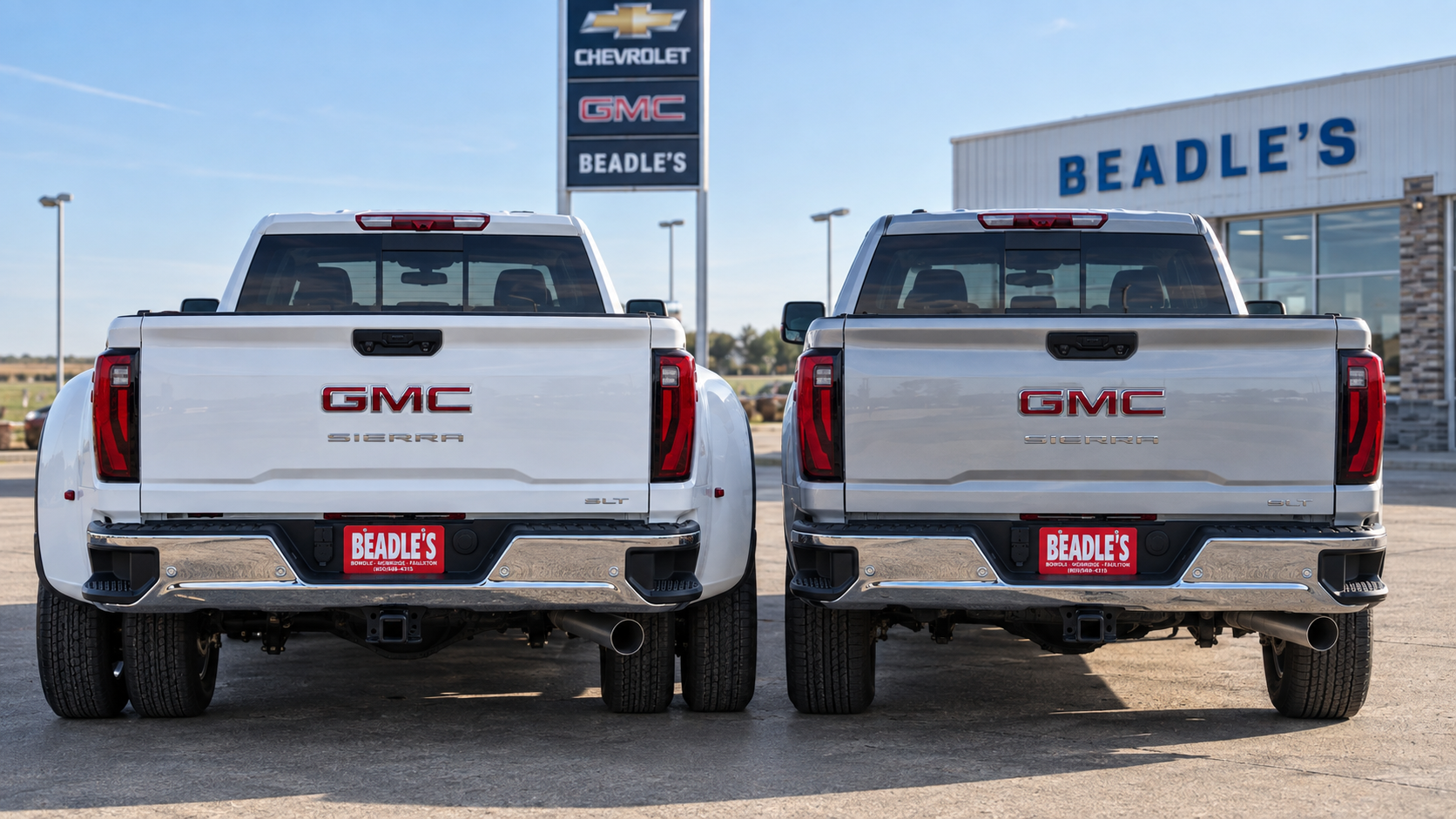
A 2026 GMC Sierra 3500 HD dually and a single-rear-wheel Sierra 3500 HD parked side by side, seen from the rear, at Beadle Chevrolet GMC in Mobridge, South Dakota

Single Rear Wheel or Dually? Choosing the 2026 Sierra 3500 HD That Fits Your Trailer and Your Shop Door

Almost every one-ton conversation at Beadle Chevrolet GMC opens the same way. Somebody walks in with a trailer they already own, or one they are about to sign for, and asks whether they need the dually. That is the right question to ask first, because on a 2026 GMC Sierra 3500 HD the second set of rear wheels is not a styling choice. It changes the gooseneck rating, the payload, the weight the rear axle is allowed to carry, and how wide the truck is when you pull into your own shop. Short version: on a Crew Cab long bed 4WD with the Duramax, the truck most outfits here order, dual rear wheels take the gooseneck rating from 21,460 pounds to 31,000 pounds and the payload from 4,195 pounds to 5,647 pounds, properly equipped. They also make the truck 14.77 inches wider and firmer riding with an empty bed. Here is what changes, what it costs you the other six days of the week, and the three questions that actually settle it. View Sierra 3500 HD Inventory Get Pre-Qualified On This Page What the dually actually changes The numbers on the truck people actually buy The three-question decision What a dually costs you day to day Which trims come as a dually How to check your trailer against both trucks What Does the Dually Actually Change on a 2026 Sierra 3500 HD? Dual rear wheels put four tires under the back of the truck on a wider axle, and with them comes the 14,000-pound GVWR, the highest gross weight rating in the 2026 Sierra 3500 HD lineup. The rear axle goes from 7,250 pounds to 10,400. That rating is where the extra towing and payload come from, not the tires by themselves. Two ordering rules come attached. A dually is always a long-bed truck, because GM ties dual rear wheels to the long bed and the 14,000-pound GVWR. So a Crew Cab standard bed is a single-rear-wheel truck by definition: if you want a crew cab dually, you are buying the 8-foot bed and 266.77 inches of truck. The other big change is width. GM publishes the body width of a single-rear-wheel Sierra 3500 HD at 81.85 inches and a dually at 96.62 inches, both measured without mirrors. That is 14.77 inches more truck across the rear fenders, and it is the number that decides whether this truck lives in your shop or outside it. Rear ground clearance drops a little too, from 11.14 inches on a Crew Cab long bed single-rear-wheel to 10.39 inches on the dually. The wheel and tire menu changes with it. A Pro, SLE, or SLT dually leaves the factory on 17-inch painted steel wheels with LT235/80R17E tires, wearing painted center caps on the Pro and chrome skins on the SLE and SLT. A Denali or Denali Ultimate dually, and any SLE or SLT that orders the 18-inch polished forged wheel, rides on LT235/80R18 tires instead. There is no 20-inch wheel on a 3500 HD dually, and the Denali and Denali Ultimate duallys use the Z85 suspension package. The full side-by-side sits in the dually section of our 2026 Sierra 3500 HD buyers guide. What Do the Numbers Look Like on the Truck People Actually Buy? The truck that moves out of this lot is a Crew Cab long bed 4WD Duramax, usually an SLE or an SLT. Ordered that way, the dually is rated for 31,000 pounds on a gooseneck against 21,460 pounds for the same truck on single rear wheels, and it carries 5,647 pounds of payload against 4,195, properly equipped. Conventional bumper-pull towing is the one place the two trucks tie. 2026 Sierra 3500 HD Crew Cab long bed 4WD Single rear wheel Dual rear wheel Gooseneck towing, Duramax 21,460 lb 31,000 lb Conventional towing, Duramax 20,000 lb 20,000 lb Payload, Duramax 4,195 lb 5,647 lb Payload, 6.6L gas V8 4,412 lb 6,378 lb GVWR 12,250 lb 14,000 lb Rear axle rating 7,250 lb 10,400 lb Combination rating, Duramax 30,000 lb 40,000 lb Body width, no mirrors 81.85 in 96.62 in Rear ground clearance 11.14 in 10.39 in One line in that table does the most work: conventional towing is 20,000 pounds either way with the Duramax. If you pull a bumper-pull equipment trailer and nothing else, the dually buys you almost nothing on the tow rating. It earns its keep on a gooseneck, where the rating jumps by better than 9,500 pounds, and in payload, where it adds roughly 1,450 pounds with the diesel and nearly 2,000 with the gas V8. Every figure there is a GM rating for a standard-equipped truck with a driver and the required trailering gear. Options, passengers, a bale bed, and a full fuel tank all come out of payload, which is why the trailering information label in the driver door jamb of the exact truck is the final word, not this table. The gooseneck math, worked against a real stock trailer and a real hay flatbed, is in the gooseneck towing post. Which Three Questions Actually Settle It? Three, and they go in this order: what does your trailer weigh loaded, what does the pin put on the truck, and how often do you haul it that way. Answer those honestly and the truck picks itself. Skip them and you will be shopping again in two years. One: what does the loaded trailer weigh? Not the empty weight on the title, and not what the neighbor says his weighs. Run it across the elevator scale loaded the way you actually haul. A 40-foot tandem-dual aluminum stock trailer full of fats or a 40-foot flatbed stacked two-high with big rounds will clear the single-rear-wheel gooseneck rating on its own, and that answers the question before you get to the other two. Two: what does the pin weight do to payload? GM puts the recommended gooseneck kingpin load at 15 to 25 percent of the trailer weight, and a loaded stock trailer with the cattle standing forward sits at the top of that band. This is where most three-quarter-ton owners got surprised, and it is the same trap one notch up. Pin weight is payload, carried on the same rear axle that went from 7,250 pounds to 10,400. Three: how often are you at that weight? A truck that runs a heavy gooseneck twice a year and hauls kids and feed the rest of the time is a different truck from one that goes to the sale barn loaded every Tuesday. Margin is worth paying for when you use it weekly. If those answers come back well under the single-rear-wheel numbers, there is one more conversation worth having before you spend the money, and that is whether a three-quarter-ton covers it. We wrote that one out in the 2500 HD versus 3500 HD post. Straight from the rear is the honest angle on a dually: 96.62 inches across the fenders, against 81.85 on a single-rear-wheel truck. What Does a Dually Cost You Day to Day? Four things, and I would rather you hear them from me than find them out in your own driveway: it rides harder empty, it is wider everywhere you go, it wears six tires, and it gives up a little ground clearance in the back. None of that is a reason to skip the dually if you need it. All of it is a reason not to buy one you do not. The ride is what people notice first. A dually is sprung to carry 14,000 pounds, so with an empty bed it walks over washboard gravel more than a single-rear-wheel truck does. Put the trailer on and it settles down and tracks straight, which is the whole point. If the truck spends most of its life empty, that trade runs the wrong direction for you. Measure before you buy, not after The 96.62-inch figure is the body, fender to fender, with the mirrors folded out of the equation. Your shop door, the gate into the corral, the drive-through at the co-op, and the automatic wash in town all care about a number bigger than that once the trailering mirrors are out. Take a tape to the openings you use every week before you sign anything. A Crew Cab long bed also needs 57 feet of road curb to curb to turn around, dually or not. Tires are simple arithmetic: six instead of four, in their own sizes, LT235/80R17E on the 17-inch steel wheels and LT235/80R18 on the 18-inch polished forged wheels. Ask our parts counter what a set runs rather than budgeting from a number you read somewhere. Rear ground clearance of 10.39 inches instead of 11.14 is a small thing on a county road and a real thing in a rutted pasture approach. One more that surprises people: a dually narrows the option sheet. No 20-inch wheel, no 22-inch dealer wheel, and the X31 off-road content is single-rear-wheel only. The snow plow prep and camper package is offered on all six trims, duallys included, so a blade is still on the table for snow contracts. Which 2026 Sierra 3500 HD Trims Come as a Dually? Five of the six: Pro, SLE, SLT, Denali, and Denali Ultimate can all be ordered with dual rear wheels on a long bed at 14,000 pounds GVWR. The AT4 is the exception, a single-rear-wheel truck only, and there is no AT4X in the 3500 HD line, so the off-road trim and the dually never meet. A few ordering details worth knowing before you pick a trim. Two-wheel drive is a Pro-only proposition on this truck; every other trim is 4WD. The Denali Ultimate comes only with the Duramax. An SLT dually ordered with the Premium package has to take the 18-inch polished forged wheels. The Max Trailering Package is a Pro, two-wheel-drive, Regular Cab, dually-only option on the 3500 HD, so the crew cab trucks on our lot are rated on their own springs rather than on that package. Yes, you can have a Denali dually, and people do. It is the answer for a buyer who wants Forge leather, the Bose system, and the head-up display in front of a trailer whose pin weight a single-rear-wheel truck cannot carry. The Denali and Denali Ultimate duallys are rated 30,800 and 30,700 pounds on a gooseneck, properly equipped. Payload varies by equipment on those trims; see the door-jamb label. On our lot as this is written we have two SLT Crew Cab long bed 4WD Duramax duallys, one Volcanic Red Tintcoat and one Summit White, and an Onyx Black Denali Crew Cab standard bed 4WD Duramax on single rear wheels. That is a fair sample of both sides of this decision parked forty feet apart. If your trailer is a big camper rather than a stock trailer, the Denali towing post works through that version of the same question. How to Check Your Trailer Against Both Trucks Five steps, one trip to the scale, and the argument is over. Weigh the trailer loaded: hitch up the way you actually haul, run the whole rig across the elevator scale, and write down the loaded trailer weight. That single number rules out one of the two trucks most of the time. Weigh the pin: weigh the truck alone, then weigh it hitched with the trailer loaded and only the truck on the platform. The difference is your pin weight. Expect it in the 15 to 25 percent range of the loaded trailer, higher when the load sits forward. Add the cab and the bed: pin weight plus driver, passengers, fuel, tools, mineral, dog, and anything bolted to the truck. Compare that total to 4,195 pounds on a Crew Cab long bed 4WD Duramax single rear wheel and 5,647 pounds on the dually. Check the combination: loaded truck plus loaded trailer against 30,000 pounds on the single-rear-wheel Duramax and 40,000 on the dually. Long hauls on Highway 12 and US 83 are where that ceiling shows up. Measure your openings: shop door, corral gate, wash bay, and the spot the truck parks at home, against 96.62 inches plus mirrors. Then read the trailering information label in the driver door jamb of the specific truck and make sure the paperwork agrees with the plan. Is the Dually the Right 2026 Sierra 3500 HD for You? Worth it if Skip it (order single rear wheel) if Your loaded gooseneck runs past 21,460 pounds, or the pin weight alone is past 4,195 You haul at or near that weight weekly, not twice a season You want stability behind a 40-foot trailer in a Highway 12 crosswind A bale bed, flatbed, service body, or hotshot deck is going on the truck You have the width at home, at the shop, and where you back in Your trailer and pin weight both clear the single-rear-wheel numbers with room left The truck is also the family truck and spends most weeks empty You pull a bumper-pull trailer, where both trucks are rated 20,000 pounds with the Duramax Your shop door, gate, or parking spot will not take 96.62 inches plus mirrors You want the AT4, a standard-bed crew cab, or a 20-inch wheel Key Takeaways On a Crew Cab long bed 4WD Duramax, the dually is rated 31,000 pounds on a gooseneck against 21,460 for the single-rear-wheel truck, properly equipped. Payload on that same pair is 5,647 pounds dually and 4,195 single rear wheel with the Duramax; the gas V8 reads 6,378 and 4,412. Conventional bumper-pull towing is 20,000 pounds either way with the Duramax, so a dually buys you nothing there. A dually is 96.62 inches wide against 81.85, always a long bed at 14,000 pounds GVWR, and never an AT4. Weigh the loaded trailer and the pin once, then check both against the trailering information label in the driver door jamb. Frequently Asked Questions How much wider is a Sierra 3500 HD dually, and will it fit my shop door? GM publishes 96.62 inches of body width on a dually and 81.85 inches on a single-rear-wheel Sierra 3500 HD, a difference of 14.77 inches. Both are measured without mirrors and without accessories, so plan on more than that with the trailering mirrors extended. A 14-foot shop door is not a problem; a narrow older door, a car wash bay, or a corral gate can be. Measure your openings before you order. Does a Sierra 3500 HD dually ride worse when it is empty? Yes, and anyone who tells you otherwise has not driven one down a washboard section line with nothing in the bed. The springs and rear axle are built to carry 14,000 pounds, so an unloaded dually is firmer. Loaded, that reverses: the dually is the calmer truck behind a heavy gooseneck. Buy for the loaded condition if that is what the truck does for a living. What wheels and tires does a 2026 Sierra 3500 HD dually come on? A Pro, SLE, or SLT dually comes on 17-inch painted steel wheels with LT235/80R17E all-terrain tires, with painted center caps on the Pro and chrome skins on the SLE and SLT. A Denali or Denali Ultimate dually, and any SLE or SLT ordered with the 18-inch polished forged wheel, runs LT235/80R18 tires. No 20-inch wheel is offered on a dually. Replacement is six tires, not four, so ask our parts counter for current pricing when the time comes. Can you get a Denali dually, and is there an AT4 dually? You can order a dually on the Pro, SLE, SLT, Denali, and Denali Ultimate, always on a long bed at 14,000 pounds GVWR. The AT4 is single rear wheel only, and the 3500 HD has no AT4X, so the off-road trim and the dually never meet. The Denali Ultimate is Duramax only. Denali and Denali Ultimate duallys use the Z85 suspension and come on the 18-inch polished forged wheels with Denali center caps. My Take on Single Rear Wheel Versus Dually I have sold this decision both directions in the same week and been right both times, because it is not a question about trucks. It is a question about your trailer and your calendar. If you move a loaded 40-foot gooseneck to the sale barn every week, buy the dually and quit doing arithmetic on the shoulder of Highway 12. If your heaviest trip comes twice a year and the truck otherwise hauls a toolbox and a kid to practice, the single-rear-wheel 3500 HD is a better truck to live with and still carries more than most people expect. What I will not do is let somebody order a dually because it looks the part and then find out the shop door is 8 feet wide. Bring me the loaded weight of your trailer, the pin weight if you have it, and the width of the tightest opening you use every week. Those three numbers beat a year of second-guessing, and if the answer is single rear wheel, that is a win too. Full towing and payload tables, trims, packages, and dimensions for both configurations are in the 2026 GMC Sierra 3500 HD buyers guide. Or come stand between the two of them at Beadle Chevrolet GMC, 2200 US Hwy 12 in Mobridge, or call or text 605-845-7277 and we will pull the door-jamb labels on both. View Sierra 3500 HD Inventory Get Pre-Qualified Contact Beadle Chevrolet GMC About the Author Lexy Tabbert — Beadle Chevrolet, Mobridge, SD Lexy Tabbert is the Director of Sales and Marketing at Beadle Chevrolet in Mobridge, South Dakota. She covers Chevrolet and GMC vehicles, trim comparisons, and buyer guidance — helping families, ranchers, and ag operators across the region find the right truck and configuration for their needs. Learn more about Lexy.
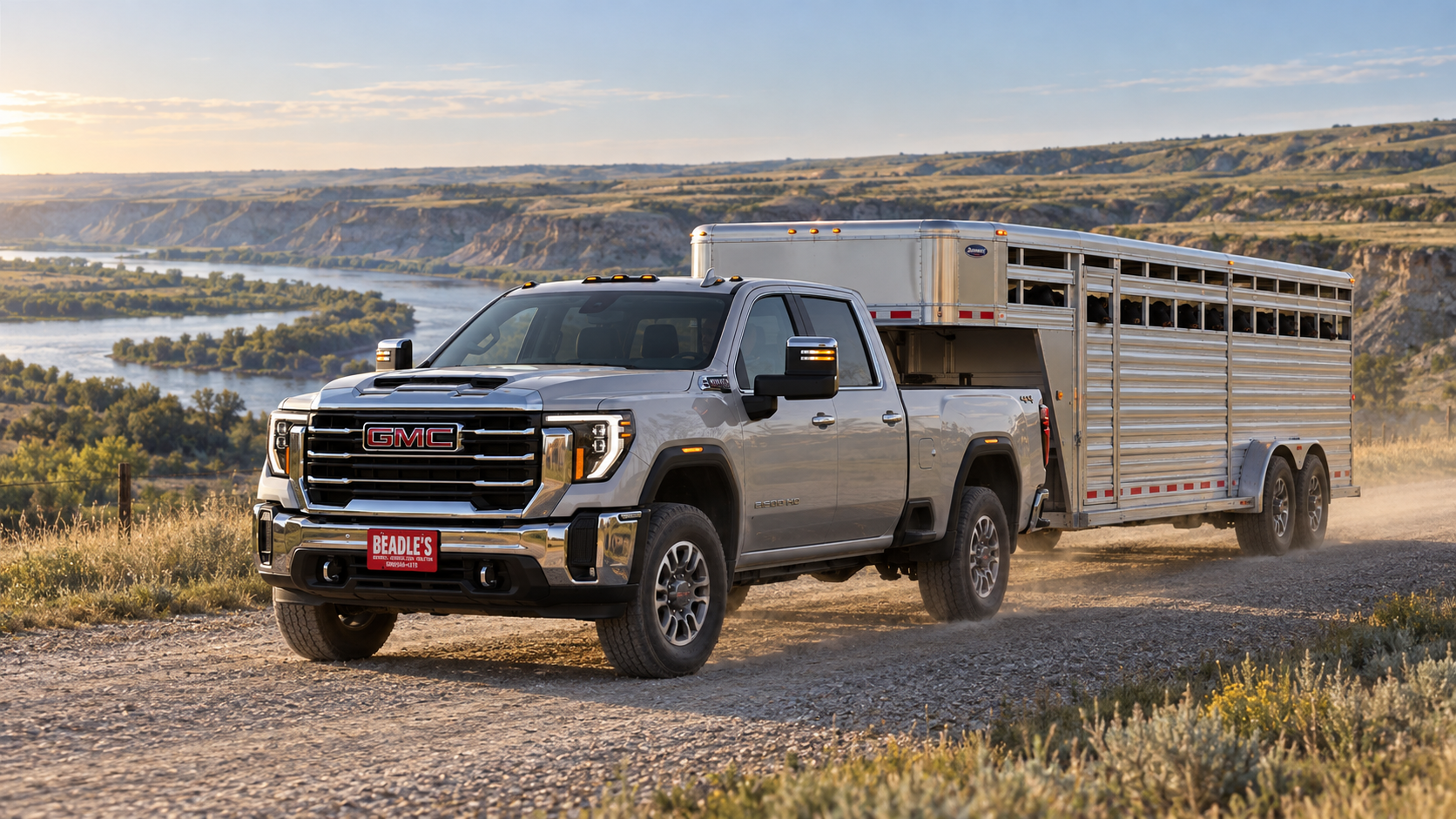
2026 GMC Sierra 2500 HD SLT pulling a gooseneck stock trailer loaded with cattle on a gravel road near Mobridge, South Dakota

How Much Can the 2026 Sierra 2500 HD Tow With a Gooseneck? Stock-Trailer Math for Mobridge Ranches

Every fall somebody stands in our showroom with a sale-barn ticket in one hand and asks the same question: will a three-quarter-ton pull my stock trailer loaded, or do I need to step up to a one-ton? The brochure answer for the 2026 GMC Sierra 2500 HD is 22,390 pounds, and it is a true number. It is also not the number for the truck you are going to buy, and if you plan a trailer around it you will find out the hard way at the scale. Short answer: a Crew Cab long bed 4WD Sierra 2500 HD with the Duramax, the truck most ranchers around Mobridge actually order, is rated to tow 19,000 pounds on a gooseneck, and 21,500 pounds with the Max Trailering Package, properly equipped. That handles a 28-foot aluminum stock trailer with a normal load of pairs, and a spring hay flatbed, with one catch that this post spends most of its time on: the pin weight eats your payload long before the trailer reaches the tow rating. View Sierra 2500 HD Inventory Get Pre-Qualified On This Page Conventional, gooseneck, fifth-wheel: three different numbers What the rancher configuration is actually rated for Where 22,390 pounds comes from A 28-foot stock trailer and a hay flatbed, worked as examples Pin weight and what is left for payload How to check a gooseneck load against your truck Conventional, Gooseneck, Fifth-Wheel: Why Are There Three Different Numbers? A Sierra 2500 HD carries two tow ratings on its trailering label, not one. The conventional rating is for a bumper-pull trailer hooked to the receiver hitch and tops out at 20,000 pounds with the Duramax and the Max Trailering Package. The gooseneck and fifth-wheel rating is for a trailer that couples in the bed, over the rear axle, and it runs higher because the truck carries the hitch weight where it was built to carry it. Gooseneck and fifth-wheel share the same rating on this truck. The difference is the hitch: a gooseneck uses a ball in the bed floor, which is what every stock trailer and hay flatbed in Walworth County rides on, and a fifth-wheel uses a kingpin and plate, which is what the camper at Indian Creek rides on. The truck does not care which one you bolt in; it cares about the weight and where it sits. Both ratings change with cab, bed, drive, engine, and whether the Max Trailering Package is on the truck. That is why the honest way to shop is by configuration, not by the biggest number on the website. Our 2026 Sierra 2500 HD buyers guide lays out both full tables; the rest of this post works through the ones that matter to a cow-calf outfit. What Is the Rancher Configuration Actually Rated For? The truck most of our ranch buyers order is a Crew Cab long bed 4WD with the Duramax, usually an SLE or SLT. With the standard gooseneck prep it is rated for 19,000 pounds gooseneck; add the Max Trailering Package and it is rated for 21,500 pounds. Conventional, the same truck is rated 18,500 pounds, or 20,000 pounds with the package. Properly equipped, in every case. 2026 Sierra 2500 HD configuration Gooseneck, Duramax Gooseneck, Duramax + Max Trailering Max payload, Duramax Crew Cab long bed 4WD 19,000 lb 21,500 lb 3,566 lb Crew Cab standard bed 4WD 19,100 lb 21,600 lb 3,463 lb AT4 Crew Cab long bed 18,000 lb 21,190 lb ask us for the label Denali Crew Cab long bed 18,400 lb 19,820 lb ask us for the label Crew Cab long bed 4WD, 6.6L gas 18,280 lb not available 3,812 lb Two things jump out of that table. First, the gas V8 is not far behind on the gooseneck rating without the package, and it carries more payload because the engine is lighter. Second, the Max Trailering Package is only offered with the Duramax, so if you want the 21,500-pound number the engine decision is made for you. The Duramax-versus-gas post goes through the rest of that trade. The AT4 and the Denali give up a little because of their wheels and equipment. The AT4X cannot be ordered with the Max Trailering Package at all, which makes it the wrong Sierra for a gooseneck outfit, however good it is on a pasture two-track. Where Does the 22,390-Pound Number Come From? The 22,390-pound maximum belongs to one configuration: a Regular Cab 2WD long bed with the Duramax and the Max Trailering Package. It is the lightest truck in the lineup with the strongest driveline, so it has the most left over for the trailer. The 4WD version of the same truck is rated 22,000 pounds. Almost nobody in north-central South Dakota orders that truck. A Regular Cab has one row of seats, a 2WD truck is a hard sell in a county with gravel section lines and a January, and the extra 890 pounds of rating over the Crew Cab long bed 4WD does not buy you a bigger trailer once payload enters the picture. It is a real rating and we will order one for a farm that wants it, but it is a spec-sheet champion, not the truck in your yard. Numbers to ignore Third-party listing sites regularly print a higher gooseneck figure for the 2500 HD. Those are either rounding errors or Sierra 3500 HD numbers pasted into the wrong table, and the one-ton figures are published with their configurations here. Our figures are GM's ratings for the 2026 truck, and the trailering information label in the driver door jamb of the specific truck is the final word on every one of them. The gooseneck prep that comes with the Max Trailering Package: hitch tray, stamped and capped bed holes, and the 7-pin connector in the bed wall. Will It Pull a 28-Foot Stock Trailer or a Spring Hay Flatbed? Yes to both, within the rating, on a Crew Cab long bed 4WD Duramax. The tow rating is rarely the problem. The problem is that a loaded stock trailer puts a quarter of its weight on the truck through the gooseneck ball, and that weight comes out of payload. Here are two examples worked the way we work them at the desk. The trailer and animal weights are illustrations; yours will differ, and a scale ticket beats every estimate. Example one, for illustration: a 28-foot aluminum gooseneck stock trailer. Say the trailer weighs 7,000 pounds empty and you load 10 cows at 1,300 pounds. That is 20,000 pounds behind the truck. Without the Max Trailering Package the 19,000-pound rating is already exceeded; with the package, 21,500 pounds covers it. Now the pin: at 20 percent that load puts 4,000 pounds on the truck, and the Crew Cab long bed 4WD Duramax has 3,566 pounds of payload before you climb in. The truck is over on payload while it is under on towing. Drop to eight cows and the trailer is 17,400 pounds with a 3,480-pound pin, and now the driver alone is enough to push it to the line. Example two, for illustration: a 32-foot gooseneck hay flatbed. Say the flatbed weighs 6,500 pounds and you stack 10 round bales at 1,200 pounds. That is 18,500 pounds, inside both ratings with the package. A flatbed carries more of its weight on its own axles when it is loaded evenly, so a pin weight closer to 15 percent, about 2,800 pounds, leaves roughly 750 pounds for the driver, a passenger, and a toolbox. It works, but it is not the wide-open margin the 21,500-pound rating implies. The lesson is not that the 2500 HD is too small. It is that a three-quarter-ton with a gooseneck is a payload truck first and a towing truck second. Most outfits around here run one of these trucks exactly this way for years by hauling a few less head per trip, and the ones who move pairs every week at full load are the ones we walk over to the 3500 HD. The Max Trailering Package post covers what the package actually changes in the truck. How Much Payload Is Left After the Pin Weight? Payload is the truck's own carrying limit: everything in the cab and the bed, plus the weight the trailer puts on the hitch. On a Crew Cab long bed 4WD, it is 3,566 pounds with the Duramax and 3,812 pounds with the gas V8. Subtract the pin weight, then subtract the people, the dog, the fuel tank, the mineral tubs, and whatever else rides along, and what is left is your margin. This is why the same truck can be under its tow rating and over its payload at the same moment, and why the label in the door jamb lists both. Gooseneck stock trailers tend to run 20 to 25 percent of their loaded weight on the pin. Flatbeds loaded evenly run lower. Tandem-dual livestock trailers with the load pushed forward run higher. If you do not know your number, the elevator scale will tell you in five minutes: weigh the truck alone, then weigh it hitched with the trailer loaded but the trailer axles off the scale, and the difference is your pin weight. Two more numbers matter on a long haul. GVWR is the truck's own maximum loaded weight, up to 11,900 pounds on a Crew Cab Duramax with the Max Trailering Package. GCWR is the truck and trailer together, and it is 30,000 pounds with the package, 27,500 pounds on a Crew Cab Duramax with 18-inch or larger wheels without it. For a 20,000-pound trailer behind an 8,000-pound truck you are at 28,000 pounds combined, which is why the package matters for a stock trailer even before you look at the tow rating. The truck helps you here. Every Sierra 2500 HD has an integrated trailer brake controller, trailer sway control, and Hitch Guidance on the rear camera; SLT and up add Hitch View and the In-Vehicle Trailering App, which runs a light check and tracks your trailers. In a Mobridge winter the Duramax's block heater and the Autotrac transfer case on SLT and up matter as much as any rating, and the winter post covers that side of it. How to Check a Gooseneck Load Against Your Sierra 2500 HD Five steps, once, and you will know your real margin for as long as you own the trailer. Read the label: open the driver door and find the trailering information label. Write down the gooseneck rating, the payload, and the GCWR for that truck, not the brochure. Weigh the loaded trailer: run the whole rig across the elevator scale loaded the way you actually haul. That is your trailer weight. Weigh the pin: weigh the truck alone, then hitched with only the truck on the scale. The difference is the pin weight. Add the cab and bed: pin weight plus driver, passengers, fuel tank, tools, and feed. Compare the total to the payload on the label. If it is over, the truck is over, whatever the tow rating says. Check the combination: truck weight plus loaded trailer against the GCWR. Then set the trailer brake gain on the controller with the trailer loaded, on a quiet stretch of gravel, before the first trip down Highway 12. Is the Sierra 2500 HD Enough Truck for Your Gooseneck? Worth it if Skip it (look at the 3500 HD) if Your loaded stock trailer or flatbed weighs under about 19,000 pounds, or under 21,500 pounds with the Max Trailering Package Your pin weight plus people and gear stays under the payload on the label The truck is also the family truck, the parts runner, and the Sunday truck You haul a few times a month, not every day You move full loads of pairs weekly and want margin, not math Your pin weight alone is over 3,500 pounds You run a tandem-dual livestock trailer or a 40-foot flatbed loaded heavy You are within 10 percent of both the tow rating and the payload every trip Key Takeaways A Crew Cab long bed 4WD Duramax Sierra 2500 HD is rated 19,000 pounds gooseneck, or 21,500 pounds with the Max Trailering Package, properly equipped. The 22,390-pound maximum is a Regular Cab 2WD long bed with the Duramax and the package, a truck almost nobody here orders. Payload, 3,566 pounds on that Crew Cab Duramax, runs out before the tow rating does once a 20 to 25 percent pin weight is on the truck. The Max Trailering Package needs the Duramax; the AT4X cannot take it at all. Weigh the loaded trailer and the pin once at the elevator, then compare both to the label in the driver door jamb. Frequently Asked Questions Does the Sierra 2500 HD come with a gooseneck hitch? It comes with the prep, not the ball. The Gooseneck and Fifth-Wheel Prep Package adds the hitch platform with a ball tray, stamped and capped holes in the bed floor, and a 7-pin connector in the bed wall; it is included with the Max Trailering Package and available on any other trim. The gooseneck ball and safety-chain kit is a dealer-installed accessory we can add before delivery. What is the GCWR of a 2026 Sierra 2500 HD Duramax? 26,000 pounds standard, 27,500 pounds on a Crew Cab with 18-inch or larger wheels, and 30,000 pounds with the Max Trailering Package. The gas V8 is rated 24,500 or 26,000 pounds depending on wheels. GCWR is the loaded truck and loaded trailer together. Which Sierra 2500 HD has the most payload? The Regular Cab long bed with the 6.6L gas V8, at 4,049 pounds. Among the Crew Cabs people actually buy, the long bed 4WD is 3,812 pounds with the gas engine and 3,566 pounds with the Duramax. The diesel gives up roughly 250 pounds of payload for its extra towing on the same truck. Can the gas Sierra 2500 HD pull a gooseneck stock trailer? Yes. A Crew Cab long bed 4WD with the 401-horsepower gas V8 is rated 18,280 pounds gooseneck, properly equipped, and carries 3,812 pounds of payload, more than the diesel. What it cannot do is take the Max Trailering Package, so 18,280 is its ceiling, and it will work harder on the Highway 12 grades with its 3.73 axle than the Duramax does with 975 lb-ft of torque. My Take on Gooseneck Towing With the Sierra 2500 HD I would rather send a rancher home with a truck that is honestly rated for the trailer than sell the biggest number on the page. The Sierra 2500 HD is enough truck for the way most cow-calf operations around Mobridge actually haul: a 28-foot stock trailer with a normal load, a hay flatbed in April, the sale barn a few times a year. Order it as a Crew Cab long bed 4WD Duramax with the Max Trailering Package and you have 21,500 pounds of gooseneck rating and every piece of gooseneck prep already in the bed. What I ask everyone to do is weigh the loaded trailer and the pin once, then compare both to the label in the door. If the pin weight plus the crew in the cab clears the payload with room to spare, buy the 2500 HD and enjoy the ride when it is empty. If it does not, or you are hauling full loads every week, the 3500 HD is on the same lot and I will walk you over to it without a second thought. The full towing and payload tables, engines, trims, and packages are in the 2026 GMC Sierra 2500 HD buyers guide. Or bring your scale ticket to Beadle Chevrolet GMC at 2200 US Hwy 12 in Mobridge, or call or text 605-845-7277, and we will match it to a truck. View Sierra 2500 HD Inventory Get Pre-Qualified Contact Beadle Chevrolet GMC About the Author Lexy Tabbert — Beadle Chevrolet, Mobridge, SD Lexy Tabbert is the Director of Sales and Marketing at Beadle Chevrolet in Mobridge, South Dakota. She covers Chevrolet and GMC vehicles, trim comparisons, and buyer guidance — helping families, ranchers, and ag operators across the region find the right truck and configuration for their needs. Learn more about Lexy.
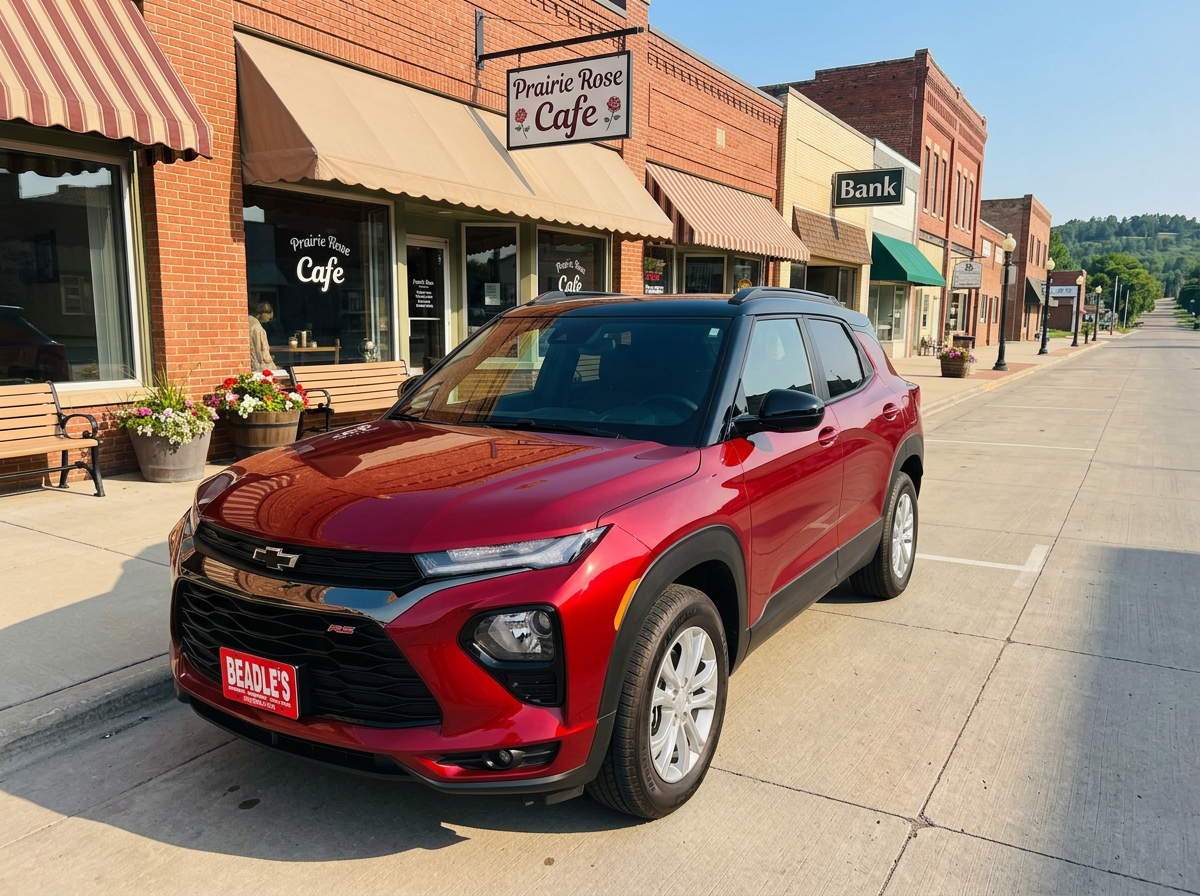
2026 Chevrolet Trailblazer RS in Apex Red parked on Main Street in Mobridge SD

2026 Trailblazer Colors, Two-Tone Roofs & the Midnight Edition

Here's the thing nobody tells you about Trailblazer colors until you're deep in the build tool: the palette is trim-restricted. The color you fell for might not be available on the trim you're buying — Apex Red never meets the ACTIV, Summit White never wraps an RS body, and the two-tone roofs belong to exactly two trims. This guide lays out the full 2026 palette, which trims get which colors, how the two-tone roof program works, and what the blacked-out Midnight Edition actually includes — so you can walk in knowing your combination exists before you set your heart on it. Quick Answer The 2026 Trailblazer offers eight colors, including two new ones — White Sands (RS and ACTIV only) and Apex Red (LS, LT, RS only). Two-tone roofs are exclusive to RS and ACTIV, and the blacked-out Midnight Edition is an LT-only appearance package. Every color is trim-restricted, so check availability before you commit. Search Available Trailblazer Inventory Get Pre-Qualified On This Page What Colors Does the 2026 Trailblazer Come In? What's New for 2026: White Sands and Apex Red Which Trims Get the Two-Tone Roof? What Is the Trailblazer Midnight Edition? Which Color Should You Pick in South Dakota? What Colors Does the 2026 Trailblazer Come In? Eight exterior colors, each with its own trim list. Three are available on every trim; the rest are restricted — and two carry an extra cost. Color Available On Notes White Sands RS, ACTIV NEW for 2026 Apex Red LS, LT, RS NEW for 2026 Summit White LS, LT — Mosaic Black Metallic All trims — Marina Blue Metallic All trims Extra cost Iridescent Pearl Tricoat RS, ACTIV Extra cost Cacti Green LS, LT, ACTIV — Sterling Gray Metallic All trims — Read the restrictions before you shop: there's no Summit White RS, no Apex Red ACTIV, and no Cacti Green RS. If a specific color-trim pairing is the whole reason you're buying, confirm it exists in the table above first — then confirm it on the window sticker of the actual unit, because color availability can shift during a model year. What's New for 2026: White Sands and Apex Red Two additions headline the 2026 palette. White Sands is a warm, desert-toned neutral reserved for the RS and ACTIV, and Apex Red is a brighter, sportier red offered on LS, LT, and RS. Apex Red matters beyond the paint booth because it also joined the two-tone roof program — an Apex Red roof over a contrasting body is one of the loudest combinations Chevy has offered on this vehicle, and it turns heads parked on Main Street. White Sands runs the other direction: it reads upscale and hides gravel dust better than any dark color in the lineup, which makes it a quietly practical pick for the ACTIV's back-road mission. Which Trims Get the Two-Tone Roof? Only the RS and ACTIV — and each gets its own roof menu. The RS offers a Mosaic Black or Apex Red contrasting roof; the ACTIV offers Summit White or Iridescent Pearl Tricoat. LS and LT are single-color only. Trim Roof Options Character RS Mosaic Black or Apex Red roof Street-sport look — black roof over Apex Red is the signature combo ACTIV Summit White or Iridescent Pearl Tricoat roof Outdoor-rig look — Cacti Green under a white roof is the lot favorite LS / LT Body color only Midnight Edition (LT) delivers the monochrome look instead Two fine-print notes: the contrasting roof can be skipped — RS and ACTIV can be ordered without it if you prefer a single color — and roof choice interacts with the panoramic sunroof option, so tell us both preferences up front when ordering. Trim-by-trim equipment logic is mapped in our LS vs LT comparison and the ACTIV deep dive. What Is the Trailblazer Midnight Edition? The Midnight Edition is an LT-exclusive appearance package, added to the lineup in October 2025: 18-inch gloss black wheels with black bowtie center caps, black mirror caps, black roof rails, and blacked-out badging. Ordered over Mosaic Black Metallic paint, it delivers the full murdered-out look; over Sterling Gray or Marina Blue it reads as a sharp contrast package instead. Worth knowing before you fall for it: it's appearance only — no mechanical changes — and it's the only route to a blacked-out Trailblazer, since the RS's dark styling always keeps its red accents. It's also the LT's answer to buyers who wanted the two-tone drama the LS and LT don't offer. Which Color Should You Pick in South Dakota? Pick with your roads in mind, not just the showroom lights. Light and mid-tone colors — Summit White, White Sands, Sterling Gray — hide the gravel dust and hard-water spots that are simply part of life here. Dark colors look spectacular for the first hour after a wash and honest the rest of the week. Worth the extra cost if you love it every time you walk up to it — Marina Blue Metallic and Iridescent Pearl Tricoat are the two paints people choose with their hearts, and both photograph beautifully against prairie sky. Skip the premium paint if the budget is tight; the no-cost palette covers every practical base, and the money does more work in the Cold Weather Package. One more practical note for our winters: a darker vehicle stands out against snow, while white-on-white asks a little more of other drivers in a ground blizzard — one small reason running your headlights year-round is good practice regardless of color. The Color Mistake to Avoid Choosing trim by color instead of color by trim. We've watched buyers pick an RS because they wanted Apex Red, then miss the ACTIV's gravel hardware they actually needed. Decide the trim that fits your life first — then choose from that trim's palette. And confirm the exact color and roof on the window sticker before signing; two-tone builds are specific-order vehicles. Key Takeaways Eight 2026 colors, all trim-restricted — only Mosaic Black, Marina Blue, and Sterling Gray span every trim. New for 2026: White Sands (RS/ACTIV only) and Apex Red (LS/LT/RS only). There is no Apex Red ACTIV and no Summit White RS. Marina Blue Metallic and Iridescent Pearl Tricoat are the two extra-cost paints. Two-tone roofs are RS/ACTIV exclusives: black or Apex Red roofs on RS, Summit White or Iridescent Pearl roofs on ACTIV — and either trim can be ordered without one. The Midnight Edition (added October 2025) is LT-only: 18-inch gloss black wheels, black badging, mirrors, and rails — appearance only, no mechanical changes. Pick trim first, color second — and confirm the exact color/roof combination on the window sticker. Frequently Asked Questions What colors does the 2026 Chevy Trailblazer come in? Eight colors: new White Sands and Apex Red, plus Summit White, Mosaic Black Metallic, Marina Blue Metallic, Iridescent Pearl Tricoat, Cacti Green, and Sterling Gray Metallic. Every color is restricted to specific trims, so check availability for the trim you want. Which 2026 Trailblazer trims can get a two-tone roof? Only the RS and ACTIV. The RS offers a Mosaic Black or Apex Red contrasting roof, and the ACTIV offers Summit White or Iridescent Pearl Tricoat. Both trims can also be ordered without the two-tone roof. The LS and LT are single-color only. What is the Trailblazer Midnight Edition? An LT-exclusive appearance package added in October 2025: 18-inch gloss black wheels with black bowtie caps, black mirror caps, black roof rails, and blacked-out badging. It changes nothing mechanical — it's the styling route to a fully blacked-out Trailblazer. Do any 2026 Trailblazer colors cost extra? Yes, two: Marina Blue Metallic (available on all trims) and Iridescent Pearl Tricoat (RS and ACTIV only) are extra-cost paints. The other six colors carry no charge. Can you get Apex Red on the Trailblazer ACTIV? No — Apex Red is offered on the LS, LT, and RS only. The ACTIV's palette is White Sands, Mosaic Black Metallic, Marina Blue Metallic, Iridescent Pearl Tricoat, Cacti Green, and Sterling Gray Metallic. Quick Answers How many 2026 colors? Eight, all trim-restricted. New this year? White Sands (RS/ACTIV) and Apex Red (LS/LT/RS). Colors on every trim? Mosaic Black Metallic, Marina Blue Metallic, and Sterling Gray Metallic. Extra-cost paints? Marina Blue Metallic and Iridescent Pearl Tricoat. Two-tone roofs? RS (black or Apex Red roof) and ACTIV (white or pearl roof) only — deletable on both. Midnight Edition? LT-only black-out appearance package, added October 2025. Best dust-hider for gravel roads? White Sands, Summit White, or Sterling Gray. The lot favorite? Cacti Green ACTIV with the Summit White roof. Can I see what's here now? Current colors in stock are on our Trailblazer inventory page. Keep Researching 2026 Chevrolet Trailblazer: The Complete Guide — trims, engines, packages, and the full color program 2026 Trailblazer LS vs LT — where the Midnight Edition fits in the trim decision The Trailblazer ACTIV on Gravel — the trim behind the Cacti Green two-tone Trailblazer Tech & Safety for Families — what's identical under every color My Take on the 2026 Trailblazer Palette Color is supposedly the least rational part of buying a vehicle, but I've stopped believing that after years at Beadle Chevrolet. The color is the part you see every single morning — from the kitchen window, across the co-op parking lot, in the school pickup line. People who settle on color quietly resent it by spring. So no, I won't talk you out of the Marina Blue. What I will do is make you pick the trim first, because the palette follows the trim and not the other way around. And I'll offer the local wisdom: on gravel, White Sands and Sterling Gray stay presentable for weeks, black shows every mile, and the Cacti Green ACTIV with the white roof is the one that gets photographed by strangers at the Lake Oahe boat ramp. To see how colors line up with trims, engines, and packages in one view, start with our complete 2026 Chevrolet Trailblazer guide — then come see the paint in person at the store in Mobridge. Every one of these colors reads differently under a real prairie sky than it does on a screen. Search Available Trailblazer Inventory Get Pre-Qualified Contact Beadle Chevrolet About the Author Lexy Tabbert — Beadle Chevrolet, Mobridge, SD Lexy Tabbert is the Director of Sales and Marketing at Beadle Chevrolet in Mobridge, South Dakota. She covers Chevrolet and GMC vehicles, trim comparisons, and buyer guidance — helping families, ranchers, and ag operators across the region find the right truck and configuration for their needs. Learn more about Lexy.
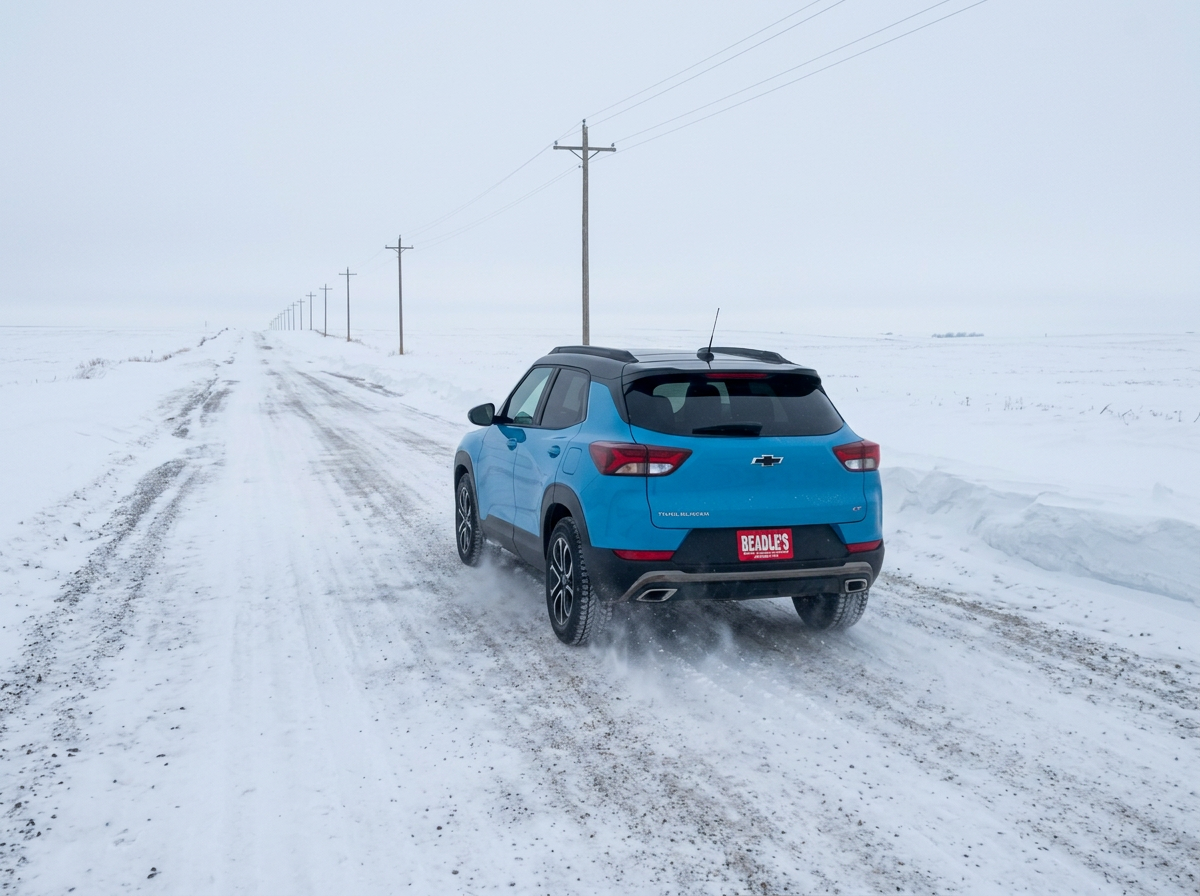
2026 Chevrolet Trailblazer AWD holding steady on a snow-packed gravel road in rural South Dakota

Trailblazer vs Subaru Crosstrek: Is Standard AWD Worth the Premium in South Dakota?

The Subaru Crosstrek is the comparison serious winter shoppers bring up, and it deserves a serious answer. Subaru has built its reputation on standard all-wheel drive, and in a climate like ours that reputation carries real weight. So is the Crosstrek's standard AWD worth its premium over the Trailblazer — or is Chevy's approach the smarter money? Here's the fair version of the matchup, with current numbers from both manufacturers: prices, powertrains, clearance, towing, and the ownership details that matter when the nearest dealership isn't around the corner. Quick Answer The 2026 Crosstrek starts at $26,995 plus $1,420 destination with standard AWD; the 2026 Trailblazer starts at $23,300 with AWD available on every trim. The Crosstrek counters with more power and clearance; the Trailblazer answers with a lower price, a 9-speed automatic instead of a CVT on AWD builds, and hometown service. Search Available Trailblazer Inventory Get Pre-Qualified On This Page What Do the Trailblazer and Crosstrek Cost? Is Standard AWD Better Than Available AWD? How Do Power and Transmissions Compare? What About Ground Clearance, Gravel, and Towing? Which Should a South Dakota Winter Commuter Buy? What Do the Trailblazer and Crosstrek Cost? The 2026 Trailblazer starts at $23,300 MSRP; the 2026 Crosstrek starts at $26,995 MSRP plus a $1,420 destination charge — $28,415 as delivered, per Subaru's official pricing announcement. That's a gap of several thousand dollars before options. Measure 2026 Trailblazer 2026 Crosstrek Starting MSRP $23,300 $26,995 (+$1,420 destination) Drivetrain FWD standard; AWD available every trim AWD standard Engine 137-hp 1.2L or 155-hp/174 lb-ft 1.3L Turbo 180-hp/178 lb-ft 2.5L (gas trims) Transmission CVT (FWD) / 9-speed automatic (AWD) CVT (all gas trims) Ground clearance 7.5 in 8.7 in (9.3 in Wilderness) Max towing 1,000 lbs (1.3L + Trailering Pkg) 1,500 lbs (3,500 lbs Wilderness) Source Trailblazer figures from chevrolet.com and the 2026 order guide; Crosstrek figures from Subaru's 2026 pricing announcement (media.subaru.com). Both retrieved July 17, 2026. MSRPs exclude tax, title, license, and dealer fees; Subaru destination shown per its announcement. Confirm current pricing before comparing — both change. The like-for-like comparison is an AWD Trailblazer LT against the base Crosstrek — and even with the AWD option added, the Trailblazer typically enters the conversation below the Crosstrek's as-delivered number while carrying more standard screen and heated-equipment access. Price out both configured the way you'd order them; the monthly-payment view is in our price and payment guide. Is Standard AWD Better Than Available AWD? Standard AWD is simpler — every Crosstrek has it, full stop, and Subaru's symmetrical system has earned its winter reputation honestly. But "available" has its own advantage: the Trailblazer lets you not buy AWD when you don't need it, and that choice is worth thousands to an in-town driver. Think of it as two philosophies. Subaru builds one answer and builds it well. Chevy builds a menu: a $23,300 front-driver for the plowed-streets buyer, and an AWD build — which automatically brings the stronger 1.3L Turbo and the 9-speed automatic — for the US-12 commuter. Neither philosophy is wrong; one of them matches your driveway better than the other. What actually gets a winter commuter to work, in either vehicle, is the combination of driven wheels and tires with real tread — the full breakdown of what AWD does and doesn't do on ice is in our South Dakota winters guide. How Do Power and Transmissions Compare? On paper the Crosstrek's 2.5L boxer wins the power column: 180 horsepower and 178 lb-ft against the Trailblazer 1.3L Turbo's 155 and 174. The transmission column flips the other way — every gas Crosstrek uses a CVT, while every AWD Trailblazer carries a conventional 9-speed automatic. The character difference is bigger than the numbers. The Trailblazer's turbo delivers its 174 lb-ft at just 1,600 rpm, so passing pull arrives early without revving; the naturally aspirated Subaru builds its power higher in the range, and the CVT holds engine speed up while it does. Drivers who dislike the CVT drone that comes with hard acceleration — a common objection we hear — will prefer how the 9-speed steps through gears on a two-lane pass. If engine details drive your decision, our Trailblazer engines guide covers both Chevy powerplants, their EPA numbers, and which builds get which hardware. What About Ground Clearance, Gravel, and Towing? Credit where due: the Crosstrek carries more clearance — 8.7 inches standard and 9.3 on the Wilderness, against the Trailblazer's 7.5 — and it out-tows the Trailblazer, 1,500 pounds versus 1,000 (3,500 for the Wilderness trim). For graded gravel section roads, both vehicles have what the job requires; clearance differences matter at the extremes — deep ruts, spring washouts — more than on maintained county gravel. The Trailblazer's gravel-focused answer is the ACTIV trim, which adds off-road suspension tuning and a functional skid plate as standard hardware at the same $27,900 as the RS. Underbody protection is something a clearance number alone doesn't give you; kicked-up rock doesn't check specs. On towing: if a 3,500-pound rating is genuinely on your list, the honest advice from a dealership that sells trucks is that you're shopping the wrong segment in both cases — that's utility-trailer-plus territory where a compact crossover, any compact crossover, is working at its ceiling. For the kayaks-and-small-trailer life, both vehicles are adequately rated. Which Should a South Dakota Winter Commuter Buy? Both will get you to work in January. The Trailblazer wins on price, transmission feel, and — for buyers around Mobridge — on where it gets serviced. The Crosstrek wins on standard AWD, clearance, and towing headroom. Your priorities pick the winner, not the badges. The Trailblazer is worth it if you want the lower payment, prefer a geared automatic over a CVT in your AWD vehicle, or value buying and servicing where you live — our service department is on US Hwy 12 in Mobridge, not a hundred highway miles away. Skip it for the Crosstrek if maximum clearance and the biggest tow rating in the class are your top criteria and the price premium fits your budget — it's a well-built vehicle and we'd rather tell you that than pretend otherwise. The Cross-Brand Comparison Mistake Comparing MSRPs from two brands without checking what's inside them. Subaru's advertised prices exclude a $1,420 destination charge; equipment groupings differ; and incentives on each side move monthly. Build both vehicles to your actual spec, get both out-the-door numbers in writing, and compare those — never the headline prices. Key Takeaways Entry pricing: Trailblazer $23,300 vs Crosstrek $26,995 + $1,420 destination ($28,415 as delivered) — both retrieved July 17, 2026. AWD philosophy differs: standard on every Crosstrek; available on every Trailblazer trim, where it brings the 1.3L Turbo and a 9-speed automatic with it. Power: Crosstrek 180 hp / 178 lb-ft; Trailblazer 1.3L 155 hp / 174 lb-ft at just 1,600 rpm. Transmission: Crosstrek CVT-only; Trailblazer AWD gets a geared 9-speed. Capability columns go to Subaru: 8.7–9.3 in clearance vs 7.5, and 1,500–3,500 lbs towing vs 1,000. The Trailblazer ACTIV answers with standard skid-plate and suspension hardware. Ownership tiebreaker for this region: the Trailblazer is sold and serviced in Mobridge — worth real money in time over a multi-year ownership. Compare built-to-spec out-the-door numbers, never headline MSRPs across brands. Frequently Asked Questions Does the Subaru Crosstrek have standard AWD? Yes — Symmetrical All-Wheel Drive is standard on every 2026 Crosstrek. On the 2026 Trailblazer, AWD is available on all four trims rather than standard, which lets FWD buyers keep the savings. Which costs less, the Trailblazer or the Crosstrek? The Trailblazer — it starts at $23,300 MSRP versus the Crosstrek's $26,995 plus a $1,420 destination charge (July 17, 2026 figures). Even with AWD added, the Trailblazer typically undercuts the Crosstrek's as-delivered price. Does the Trailblazer or Crosstrek have more power? The Crosstrek's 2.5L makes 180 hp and 178 lb-ft versus the Trailblazer 1.3L Turbo's 155 hp and 174 lb-ft. The Trailblazer's torque arrives earlier (1,600 rpm), and its AWD models use a 9-speed automatic while every gas Crosstrek uses a CVT. Which tows more, the Trailblazer or the Crosstrek? The Crosstrek — 1,500 pounds on standard trims and 3,500 on the Wilderness, versus the Trailblazer's 1,000 pounds with the 1.3L Turbo and available Trailering Package. Buyers who genuinely need 3,500 pounds regularly are usually better served by a larger vehicle. Which has more ground clearance? The Crosstrek, at 8.7 inches standard and 9.3 on the Wilderness, versus the Trailblazer's 7.5 inches. For maintained gravel roads both are sufficient; the Trailblazer ACTIV adds a standard skid plate and off-road suspension tuning for unpaved-road duty. Quick Answers Price gap? Trailblazer from $23,300; Crosstrek from $26,995 + $1,420 destination = $28,415 as delivered (July 17, 2026). AWD? Standard on every Crosstrek; available on every Trailblazer trim. Transmissions? Crosstrek: CVT on all gas trims. Trailblazer AWD: 9-speed automatic. Power? Crosstrek 180 hp / 178 lb-ft; Trailblazer 1.3L 155 hp / 174 lb-ft at 1,600 rpm. Clearance? 8.7–9.3 in (Crosstrek) vs 7.5 in (Trailblazer). Towing? 1,500–3,500 lbs (Crosstrek) vs 1,000 lbs (Trailblazer, 1.3L + Trailering Package). The Trailblazer's edge? Lower cost of entry, geared automatic with AWD, 11-inch screen standard, and sales plus service in Mobridge. How to decide? Build both to your spec and compare out-the-door numbers — then drive both back-to-back. Keep Researching 2026 Chevrolet Trailblazer: The Complete Guide — trims, engines, colors, and packages in one place Is the Trailblazer Right for South Dakota Winters? — what AWD actually does on ice and snow Trax vs Trailblazer — the in-house comparison one price step down Trailblazer Engines Explained — the 1.3L Turbo and 9-speed story in full My Take on Trailblazer vs Crosstrek I respect the Crosstrek, and I tell shoppers at Beadle Chevrolet exactly that — pretending a competitor is junk is the fastest way to lose someone's trust. What I ask instead is what the extra money is buying for their specific life. If the answer is "standard AWD," the Trailblazer already offers AWD on every trim for less. If the answer is clearance and towing they'll genuinely use, the Crosstrek earned its premium and I'll shake their hand either way. The factor people underweight until they live it: where the vehicle gets serviced. An oil change, a warranty visit, a recall — over years of ownership, having your dealer on US Hwy 12 in Mobridge instead of a hundred-mile round trip away is worth real time and real money. That's not a spec, but out here it might be the most practical line on the whole comparison sheet. If you're weighing the Chevy side, everything — trims, engines, winter equipment, colors, pricing — is gathered in our complete 2026 Chevrolet Trailblazer guide. Then come drive an AWD Trailblazer back-to-back with the Crosstrek you're considering. The transmission difference alone usually makes the decision clearer than any table can. Search Available Trailblazer Inventory Get Pre-Qualified Contact Beadle Chevrolet About the Author Lexy Tabbert — Beadle Chevrolet, Mobridge, SD Lexy Tabbert is the Director of Sales and Marketing at Beadle Chevrolet in Mobridge, South Dakota. She covers Chevrolet and GMC vehicles, trim comparisons, and buyer guidance — helping families, ranchers, and ag operators across the region find the right truck and configuration for their needs. Learn more about Lexy.
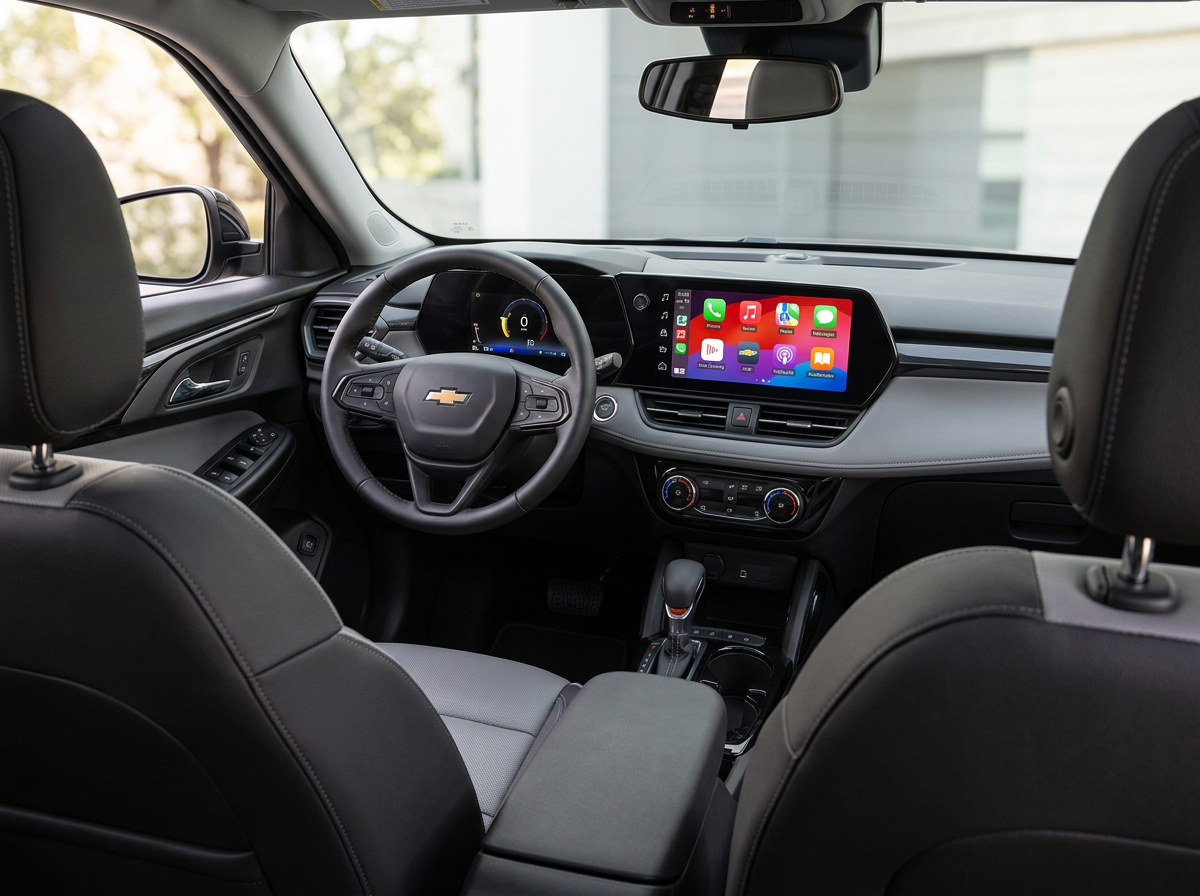
11-inch touchscreen with wireless Apple CarPlay in the 2026 Chevrolet Trailblazer

Trailblazer Tech & Safety for Families: Teen Driver, Wireless CarPlay & Chevy Safety Assist

Two kinds of shoppers ask us about Trailblazer technology: the first-time buyer who wants to know if the affordable trim still gets the good screen, and the parent quietly asking what this vehicle will do when their new driver is behind the wheel alone. Good news for both — the answers don't depend on how much you spend. Here's the full picture of what every 2026 Trailblazer includes — wireless phone connectivity, the Chevy Safety Assist suite, and Teen Driver — plus which driver-assist upgrades are worth chasing on the order sheet. Quick Answer Every 2026 Trailblazer — including the base LS — has an 11-inch touchscreen with wireless Apple CarPlay and Android Auto, the full Chevy Safety Assist suite, Teen Driver controls, Buckle to Drive, and an HD Rear Vision Camera as standard equipment. Blind zone alert and adaptive cruise control are available adds. Search Available Trailblazer Inventory Get Pre-Qualified On This Page Does the Trailblazer Have Wireless Apple CarPlay and Android Auto? What Safety Features Come Standard on the 2026 Trailblazer? What Is Teen Driver Mode and How Does It Work? Which Driver-Assist Features Are Optional — and Which Trims Get Them? Is the Trailblazer a Good First Car for a Teenager? Does the Trailblazer Have Wireless Apple CarPlay and Android Auto? Yes — wireless Apple CarPlay and Android Auto are standard on every 2026 Trailblazer trim, running on an 11-inch diagonal HD color touchscreen. No cable, no trim-level games: the LS gets the identical screen and connectivity as the ACTIV. The word wireless matters more than it sounds. Your phone connects the moment you sit down — maps, music, podcasts, and texts read aloud, with the phone still in your pocket or on the charger. For a young buyer coming out of an older car with a cracked phone mount, this is the feature that makes the Trailblazer feel like a generational leap. The screen pairs with an 8-inch fully digital driver information display behind the wheel, and every Trailblazer is Wi-Fi hotspot capable (the hotspot itself requires a data plan — ask us about activation). Out here, where a passenger's phone can drop signal between towns, an in-vehicle hotspot riding on the car's antenna holds a connection noticeably better than a phone alone. What Safety Features Come Standard on the 2026 Trailblazer? The complete Chevy Safety Assist suite is standard on all four trims: Automatic Emergency Braking, Front Pedestrian Braking, Lane Keep Assist with Lane Departure Warning, Forward Collision Alert, Following Distance Indicator, and IntelliBeam automatic high beams. Standard Feature What It Does for a Driver Here Automatic Emergency Braking + Forward Collision Alert Backup reflexes for the deer that steps onto US-12 at dusk Front Pedestrian Braking Watches crosswalks and school zones in town Lane Keep Assist w/ Lane Departure Warning A nudge back when a long, straight two-lane gets hypnotic Following Distance Indicator Real-time gap coaching — especially useful for new drivers IntelliBeam auto high beams Maximum light on dark rural highways without blinding oncoming traffic HD Rear Vision Camera + Buckle to Drive + Teen Driver Clear reversing view, seat-belt enforcement, and parental controls The point worth repeating: none of this is an upgrade. A $23,300 LS carries the same standard safety suite as a $27,900 ACTIV — the differences between trims live in comfort and appearance, not in crash-avoidance hardware. How that plays into trim choice is covered in our LS vs LT comparison. What Is Teen Driver Mode and How Does It Work? Teen Driver is a standard, PIN-protected mode tied to a specific key that lets parents set guardrails: it keeps the safety systems switched on, supports speed and audio-volume limits, and produces an in-vehicle report card of how the vehicle was driven. It pairs with Buckle to Drive, which holds the new driver accountable to the seat belt before the vehicle will shift out of park under the teen profile. Neither system replaces the conversations you're already having — but the report card gives those conversations facts to work with, which every parent of a 14-and-a-half-year-old with a South Dakota restricted permit will appreciate. The best way to evaluate it is hands-on: come by the store and we'll walk through the Teen Driver setup screens on an in-stock unit, so you can see exactly which limits and reports apply before your household's next driver gets keys. Which Driver-Assist Features Are Optional — and Which Trims Get Them? Two upgrades sit outside the standard suite: the blind-zone package — Blind Zone Steering Assist-style side alerts with Rear Cross Traffic Alert and Rear Park Assist — available across the lineup by package, and adaptive cruise control, which is offered on LT and above with package prerequisites. Our take on each: the blind-zone package is the sleeper value, especially for anyone backing out of angled Main Street parking or a school pickup line — rear cross traffic alert sees what mirrors can't. Adaptive cruise earns its cost on regular Aberdeen or Pierre highway runs and requires the Cold Weather Package first on the LT; on the RS and ACTIV it arrives bundled with the Bose audio upgrade later in the package chain. Because these arrive by package rather than trim, two identical-looking Trailblazers can differ — always confirm the driver-assist equipment on the specific unit's window sticker. Worth It or Skip It? Blind-zone package: worth it for nearly everyone — it's the add that prevents the most common low-speed claims. Adaptive cruise: worth it if you run the highway weekly; skip it if your Trailblazer lives in town and the package chain pushes the price past what you'd use. Is the Trailblazer a Good First Car for a Teenager? It's one of the strongest cases in the class: full crash-avoidance tech standard at the lowest Chevy SUV price with AWD available, plus Teen Driver oversight built in. A new LS costs real money next to a ten-year-old used car — but it carries a decade-newer safety suite, and that's precisely the feature set you want wrapped around your least experienced driver. Best for: the family whose teen drives real distances — the 20-mile gravel-and-highway run to school activities — where forward collision alert, lane keep assist, and available AWD are working every single trip. The winter side of the new-driver equation, including why we'd put a teen in AWD with good tires, is covered in our South Dakota winters guide, and the budget side in the price and payment guide. What Parents Overlook Assuming safety tech replaces experience. These systems are backup, not autopilot — a lane-keep nudge won't save a driver doing 70 on glare ice. Set the Teen Driver limits, insist on the gravel-road practice hours, and treat the technology as the second line of defense it's designed to be. Key Takeaways Wireless Apple CarPlay and Android Auto on an 11-inch HD touchscreen are standard on every 2026 Trailblazer trim, LS included. The full Chevy Safety Assist suite — automatic emergency braking, pedestrian braking, lane keep assist, forward collision alert, following distance indicator, IntelliBeam — is standard on all four trims. Teen Driver and Buckle to Drive are standard: PIN-protected limits, always-on safety systems, and an in-vehicle report card for new drivers. The blind-zone package (side alerts + rear cross traffic + rear park assist) is the highest-value optional add; adaptive cruise is for weekly highway drivers. Driver-assist options arrive by package, not trim — confirm equipment on the window sticker of any specific unit. Safety hardware doesn't scale with price here: the $23,300 LS and $27,900 ACTIV carry the same standard suite. Frequently Asked Questions Does the 2026 Trailblazer have wireless Apple CarPlay and Android Auto? Yes — wireless Apple CarPlay and Android Auto are standard on every 2026 Trailblazer trim, displayed on the standard 11-inch diagonal HD color touchscreen. No cable or dock is required. Does the Trailblazer have Teen Driver mode? Yes, Teen Driver is standard on every 2026 Trailblazer. It's a PIN-protected mode tied to a specific key that keeps safety systems on, supports speed and volume limits, and generates an in-vehicle report card of the driving. What safety features are standard on the 2026 Trailblazer? Every trim includes Chevy Safety Assist — Automatic Emergency Braking, Front Pedestrian Braking, Lane Keep Assist with Lane Departure Warning, Forward Collision Alert, Following Distance Indicator, and IntelliBeam auto high beams — plus an HD Rear Vision Camera, Teen Driver, and Buckle to Drive. Is blind zone alert standard on the Trailblazer? No — side blind zone alert with Rear Cross Traffic Alert and Rear Park Assist comes in an available package rather than as standard equipment. Because it's package-based, confirm it on the window sticker of the specific vehicle you're considering. Does the Trailblazer have a Wi-Fi hotspot? Every 2026 Trailblazer is Wi-Fi hotspot capable. Using the hotspot requires an active data plan — ask the dealership about activation and current plan options when you buy. Quick Answers Screen size? 11-inch diagonal HD touchscreen, standard on every trim, with an 8-inch digital driver display. Wireless CarPlay/Android Auto? Standard on all four trims — no cable needed. Is the safety suite trim-dependent? No — Chevy Safety Assist is identical from LS to ACTIV. Teen Driver? Standard: PIN-protected limits, always-on safety systems, and a driving report card. Buckle to Drive? Standard — under the teen profile, the vehicle holds in park until the belt clicks. Blind zone alert? Available by package on the lineup, with Rear Cross Traffic Alert and Rear Park Assist. Adaptive cruise? Available on LT and above with package prerequisites — not offered on LS. Wi-Fi? Hotspot capable on every trim; requires a data plan. Best tech-per-dollar trim? The LS — the screen, connectivity, and safety suite are already all there. Keep Researching 2026 Chevrolet Trailblazer: The Complete Guide — trims, engines, packages, and equipment in one place 2026 Trailblazer LS vs LT — which trim unlocks the optional driver-assist packages Is the Trailblazer Right for South Dakota Winters? — where the safety tech earns its keep 2026 Trailblazer Price & Payment Guide — what all this standard equipment costs monthly My Take on Trailblazer Tech & Safety The conversation that sticks with me at Beadle Chevrolet is the parent pricing a first car. They usually walk in planning to spend as little as possible on something used, and I understand the math. But when we walk through what a base Trailblazer includes — automatic braking, lane keep, Teen Driver reporting, a camera that actually shows you things — the question quietly changes from "what's cheapest" to "what's my kid driving through a Mobridge winter." My honest guidance: don't pay up a trim for technology, because the technology is already standard. Spend your option money on the blind-zone package, and on adaptive cruise only if the highway is your weekly reality. That's the whole tech strategy for this vehicle — it's refreshingly simple. To see how the tech fits alongside trims, engines, and pricing, our complete 2026 Chevrolet Trailblazer guide pulls it all together. Or bring the family — and the new driver — by the store in Mobridge, and we'll set up a Teen Driver profile together so you can see exactly what it reports. Search Available Trailblazer Inventory Get Pre-Qualified Contact Beadle Chevrolet About the Author Lexy Tabbert — Beadle Chevrolet, Mobridge, SD Lexy Tabbert is the Director of Sales and Marketing at Beadle Chevrolet in Mobridge, South Dakota. She covers Chevrolet and GMC vehicles, trim comparisons, and buyer guidance — helping families, ranchers, and ag operators across the region find the right truck and configuration for their needs. Learn more about Lexy.
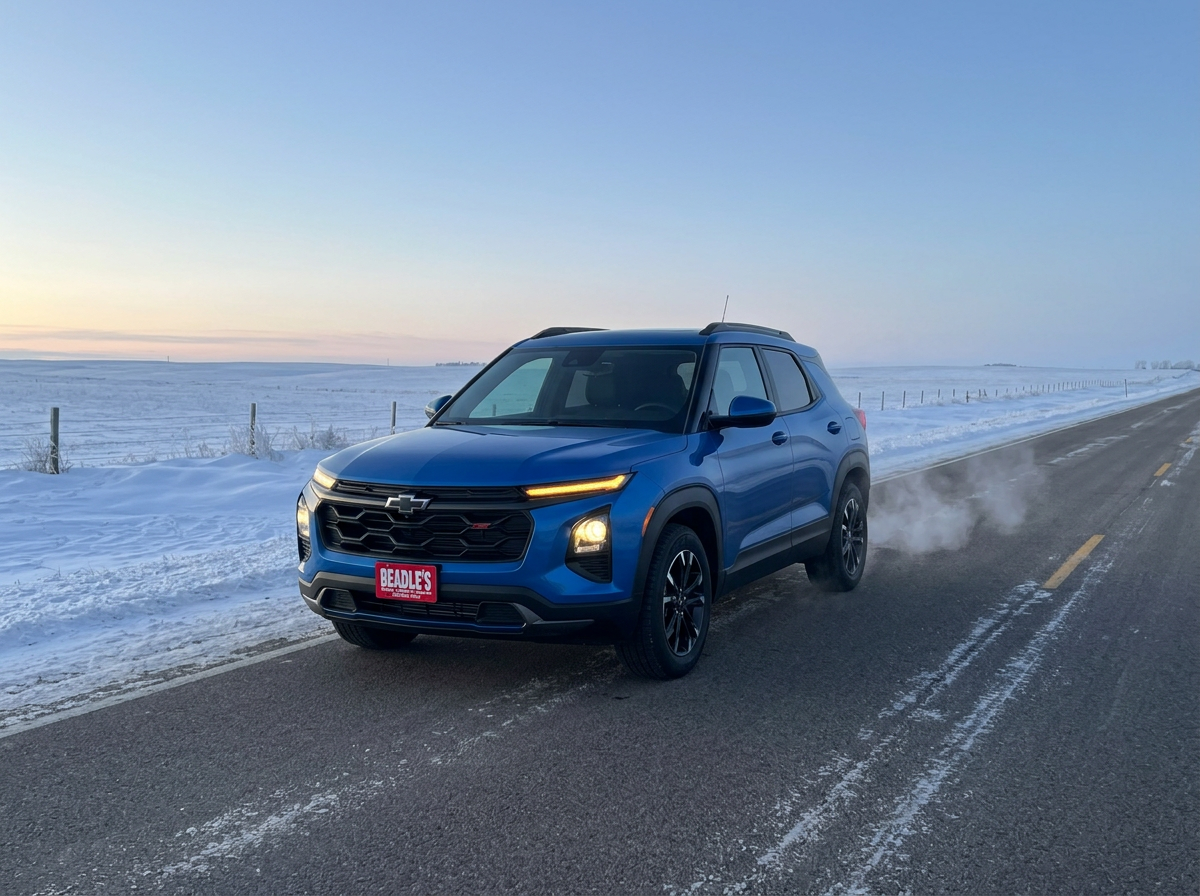
2026 Chevrolet Trailblazer LT AWD driving a plowed, snowy US Highway 12 in South Dakota winter

Trax vs Trailblazer for South Dakota Drivers: The AWD Question Settles It

On paper, the Trax and the Trailblazer look like the same decision at two prices — both are small Chevy SUVs, both seat five, both carry the 11-inch-screen modern cabin. But for drivers in our part of South Dakota, one specification splits them cleanly in two: the Trax cannot be ordered with all-wheel drive. Not as an option, not on any trim. That single fact reorganizes the whole comparison. Here's where the two overlap, where they don't, and how to decide which one belongs in your driveway. Quick Answer The 2026 Trax starts at $21,700 and is front-wheel-drive only; the 2026 Trailblazer starts at $23,300 and offers AWD on every trim (chevrolet.com, July 17, 2026). If your driving includes winter highways or gravel, the Trailblazer's available AWD settles it. For plowed in-town miles, the Trax is a legitimate money-saver. Get Pre-Qualified Search Available Trailblazer Inventory On This Page What's the Real Price Difference Between the Trax and Trailblazer? Why Does AWD Settle the Trax vs Trailblazer Question? How Do the Engines Compare? Which Is More Practical Day to Day? Trax or Trailblazer: Which Should You Buy? What's the Real Price Difference Between the Trax and Trailblazer? Base to base, $1,600: the 2026 Trax LS starts at $21,700 and the Trailblazer LS at $23,300. But line the trim ladders up side by side and the gap nearly vanishes in the middle — a Trax LT starts at $23,200, just $100 under the Trailblazer LS. 2026 Trax Starting MSRP 2026 Trailblazer Starting MSRP LS $21,700 LS $23,300 LT / 1RS $23,200 LT $24,500 2RS / ACTIV $25,400 RS / ACTIV $27,900 Source Starting MSRPs from chevrolet.com, retrieved July 17, 2026, excluding tax, title, license, dealer fees, and optional equipment. Dealer sets final price; confirm current numbers and incentives with us before comparing. The overlap is the point: at several price points you can have either vehicle. Which means the decision isn't really about money — it's about what the Trailblazer's extra hardware is worth to the way you drive. The full Trailblazer payment math lives in our price and payment guide. Why Does AWD Settle the Trax vs Trailblazer Question? Because it's the one difference no option package can close. The 2026 Trax is front-wheel-drive only on every trim; the Trailblazer offers AWD on every trim, making it the least expensive Chevy SUV you can buy with all-wheel drive. And on the Trailblazer, AWD isn't just driven rear wheels — it's a package deal that includes the stronger 155-hp 1.3L Turbo and a 9-speed automatic in place of the CVT. Checking one box upgrades the entire drivetrain. For the between-towns commuter on US-12, the household on a gravel section road, or anyone whose January schedule doesn't bend to weather, that's the configuration that earns its keep — the complete winter case is laid out in our South Dakota winters guide. The honest counterpoint: if your driving is plowed town streets, a front-wheel-drive vehicle on dedicated winter tires handles it well — braking and steering grip come from tires, not drivetrains. In that specific life, the Trax's lower price is a rational win, not a compromise. How Do the Engines Compare? The Trax's only engine — a 137-hp, 162 lb-ft 1.2L Turbo — is the Trailblazer's base engine. The Trailblazer's menu goes a step further with the 155-hp, 174 lb-ft 1.3L Turbo, which is standard on RS, ACTIV, and every AWD build. Fuel economy is close between the front-drivers: the Trax carries an EPA-estimated 30 mpg combined, and the FWD Trailblazer posts 30 combined with the 1.2L or 31 with the 1.3L. The Trailblazer AWD's 27 combined is the price of the winter hardware — a trade most local buyers make without blinking. For highway-heavy drivers, the Trailblazer's available 1.3L is the meaningful upgrade: more torque, delivered at 1,600 rpm, with better passing response on two-lane roads. The Trax simply doesn't offer an engine step-up — what it has is what it is. The full engine breakdown is in our Trailblazer engines guide. Which Is More Practical Day to Day? They're closer than the price gap implies. Both seat five, and maximum cargo is nearly identical — 54 cubic feet in the Trax, 54.4 in the Trailblazer. The practical gaps show up at the edges: the Trax carries no tow rating at all, while the Trailblazer manages 1,000 pounds with the 1.3L Turbo and the available Trailering Package. Body style is the other quiet difference. The Trax wears a lower, longer crossover profile; the Trailblazer is the more upright, traditional SUV shape — easier step-in, a more commanding seating position, and the taller cargo opening that swallows a dog kennel or a stacked feed-store load with less Tetris. For the retiree right-sizing out of a pickup, that step-in height difference matters more than any spec-sheet line. Equipment-wise they're siblings: the 11-inch touchscreen with wireless Apple CarPlay and Android Auto and the Chevy Safety Assist suite are the family standard on both. Nobody picks between these two on technology — you pick on drivetrain, engine, and shape. Trax or Trailblazer: Which Should You Buy? Buy the Trax if your miles are in-town and plowed, and the mission is maximum new-car value at the lowest price. Buy the Trailblazer if winter highways, gravel, or any towing are part of your year — the Trax has no answer for those, at any trim. The Trax is worth it if you're a first-time buyer in town, a student commuting a few plowed miles, or a household adding a cheap-to-run errand car — put the $1,600 you saved into winter tires and it's a thoroughly competent town vehicle. Skip it for the Trailblazer if your address, your job, or your winter says AWD — because that's the one thing no Trax will ever be optioned into, and it's also the gateway to the stronger engine and the 9-speed. The Mistake We See Every January Buying the cheaper front-driver in July and discovering in January that the commute really did need AWD. Drivetrain is the one decision you can't package-add later — be honest about your worst regular week, not your average one, before you sign. And on any specific unit, confirm drivetrain and engine on the window sticker; trim names alone don't tell you. Key Takeaways The 2026 Trax is FWD-only on every trim; the 2026 Trailblazer offers AWD on every trim — the deciding line for most rural South Dakota buyers. Base-to-base gap is $1,600 ($21,700 vs $23,300), but the ladders overlap: a Trax LT is just $100 under a Trailblazer LS. The Trax's only engine is the Trailblazer's base 1.2L (137 hp); the Trailblazer adds the 155-hp 1.3L and, with AWD, a 9-speed automatic. Max cargo is a wash — 54 vs 54.4 cu ft — but the Trax has no tow rating, while the Trailblazer tows 1,000 lbs with the 1.3L and Trailering Package. FWD Trax + dedicated winter tires is a rational town setup; it's the highway-and-gravel life that demands the Trailblazer. Drivetrain can't be added later — buy for your worst regular week, not your average one. Frequently Asked Questions Does the Chevy Trax come with AWD? No. The 2026 Chevy Trax is front-wheel-drive only on every trim. The 2026 Trailblazer is Chevrolet's least expensive SUV with available all-wheel drive, offered on all four of its trims. How much cheaper is the Trax than the Trailblazer? $1,600 at the base — $21,700 versus $23,300 (chevrolet.com, July 17, 2026). Mid-ladder the gap nearly closes: a Trax LT at $23,200 sits just $100 below a Trailblazer LS. Can the Chevy Trax tow? No — the 2026 Trax is not rated to tow. The 2026 Trailblazer is rated for 1,000 pounds when equipped with the 1.3L Turbo and the available Trailering Package. Do the Trax and Trailblazer have the same engine? Partially. The Trax's only engine — a 137-hp 1.2L Turbo — is the Trailblazer's base engine. The Trailblazer also offers a 155-hp 1.3L Turbo, which is standard on RS, ACTIV, and every AWD model, where it pairs with a 9-speed automatic. Which is better for South Dakota winters, the Trax or the Trailblazer? For winter highway commutes and gravel roads, the Trailblazer — its available AWD comes with the 1.3L Turbo and a 9-speed automatic. For plowed in-town driving, a Trax on dedicated winter tires is a capable, budget-friendly setup. Quick Answers Trax starting price? $21,700 MSRP; the Trailblazer starts at $23,300 (chevrolet.com, July 17, 2026). Can any Trax get AWD? No — FWD only, every trim. Cheapest Chevy SUV with AWD? The Trailblazer. Engines? Trax: 137-hp 1.2L only. Trailblazer: 137-hp 1.2L or 155-hp 1.3L. Fuel economy? Trax 30 mpg combined (EPA est.); Trailblazer 30–31 combined FWD, 27 combined AWD. Cargo? Nearly even — 54 cu ft max (Trax) vs 54.4 (Trailblazer). Towing? Trax: not rated to tow. Trailblazer: 1,000 lbs with the 1.3L + Trailering Package. Same tech? Yes — 11-inch touchscreen, wireless CarPlay/Android Auto, and Chevy Safety Assist on both. Bottom line? Town-only driving favors the Trax's price; highways, gravel, or towing favor the Trailblazer. Keep Researching 2026 Chevrolet Trailblazer: The Complete Guide — trims, engines, colors, and packages in one place Trailblazer vs Equinox — the comparison one size up 2026 Trailblazer Price & Payment Guide — MSRPs and realistic monthly payment math Is the Trailblazer Right for South Dakota Winters? — the honest AWD vs FWD breakdown My Take on Trax vs Trailblazer I ask Trax-versus-Trailblazer shoppers at Beadle Chevrolet one question before anything else: describe your road in January. Not your car — your road. If the answer includes a highway number or the word gravel, I walk them straight to the Trailblazer, because no amount of savings feels good the first morning the front tires spin and the schedule doesn't care. But I'll also defend the Trax, because it deserves it: for genuinely in-town lives, it's the best value in the Chevy lineup, and a set of winter tires makes it a perfectly honest four-season town car. The mistake isn't picking either vehicle — it's picking on price when the question was always drivetrain. If the Trailblazer side of the ledger is winning, the whole picture — trims, engines, packages, colors — is in our complete 2026 Chevrolet Trailblazer guide. Or come see both at the store in Mobridge; five minutes of sitting in each usually tells people which one is theirs. Get Pre-Qualified Search Available Trailblazer Inventory Contact Beadle Chevrolet About the Author Lexy Tabbert — Beadle Chevrolet, Mobridge, SD Lexy Tabbert is the Director of Sales and Marketing at Beadle Chevrolet in Mobridge, South Dakota. She covers Chevrolet and GMC vehicles, trim comparisons, and buyer guidance — helping families, ranchers, and ag operators across the region find the right truck and configuration for their needs. Learn more about Lexy.
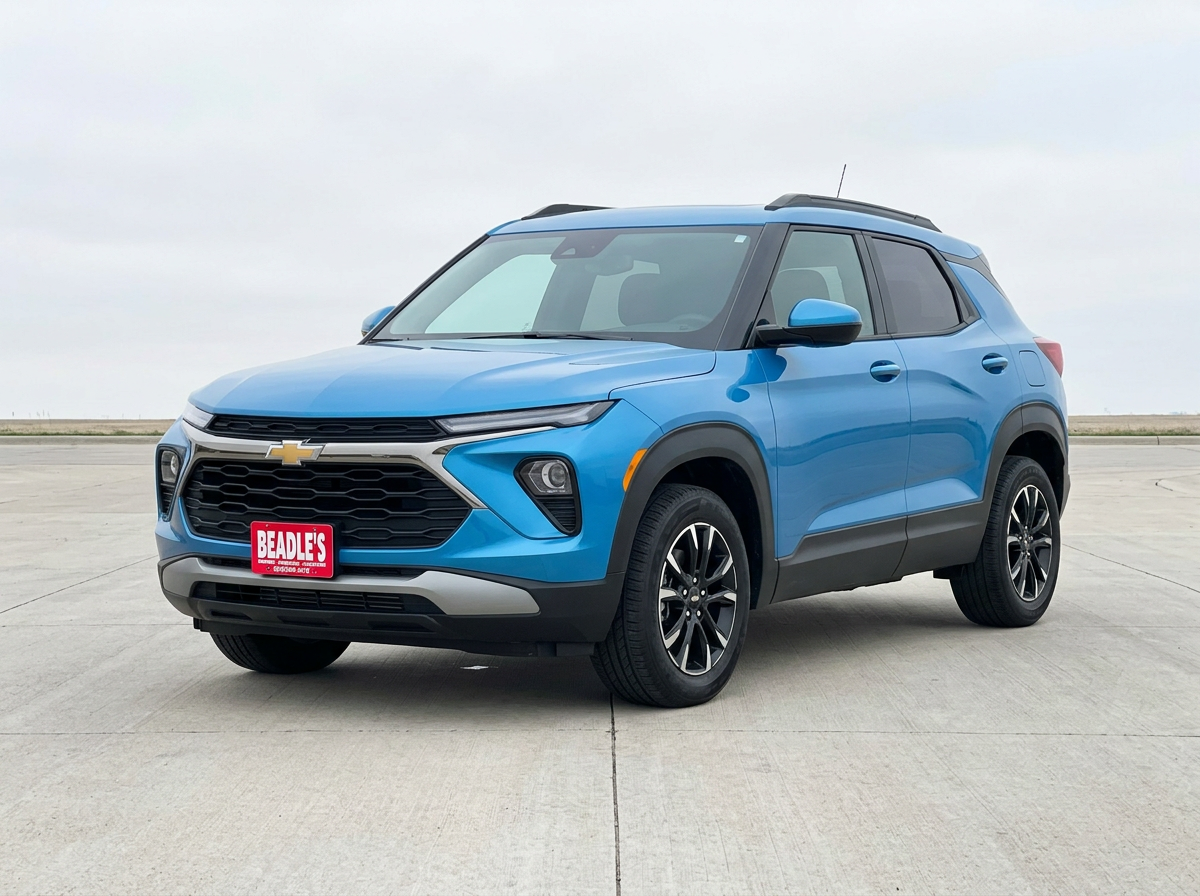
2026 Chevrolet Trailblazer LT in Marina Blue Metallic at Beadle Chevrolet in Mobridge SD

Trailblazer vs Equinox: Which Chevy SUV Fits Your Life?

This is the comparison we host in person more than any other: a family standing between a Trailblazer and an Equinox on our lot, asking which one fits their life. It's a good problem — both are Chevy crossovers, both seat five, both offer AWD — and since we sell both, we have no reason to steer you either way except toward the right answer. Here's the honest breakdown: where the roughly $5,700 price gap comes from, how much bigger the Equinox really is, and which buyers genuinely need that size versus which are paying for room they'll never fold a seat for. Quick Answer The 2026 Trailblazer starts at $23,300 MSRP; the current Equinox starts at $29,000 (chevrolet.com, July 17, 2026). The Equinox is 9 inches longer with 63.5 cu ft of max cargo versus the Trailblazer's 54.4, plus more power and a 1,500-lb tow rating. Both seat five and offer AWD — the question is whether your life uses the extra size. Get Pre-Qualified Search Available Trailblazer Inventory On This Page How Do the Trailblazer and Equinox Compare on Price? How Much Bigger Is the Equinox, Really? Will the Trailblazer Handle a Costco Run — or Do You Need the Equinox? What About Power and Towing? Which Is the Better Buy for a Small Family in Rural South Dakota? How Do the Trailblazer and Equinox Compare on Price? The 2026 Trailblazer starts at $23,300 MSRP and the current Equinox starts at $29,000 (both per chevrolet.com, July 17, 2026, excluding tax, title, license, and dealer fees). That's a $5,700 gap at the entry point — real money on a monthly payment. The gap tightens as you climb trims: a loaded Trailblazer RS or ACTIV at $27,900-plus lands within reach of a base Equinox, which is exactly where the decision gets interesting. At that crossover point you're choosing between a fully equipped small SUV and a lightly equipped bigger one — features versus footprint for similar dollars. For payment shoppers: in the same 72-month, 7.9% APR illustration we use in our Trailblazer price and payment guide, financing $5,700 less saves right at $100 a month. Run your own numbers through the pre-qualification tool before you decide the size question — sometimes the budget decides it for you, and that's a fine way to decide. How Much Bigger Is the Equinox, Really? About 9 inches of length and 9 cubic feet of maximum cargo. Both seat five — the Equinox doesn't add seats, it adds space around them. Measure 2026 Trailblazer Current Equinox Starting MSRP $23,300 $29,000 Length 174.07 in 183.2 in Seating 5 5 Max cargo (seats folded) 54.4 cu ft 63.5 cu ft Engine output 137 hp (1.2L) or 155 hp / 174 lb-ft (1.3L) 175 hp / 203 lb-ft (1.5L Turbo) Max towing 1,000 lbs (1.3L + Trailering Pkg) 1,500 lbs (properly equipped) AWD Available (1.3L + 9-speed) Available The size difference you feel most isn't in the numbers — it's in the parking. The Trailblazer's shorter body and 37.3-foot turning circle make it the easier vehicle on Main Street angle parking, school pickup loops, and tight farmyard turnarounds. The Equinox pays for its room with footprint; whether that trade is good or bad depends entirely on which end of it you live with more. Will the Trailblazer Handle a Costco Run — or Do You Need the Equinox? The Trailblazer handles it. With 25.3 cubic feet behind the rear seat and 54.4 with the 60/40 seat folded, a monthly Aberdeen supply run — coolers, totes, feed sacks, a dog kennel — fits with the family still seated or with one seat section folded. Where the Equinox's 63.5 cubic feet earns its premium is the bulky-object test: the full-size dog crate plus the stroller plus the week's groceries, the furniture pickup, the 4-H fair haul, the family of five whose gear travels with all five seated. If you're regularly folding the Trailblazer's seats for routine errands, that's the signal you're one size too small. The test we suggest: think about your last ten cargo loads, not your biggest-ever one. Most households buy for the once-a-year load and pay for it on the other 364 days. If nine of ten loads fit in 25.3 cubic feet, the Trailblazer is your vehicle and the savings are yours to keep. What About Power and Towing? The Equinox's 1.5L Turbo makes 175 horsepower and 203 lb-ft against the Trailblazer 1.3L's 155 and 174 — and it tows 1,500 pounds properly equipped versus the Trailblazer's 1,000 with the 1.3L and the Trailering Package. Keep both numbers in perspective: neither of these is a towing vehicle by this region's standards. A small fishing boat, a pair of jet skis, or a light utility trailer fits the Equinox's rating; the Trailblazer's 1,000 pounds covers a small utility trailer or a couple of kayaks' worth of gear. Anything with livestock in it, or a real boat for Lake Oahe walleye season, belongs behind a truck — we're happy to have that different conversation when it's the right one. On the highway, the Equinox's extra torque shows up with a full load of passengers; the Trailblazer's 1.3L answers with lighter weight (3,500-to-4,400-pound GVWR class) and low-rpm torque delivery at 1,600 rpm. Solo or two-up — which is how most commuting actually happens — the difference shrinks to nearly nothing. The full engine story is in our Trailblazer engines guide. Which Is the Better Buy for a Small Family in Rural South Dakota? For a household of two to four with typical errand loads, the Trailblazer is the better value — same seating count, same available AWD, $5,700 less at the entry point. The Equinox earns its price when cargo volume, rear-seat stretch room for growing teenagers, or the higher tow rating are weekly realities rather than occasional ones. The Trailblazer is worth it if you're a first-time buyer, a two-car household adding a commuter, or a family whose cargo is groceries and gear rather than furniture and trailers. Skip it for the Equinox if you regularly carry four-plus passengers with their luggage, tow at the top of the small-SUV range, or simply sat in both and needed the extra stretch — that's a legitimate reason too. Either way you're in a Chevy crossover with AWD available for the winters here, so there's no wrong door to walk out of. The Comparison Mistake to Avoid Comparing a base Trailblazer to a base Equinox on price alone. The honest comparison is spec-for-spec: price out both the way you'd actually order them — AWD, cold-weather equipment, your must-have features — and compare those two window stickers. The gap is sometimes bigger than $5,700, sometimes smaller, and the window sticker is the only place the truth lives. Key Takeaways Entry price gap: $23,300 (2026 Trailblazer) vs $29,000 (current Equinox) — $5,700, or right at $100/month in a 72-month illustration. Both seat five; the Equinox is 9 inches longer with 63.5 cu ft max cargo vs the Trailblazer's 54.4. Power: Equinox 175 hp / 203 lb-ft vs Trailblazer 1.3L 155 hp / 174 lb-ft; towing 1,500 vs 1,000 lbs (each properly equipped). The Trailblazer counters with a smaller footprint, a 37.3-ft turning circle, and a lower payment — the practical wins for town parking and tight budgets. Judge by your last ten cargo loads, not your biggest-ever load. Regular seat-folding for errands means you need the Equinox; otherwise the Trailblazer's savings are yours. Spec both the way you'd actually order them and compare window stickers — base-to-base price comparisons mislead. Frequently Asked Questions Is the Chevy Equinox bigger than the Trailblazer? Yes. The current Equinox is 183.2 inches long versus the 2026 Trailblazer's 174.07, and offers 63.5 cubic feet of maximum cargo versus 54.4. Both SUVs seat five — the Equinox adds space, not seats. How much more does the Equinox cost than the Trailblazer? At starting MSRP, $5,700 — the 2026 Trailblazer begins at $23,300 and the current Equinox at $29,000 (chevrolet.com, July 17, 2026). The gap narrows when comparing a loaded Trailblazer against a base Equinox. How much cargo space does the 2026 Trailblazer have? 25.3 cubic feet behind the rear seat and 54.4 cubic feet with the 60/40 rear seat folded — enough for a monthly supply run with the family aboard, or bulkier loads with a seat section down. Can the Trailblazer and Equinox both tow? Lightly, yes. The 2026 Trailblazer is rated for 1,000 pounds with the 1.3L Turbo and the available Trailering Package; the current Equinox is rated for 1,500 pounds properly equipped. Livestock trailers and full-size boats belong behind a truck. Do the Trailblazer and Equinox both offer AWD? Yes, AWD is available on both. On the Trailblazer, choosing AWD also upgrades the powertrain — every AWD build gets the 155-hp 1.3L Turbo with a 9-speed automatic instead of the CVT. Quick Answers Price gap? $5,700 at starting MSRP — $23,300 vs $29,000 (chevrolet.com, July 17, 2026). Size gap? The Equinox is 9 inches longer; both seat five. Cargo? Trailblazer 25.3 / 54.4 cu ft; Equinox 63.5 cu ft max. Power? Trailblazer 1.3L: 155 hp / 174 lb-ft. Equinox 1.5L: 175 hp / 203 lb-ft. Towing? 1,000 lbs (Trailblazer, 1.3L + Trailering Package) vs 1,500 lbs (Equinox, properly equipped). Easier to park? The Trailblazer — shorter body, 37.3-ft turning circle. Best for a couple or small family? The Trailblazer, unless bulky cargo or max towing is a weekly need. Can I see both in one visit? Yes — both are stocked at Beadle Chevrolet in Mobridge; check current Trailblazer inventory before you come in. Keep Researching 2026 Chevrolet Trailblazer: The Complete Guide — trims, engines, colors, and packages in one place Trax vs Trailblazer for South Dakota Drivers — the comparison one size down 2026 Trailblazer Price & Payment Guide — what the $5,700 gap means monthly The Trailblazer ACTIV on Gravel — the small-SUV capability story the Equinox doesn't tell My Take on Trailblazer vs Equinox Since Beadle Chevrolet sells both of these, I win either way — which is exactly why I can be straight with you. When a family is torn, I ask them to do one thing: fold the Trailblazer's back seat, load it with whatever's in their current vehicle's cargo area, and see what happens. Most of the time everything fits with room left over, and the $5,700 question answers itself. The buyers I move up to the Equinox without hesitation are the ones with teenagers approaching six feet, a camper-curious streak that wants the 1,500-pound rating, or a genuine every-week bulky-cargo life. Those aren't edge cases — they're just a different household than the one the Trailblazer was built for. Buying the size you live in, rather than the size you visit once a year, is the whole trick. If you're leaning Trailblazer, the full picture — trims, engines, winter equipment, and colors — is laid out in our complete 2026 Chevrolet Trailblazer guide. And if you'd rather settle it the honest way, come to the lot in Mobridge and park them nose to nose. Ten minutes with both usually beats an hour of reading. Get Pre-Qualified Search Available Trailblazer Inventory Contact Beadle Chevrolet About the Author Lexy Tabbert — Beadle Chevrolet, Mobridge, SD Lexy Tabbert is the Director of Sales and Marketing at Beadle Chevrolet in Mobridge, South Dakota. She covers Chevrolet and GMC vehicles, trim comparisons, and buyer guidance — helping families, ranchers, and ag operators across the region find the right truck and configuration for their needs. Learn more about Lexy.
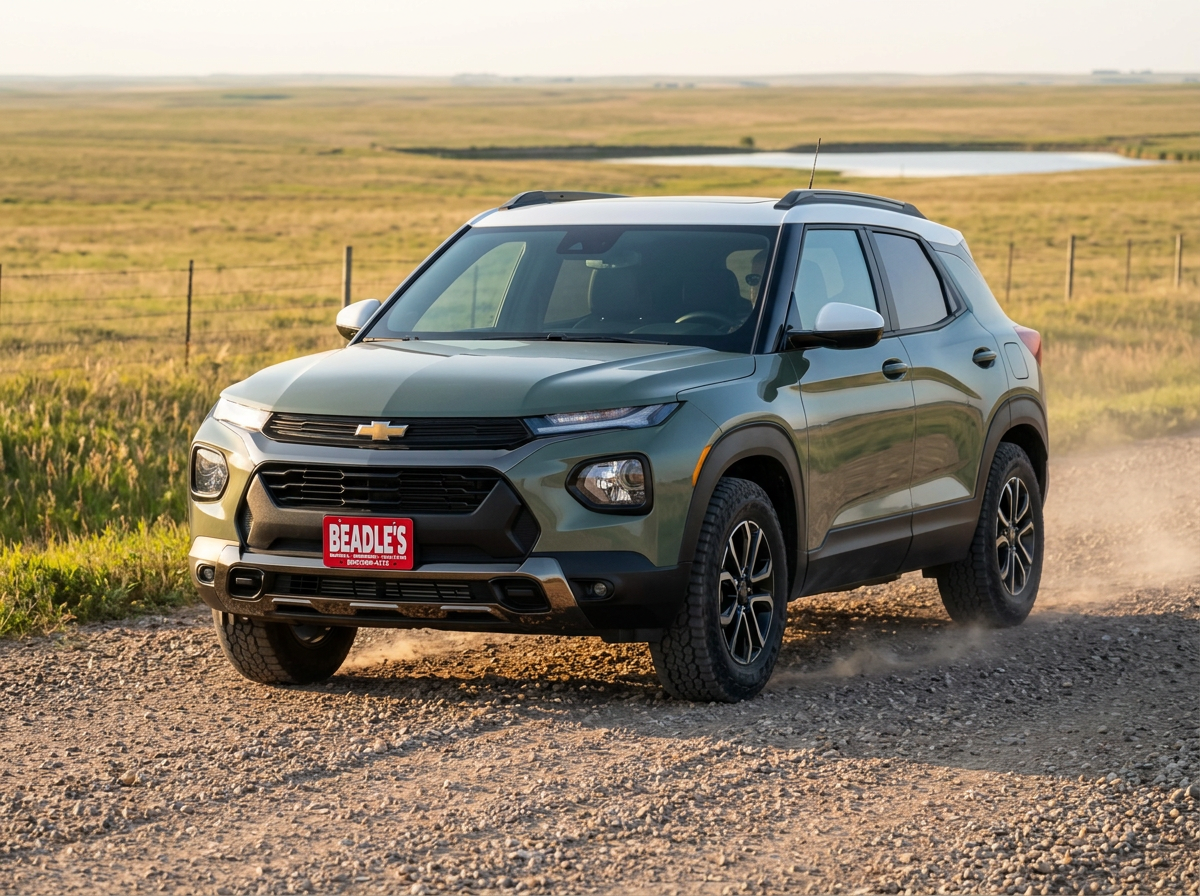
2026 Chevy Trailblazer ACTIV in Cacti Green driving a gravel section road north of Mobridge SD

The Trailblazer ACTIV on Gravel: Built for the Roads Around Mobridge

There's a specific vehicle problem in this part of South Dakota that no city car review ever addresses: the last eight miles. Pavement gets you most of the way home, and then it's washboard gravel, a section-line road, or a rutted two-track down to the lake — every day, all four seasons. Many households solve it by buying a second pickup they don't otherwise need. The 2026 Trailblazer ACTIV is Chevy's answer for exactly that problem: a small SUV with off-road suspension tuning and a functional skid plate as standard equipment, priced thousands below any truck. Here's what the ACTIV actually changes, how it compares to the RS, and who it genuinely fits. Quick Answer The 2026 Trailblazer ACTIV ($27,900 starting MSRP) is the trim built for gravel: standard off-road suspension tuning, a functional front skid plate, and sport terrain tires, with 7.5 inches of minimum ground clearance. It shares its price with the street-styled RS — the difference is what each is tuned to do. Search Available Trailblazer Inventory Get Pre-Qualified On This Page What Makes the Trailblazer ACTIV Different From Other Trims? Trailblazer RS vs ACTIV: What's the Difference? How Does the ACTIV Handle Gravel Section Roads? How Much Ground Clearance Does the Trailblazer Have? Is the ACTIV a Real Off-Road Vehicle? Who Should Buy the ACTIV? What Makes the Trailblazer ACTIV Different From Other Trims? Two pieces of standard hardware no other Trailblazer trim gets: off-road suspension tuning and a functional front skid plate. Add sport terrain tires and the ACTIV is the only Trailblazer configured from the factory for unpaved roads. The rest of the ACTIV package builds on the same equipment as the RS: the 155-horsepower 1.3L Turbo is standard (the ACTIV never gets the 1.2L), heated front seats and a heated steering wheel are standard, remote start is standard, and the interior wears durable Evotex seating with yellow contrast stitching in place of the RS's red. Like every 2026 Trailblazer, it carries the 11-inch touchscreen with wireless Apple CarPlay and Android Auto and the full Chevy Safety Assist suite. It also gets its own visual identity: ACTIV-exclusive two-tone roof options in Summit White or Iridescent Pearl Tricoat, and color availability that leans outdoorsy — Cacti Green with the white roof is the combination people stop to look at on our lot. The full 2026 palette, including which colors each trim can get, is in our Trailblazer colors guide. Trailblazer RS vs ACTIV: What's the Difference? Same $27,900 starting MSRP, same engine, same standard heated equipment — different mission. The RS is tuned for the street with 19-inch wheels and sport styling; the ACTIV trades wheel size for sidewall, suspension compliance, and underbody protection. Feature RS ACTIV Starting MSRP $27,900 $27,900 Suspension Standard tuning Off-road tuning (standard) Skid plate Not offered Functional front skid plate (standard) Wheels/tires 19-inch black machined wheels Sport terrain tires Interior stitching Evotex, red accents Evotex, yellow stitching Two-tone roof options Mosaic Black or Apex Red roof Summit White or Iridescent Pearl roof Turning circle 38.3 ft 37.3 ft The practical read: if your Trailblazer will live on pavement and you want the sharpest look, the RS is the pick. If any part of your daily route is gravel, the ACTIV's taller tire sidewalls and compliant suspension are worth more than the RS's wheel styling — big wheels and washboard are a rough marriage. How Does the ACTIV Handle Gravel Section Roads? This is what the trim was tuned for. The off-road suspension absorbs washboard chatter instead of transmitting it through the cabin, the skid plate takes the hits from kicked-up rock that would otherwise find the underbody, and AWD with the 1.3L Turbo keeps traction consistent on loose surfaces. Anyone who drives section roads knows the specific miseries involved: the washboard stretch that rattles your dash at 40 mph, the fresh-graded soft spots, the baseball-size rock the county grader left mid-lane, and the spring week when everything turns to gumbo. A suspension tuned for compliance and tires with real sidewall are the right tools for all four. The same hardware pays off on lake access roads — the rutted, rain-gullied descents to Lake Oahe boat ramps are harder on low-slung vehicles than most highways ever will be. Gravel in winter is its own subject — snow-packed gravel is the slickest surface most of us drive all year — and the AWD side of that story is covered in our South Dakota winters guide. How Much Ground Clearance Does the Trailblazer Have? 7.5 inches minimum. That's healthy for the small-SUV class and enough for graded gravel, ruts, and modest crowning — while staying well short of pickup territory. For calibration: 7.5 inches clears the center hump on a maintained section road and handles the transitions at approach angles that would scrape a sedan. It does not clear a deep rut cut by spring runoff, a drift the wind rebuilt overnight, or a prairie-dog-town two-track. The skid plate exists precisely because clearance numbers get spent fast on real roads — it's insurance for the day the road wins. Confirm the clearance figure for your specific build on its window sticker or spec sheet, since equipment can affect it. Is the ACTIV a Real Off-Road Vehicle? It's a real gravel-and-two-track vehicle, not a rock crawler. The ACTIV has no low-range gearing, no locking differential, and no recovery-grade underbody armor — and it doesn't pretend to. Its territory is unpaved roads, field approaches, and lake access, driven year-round. We'd rather set that expectation honestly than sell the wrong vehicle. The ACTIV is worth it if your "off-road" is the roads around here that simply aren't paved — section lines, shelterbelt lanes, the last mile to the ramp at Indian Creek. Skip it if you're planning genuine trail wheeling in the Black Hills or need to cross unmaintained pasture in all conditions; that's body-on-frame territory, and we'll point you at the right truck for it instead. Who Should Buy the ACTIV? The ACTIV is built for the household whose address ends in a gravel road: the ranch family that needs a second vehicle for town runs without buying a second truck, the lake regular whose boat lives at the end of a rutted access road, and the hunter who wants one vehicle for the commute and the section-line scouting drive. The ranch-second-vehicle math is the one we walk through most at the store. The Silverado handles the trailer and the feed run; what the household actually needs alongside it is 27 EPA-combined mpg for school and groceries, cargo room for feed-store and Costco loads (25.3 cubic feet behind the rear seat, 54.4 with it folded), Teen Driver controls for the kid who just got a permit, and a vehicle that doesn't flinch at the driveway. That's the ACTIV's whole résumé — and the size-versus-capability trade against the next SUV up is covered in our Trailblazer vs Equinox comparison. The Mistake Gravel-Road Buyers Make Choosing the RS for its looks when the driveway is gravel. The RS's 19-inch wheels mean less tire sidewall between the rim and the washboard, and no skid plate underneath. Same money buys the ACTIV's purpose-built hardware. Match the trim to the road you actually live on, and confirm tires, suspension, and skid plate on the window sticker of the specific unit you're buying. Key Takeaways The ACTIV is the only 2026 Trailblazer with off-road suspension tuning and a functional front skid plate — both standard, not optional. RS and ACTIV share a $27,900 starting MSRP and the 1.3L Turbo; the RS is street-tuned with 19-inch wheels, the ACTIV is gravel-tuned with sport terrain tires. Minimum ground clearance is 7.5 inches — right for section roads, ruts, and lake access; wrong for deep drifts and true off-road trails. Heated front seats, heated steering wheel, and remote start are standard on the ACTIV — the gravel trim is also a winter trim. No low-range, no locking differential: the ACTIV is honest gravel capability, not a rock crawler. Best fit: ranch households needing a truck alternative for town, Lake Oahe regulars, and anyone whose last mile home is never paved. Frequently Asked Questions What does the Trailblazer ACTIV come with for gravel and back roads? Standard off-road suspension tuning, a standard functional front skid plate, and sport terrain tires — equipment no other 2026 Trailblazer trim offers. The 155-hp 1.3L Turbo is also standard, with AWD available. What is the difference between the Trailblazer RS and ACTIV? Both start at $27,900 MSRP with the 1.3L Turbo and heated front seats. The RS is street-styled with 19-inch wheels, red interior accents, and black or Apex Red roof options. The ACTIV adds off-road suspension tuning, a functional skid plate, sport terrain tires, yellow interior stitching, and Summit White or Iridescent Pearl roof options. How much ground clearance does the 2026 Trailblazer have? 7.5 inches minimum — enough for graded gravel roads, ruts, and lake access roads, but not for deep snow drifts or unmaintained trails. Confirm the figure for your specific build, since equipment can affect it. Is the Trailblazer ACTIV good off-road? For gravel roads, field approaches, and two-tracks, yes — that is what its suspension, skid plate, and tires are built for. It has no low-range gearing or locking differential, so genuine trail wheeling and rock crawling are outside its mission. Does the Trailblazer ACTIV cost more than the RS? No — both trims start at $27,900 MSRP for 2026 (chevrolet.com, July 17, 2026). You choose by mission, not budget: street styling on the RS versus gravel hardware on the ACTIV. Quick Answers What's standard on the ACTIV that no other trim gets? Off-road suspension tuning, a functional front skid plate, and sport terrain tires. ACTIV starting price? $27,900 MSRP — identical to the RS (chevrolet.com, July 17, 2026). Which engine? The 155-hp 1.3L Turbo is standard; the ACTIV never gets the 1.2L. Ground clearance? 7.5 inches minimum. Is AWD standard on the ACTIV? AWD is available on the ACTIV — and every AWD build pairs the 1.3L with a 9-speed automatic. ACTIV two-tone roofs? Summit White or Iridescent Pearl Tricoat. Winter equipment? Heated front seats, heated steering wheel, and remote start are all standard. Cargo room for feed-store runs? 25.3 cu ft behind the rear seat; 54.4 cu ft with it folded. Can it replace a ranch truck? No — it replaces the errand miles you're currently putting on one. Keep Researching 2026 Chevrolet Trailblazer: The Complete Guide — all four trims, engines, and packages side by side Is the Trailblazer Right for South Dakota Winters? — snow-packed gravel and the AWD decision Trailblazer vs Equinox — when the bigger SUV is worth the step up My Take on the Trailblazer ACTIV The ACTIV is the Trailblazer I find myself recommending with the most conviction, because it solves a problem I watch households around Mobridge wrestle with constantly: everything here eventually involves gravel, and most vehicles are built as if it doesn't exist. A trim that takes washboard seriously — suspension, skid plate, tires, from the factory — isn't a style package. Out here it's a practical answer. My advice if you're deciding: drive your actual road, not just US-12. Take one out to the section line or down a lake access road — we're happy to send you that way, because that's where the difference between the ACTIV and everything else in this class stops being a spec-sheet line and becomes something you can feel through the seat. To see how the ACTIV fits into the rest of the lineup — pricing, engines, colors, and the other three trims — start with our complete 2026 Chevrolet Trailblazer guide, or stop by the store in Mobridge and we'll put one on gravel for you. Search Available Trailblazer Inventory Get Pre-Qualified Contact Beadle Chevrolet About the Author Lexy Tabbert — Beadle Chevrolet, Mobridge, SD Lexy Tabbert is the Director of Sales and Marketing at Beadle Chevrolet in Mobridge, South Dakota. She covers Chevrolet and GMC vehicles, trim comparisons, and buyer guidance — helping families, ranchers, and ag operators across the region find the right truck and configuration for their needs. Learn more about Lexy.
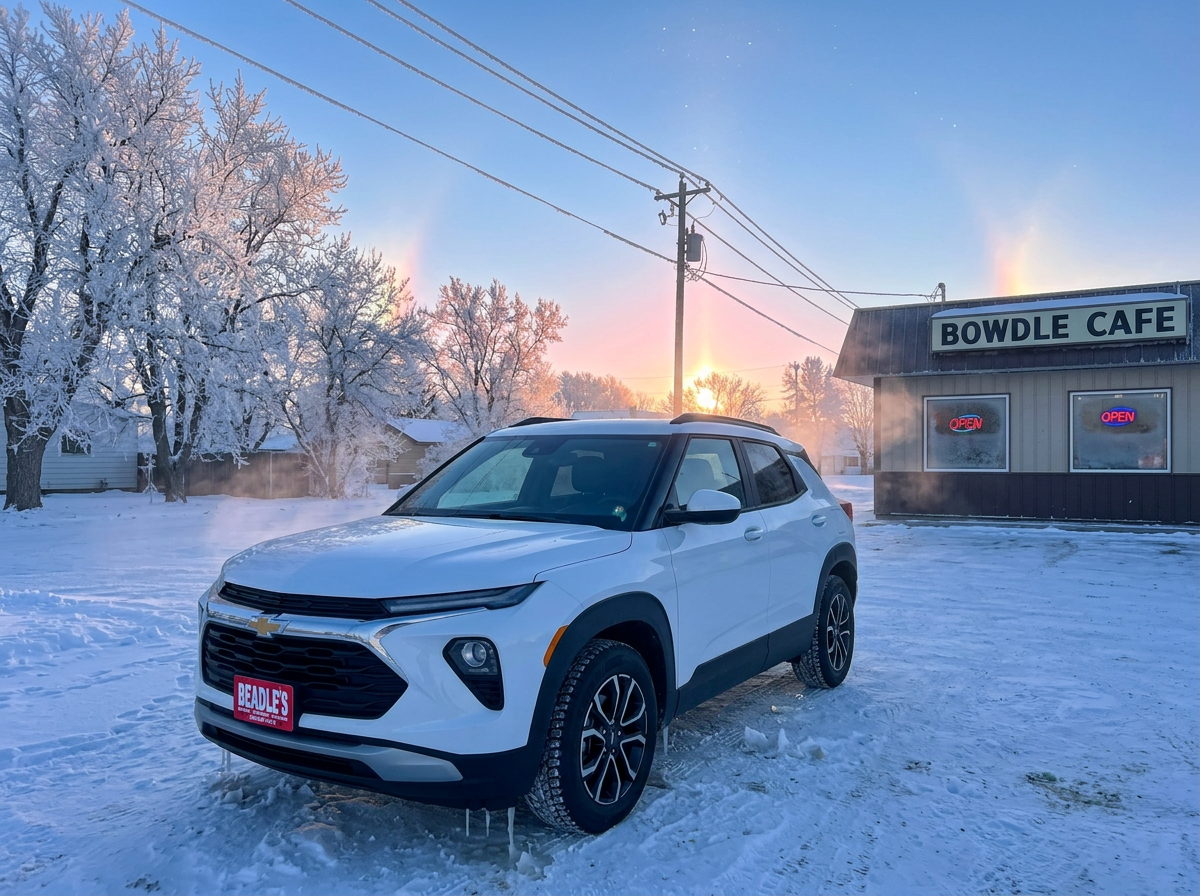
2026 Chevrolet Trailblazer LS in Summit White parked in town on a minus 20 degree South Dakota morning

Trailblazer Engines Explained: 1.2L vs 1.3L Turbo (and Why AWD Gets the 9-Speed)

"A three-cylinder? On the highway? Out here?" We hear it weekly at the store, usually from someone whose last vehicle had twice the cylinders. It's a fair question in a region where the nearest big-box store is a 200-mile round trip — and the answer is more interesting than the cylinder count suggests. The 2026 Trailblazer offers two turbocharged engines, and which one you get is partly decided for you by the trim and drivetrain you pick. Here's how the 1.2L and 1.3L Turbo differ, what each really returns at the pump, and why every AWD Trailblazer skips the CVT for a 9-speed automatic. Quick Answer The 2026 Trailblazer offers a 137-hp 1.2L Turbo (FWD only, LS and LT) and a 155-hp 1.3L Turbo (standard on RS, ACTIV, and every AWD build). FWD models use a CVT; AWD models always get the 1.3L with a 9-speed automatic. EPA estimates range from 31 mpg combined (1.3L FWD) to 27 combined (AWD). Search Available Trailblazer Inventory Get Pre-Qualified On This Page What's the Difference Between the 1.2L and 1.3L Turbo? Which Trims and Drivetrains Get Which Engine? Is a 3-Cylinder Engine Enough for 70-MPH Highway Trips? What Gas Mileage Does the 2026 Trailblazer Really Get? Does the Trailblazer Take Regular Gas? Is It E85 Compatible? Which Engine Should You Choose? What's the Difference Between the 1.2L and 1.3L Turbo? Both are turbocharged three-cylinders from the same ECOTEC family; the 1.3L makes 18 more horsepower, 12 more lb-ft of torque, and delivers that torque earlier in the rev range — 1,600 rpm versus 2,500. Spec 1.2L Turbo 1.3L Turbo Horsepower 137 @ 5,000 rpm 155 @ 5,600 rpm Torque 162 lb-ft @ 2,500 rpm 174 lb-ft @ 1,600 rpm Drivetrain FWD only FWD or AWD Transmission CVT CVT (FWD) / 9-speed automatic (AWD) Trims LS, LT Optional LS/LT (FWD); standard RS, ACTIV, all AWD Towing eligibility Not offered 1,000 lbs with available Trailering Package The torque delivery is the difference you feel. Peak torque at 1,600 rpm means the 1.3L pulls from just above idle — the engine is already working in its strong zone when you roll onto the throttle to pass a grain truck, without waiting for a downshift and a climb up the rev band. Which Trims and Drivetrains Get Which Engine? Three rules cover every 2026 Trailblazer: the 1.2L is only sold on front-wheel-drive LS and LT models; the RS and ACTIV are 1.3L-only; and every all-wheel-drive build — any trim — is the 1.3L with the 9-speed automatic. That last rule does a lot of quiet work. Checking the AWD box doesn't just add driven wheels — it upgrades the engine and swaps the CVT for a conventional 9-speed in the same stroke. It's why we tell winter-focused buyers that the AWD decision settles the engine question automatically; there is no such thing as a 1.2L AWD Trailblazer. The winter side of that story is covered in our South Dakota winters guide. Two more order-sheet consequences worth knowing: the available Trailering Package requires the 1.3L on any trim (there's no factory tow rating for the 1.2L at all), and the LT's panoramic sunroof also requires the 1.3L. If either is on your list, your engine is chosen. Is a 3-Cylinder Engine Enough for 70-MPH Highway Trips? For the 1.3L Turbo, yes — it cruises at South Dakota highway speeds without strain, and its low-rpm torque handles passing and headwinds better than the cylinder count implies. The 1.2L is adequate for lighter duty but is the engine we'd match to town-focused driving, not a weekly Aberdeen run. Here's the context the spec sheet doesn't give you: turbocharging changes what "small engine" means. A turbo three-cylinder isn't a downsized engine working hard; at cruise it's a small engine loafing, and when you need power the turbo supplies the airflow a bigger engine would get from displacement. The 1.3L's 174 lb-ft arrives at 1,600 rpm — for comparison, that's more torque, delivered earlier, than many of the four-cylinder compacts this region commuted in for decades. The honest trade-offs: with four adults and a loaded cargo area, the 1.2L will feel the weight on grades, and both engines ask you to plan two-lane passes with the same judgment any compact SUV demands. A 20-mph prairie crosswind costs some fuel economy in any vehicle this size. What you won't find is the buzzy, strained character older small engines had — Mobridge-to-Pierre in a 1.3L AWD Trailblazer is a relaxed 90 minutes. What Gas Mileage Does the 2026 Trailblazer Really Get? EPA estimates for the 2026 Trailblazer: 30 city / 31 highway / 30 combined for the 1.2L FWD, 29 / 33 / 31 for the 1.3L FWD, and 26 / 29 / 27 for the 1.3L AWD. Configuration EPA City / Hwy / Combined Tank Range (13.2 gal × combined) 1.2L Turbo FWD (CVT) 30 / 31 / 30 mpg 396 miles 1.3L Turbo FWD (CVT) 29 / 33 / 31 mpg 409 miles 1.3L Turbo AWD (9-speed) 26 / 29 / 27 mpg 356 miles Source EPA-estimated figures as published for the 2026 model year, retrieved July 17, 2026. Your mileage will vary with speed, wind, temperature, and load — winter cold and prairie headwinds both cut real-world economy in every vehicle. Range figures are straight math (13.2-gallon tank × combined mpg), not a promise. What the numbers mean here: a 1.3L FWD Trailblazer makes the Mobridge–Aberdeen round trip (roughly 200 miles) on half a tank. Note the interesting wrinkle — the bigger 1.3L is also the more efficient engine on the highway cycle, 33 mpg versus 31. Between its stronger passing power and better highway economy, the 1.3L is simply the better long-distance engine, which is exactly the duty this region assigns. Does the Trailblazer Take Regular Gas? Is It E85 Compatible? Both engines run on regular unleaded — no premium requirement — and the 1.2L Turbo is additionally E85 flex-fuel compatible. The 1.3L is not an E85 engine. In corn country, E85 capability occasionally matters at the pump: when the spread between E85 and regular is wide, flex-fuel owners have a cheaper option, with the trade-off that ethanol carries less energy per gallon and cuts mpg accordingly. Do the cents-per-mile math before assuming E85 is the bargain. As always, confirm the fuel requirements printed inside the fuel door and in the owner's manual of your specific vehicle before filling with anything other than regular unleaded. Which Engine Should You Choose? If you're buying AWD, the choice is made: 1.3L, 9-speed, done. If you're buying FWD, choose by your longest regular trip, not your average one. The 1.2L is worth it if the vehicle lives in town — school runs, groceries, the occasional Selby trip — and you want the lowest cost of entry with E85 flexibility. Skip it if your calendar includes regular highway hauls, four-up travel, any towing, or the sunroof, because all of those point to the 1.3L. The 1.3L is worth it for almost everyone else: highway commuters get better passing response and better highway mpg, and it's the only path to the Trailering Package's 1,000-lb rating. The Spec-Sheet Mistake to Avoid Assuming every FWD Trailblazer on a lot has the same engine. FWD LS and LT units can carry either the 1.2L or the 1.3L, and they look identical from the outside. Check the window sticker for the engine line on any specific unit — especially if towing eligibility or the sunroof matters to you. Key Takeaways Two turbo three-cylinders: 1.2L (137 hp, 162 lb-ft @ 2,500 rpm) and 1.3L (155 hp, 174 lb-ft @ 1,600 rpm). The 1.2L is FWD-only on LS and LT. The RS, ACTIV, and every AWD build run the 1.3L — and AWD always pairs it with a 9-speed automatic, not a CVT. EPA estimates: 30/31/30 (1.2L FWD), 29/33/31 (1.3L FWD), 26/29/27 (1.3L AWD) — the 1.3L is both the stronger and the more efficient highway engine. Towing requires the 1.3L: 1,000 lbs with the available Trailering Package. There is no tow rating for the 1.2L. Both engines take regular unleaded; only the 1.2L is E85 flex-fuel compatible. Tank-range math on the 13.2-gallon tank: 396–409 miles FWD, 356 miles AWD at EPA combined figures. Frequently Asked Questions What engines does the 2026 Chevy Trailblazer have? Two turbocharged three-cylinders: a 137-horsepower 1.2L Turbo with 162 lb-ft of torque (FWD only, LS and LT), and a 155-horsepower 1.3L Turbo with 174 lb-ft (available on LS and LT, standard on RS, ACTIV, and every AWD model). What gas mileage does the 2026 Trailblazer get? EPA estimates are 30 city / 31 highway / 30 combined for the 1.2L FWD, 29 / 33 / 31 for the 1.3L FWD, and 26 / 29 / 27 for the 1.3L AWD. Real-world results vary with wind, cold, speed, and load. Is the Trailblazer's 3-cylinder engine strong enough for highway driving? The 1.3L Turbo is — it cruises comfortably at 70-plus mph and its 174 lb-ft of torque at 1,600 rpm gives it usable passing power for two-lane highways. The 1.2L is better matched to in-town driving than to regular long-distance highway trips. Does the Trailblazer take regular gas or E85? Both engines run on regular unleaded gasoline. The 1.2L Turbo is also E85 flex-fuel compatible; the 1.3L is not. Confirm fuel requirements on the fuel door and in the owner's manual of your specific vehicle. Can the Trailblazer tow with the 1.2L engine? No. The available Trailering Package requires the 1.3L Turbo, and Chevrolet publishes no tow rating for 1.2L models. Properly equipped with the 1.3L and the Trailering Package, the 2026 Trailblazer is rated for 1,000 pounds. Quick Answers How much horsepower does the 1.2L make? 137 hp at 5,000 rpm with 162 lb-ft at 2,500 rpm. How much does the 1.3L make? 155 hp at 5,600 rpm with 174 lb-ft at 1,600 rpm. Can you get the 1.2L with AWD? No — AWD is always the 1.3L with the 9-speed automatic. Which builds use the CVT? Front-wheel-drive models only, with either engine. Best mpg configuration? The 1.3L FWD at 29/33/31 EPA — it beats the smaller 1.2L on the highway. AWD mpg? 26/29/27 EPA. Fuel tank size? 13.2 gallons — 356 to 409 miles of range at EPA combined figures, depending on configuration. Which engine allows towing? Only the 1.3L — 1,000 lbs with the available Trailering Package. Premium fuel needed? No — regular unleaded for both engines; the 1.2L also accepts E85. Keep Researching 2026 Chevrolet Trailblazer: The Complete Guide — the full trim, engine, and package picture Is the Trailblazer Right for South Dakota Winters? — where the AWD/9-speed combination earns its keep 2026 Trailblazer LS vs LT — how engine choice interacts with trim and packages My Take on the Trailblazer's Engines The cylinder-count conversation is my favorite one to have at Beadle Chevrolet, because it usually ends with a test drive and a surprised passenger. People expect a three-cylinder to feel like a concession. Then they merge onto US-12, the 1.3L pulls from 1,600 rpm without drama, and the objection quietly retires itself somewhere before the city limits. My practical advice: buy the 1.3L unless your driving is genuinely in-town. The highway economy is better, the passing power is better, and it keeps the Trailering Package and sunroof on the table. And if you're buying AWD for winter — which most of our Trailblazer customers are — the decision is already made for you, in your favor. Engines are one chapter of the story; the rest — trims, colors, packages, and pricing — lives in our complete 2026 Chevrolet Trailblazer guide. Better yet, come drive both engines back-to-back in Mobridge and let the highway settle it. Search Available Trailblazer Inventory Get Pre-Qualified Contact Beadle Chevrolet About the Author Lexy Tabbert — Beadle Chevrolet, Mobridge, SD Lexy Tabbert is the Director of Sales and Marketing at Beadle Chevrolet in Mobridge, South Dakota. She covers Chevrolet and GMC vehicles, trim comparisons, and buyer guidance — helping families, ranchers, and ag operators across the region find the right truck and configuration for their needs. Learn more about Lexy.
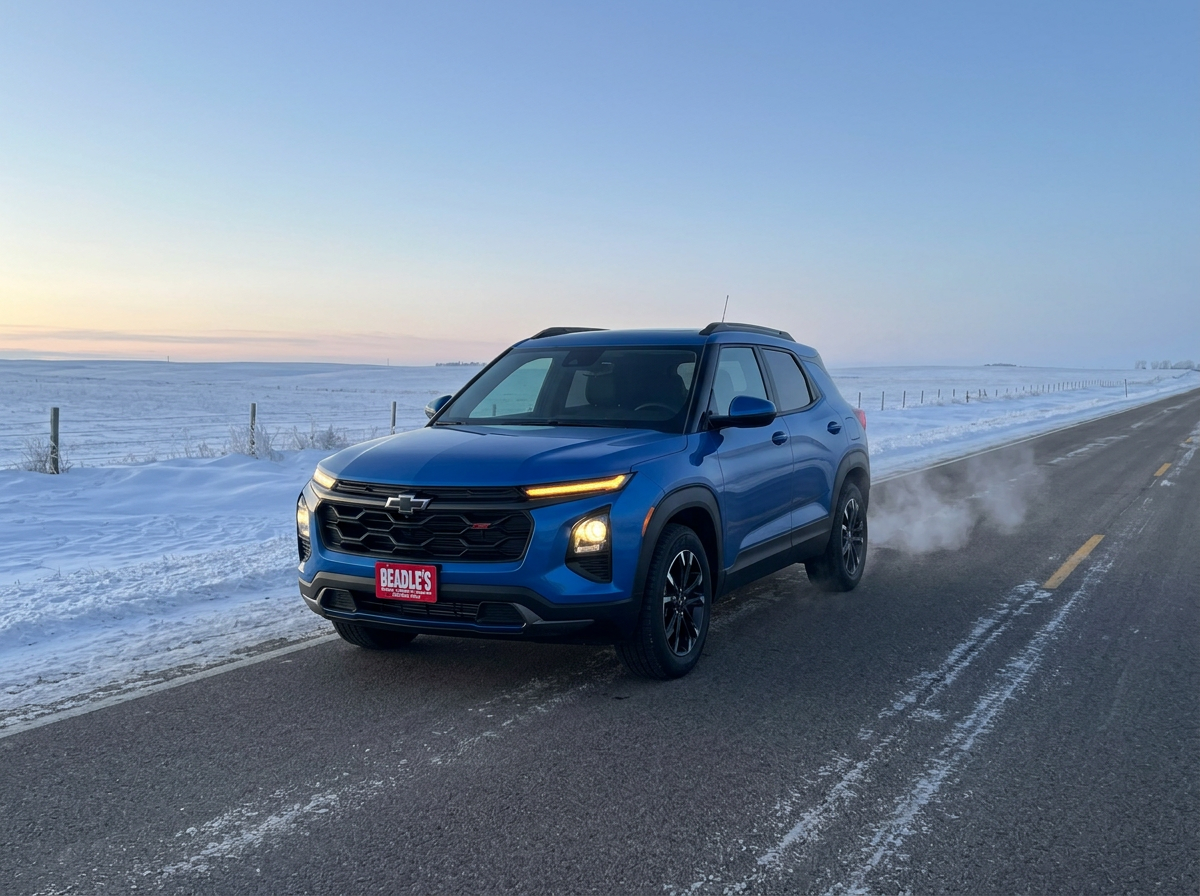
2026 Chevrolet Trailblazer LT AWD driving a plowed, snowy US Highway 12 in South Dakota winter

Is the 2026 Trailblazer Right for South Dakota Winters? AWD, FWD & the Honest Answer

Here's the question behind the question. Nobody in this part of South Dakota actually asks "is the Trailblazer good in snow?" out of curiosity. They ask because they have to be at work in the next town at 7 AM in January, and they're deciding whether a small SUV can be trusted with that job — or whether they need to spend more on something bigger. This is the honest version of that conversation: what the 2026 Trailblazer's AWD actually does, when front-wheel drive with winter tires is the smarter buy, and when neither is the right answer and you should be looking at a bigger vehicle instead. Quick Answer Yes — a 2026 Trailblazer AWD with the Cold Weather Package handles a typical South Dakota winter commute well. Every AWD build pairs the 155-hp 1.3L Turbo with a 9-speed automatic (no CVT), and a block heater is available on every trim. For in-town driving, FWD plus winter tires is the budget-smart alternative. Search Available Trailblazer Inventory Get Pre-Qualified On This Page Is the Chevy Trailblazer Good in Snow? Trailblazer AWD vs FWD: Is AWD Worth It in South Dakota? Does the Trailblazer AWD Have a CVT? Which Cold-Weather Features Should You Order? Will the Trailblazer Handle -20°F Mornings? When Should You Get Something Bigger Instead? Is the Chevy Trailblazer Good in Snow? With AWD and decent tires, yes — the Trailblazer is a capable winter commuter for plowed highways and maintained gravel. It isn't a drift-buster, and no vehicle in this size class is, but for the driving most people around Mobridge actually do in winter, it's fully capable of the job. Three things work in its favor. First, the AWD system adds traction where a front-driver spins — pulling away from a snow-packed stop sign, climbing the grade out of the Missouri River valley, merging onto US-12 before the sanding trucks have been through. Second, every AWD Trailblazer carries the stronger 1.3L Turbo, whose 174 lb-ft of torque arrives at just 1,600 rpm — low-end pull that lets you accelerate gently and predictably on slick surfaces instead of flogging the engine. Third, the standard safety suite earns its keep in winter specifically: Forward Collision Alert and automatic emergency braking are watching in exactly the low-visibility, deer-at-dawn conditions where a Highway 12 commuter needs them. The honest limitation is physics: this is a 3,500-to-4,400-pound-class vehicle with 7.5 inches of minimum ground clearance. On a plowed road that's irrelevant. In an unplowed farmyard after a ground blizzard, it's the number that decides whether you're driving or shoveling. Trailblazer AWD vs FWD: Is AWD Worth It in South Dakota? If you commute between towns in winter, AWD is worth it — full stop. If your driving is in-town errands on plowed streets, a front-wheel-drive Trailblazer wearing dedicated winter tires is the honest budget answer, and it will out-brake and out-corner an AWD model on all-seasons. Your Winter Looks Like... Smarter Buy Why Daily highway commute between towns (US-12, SD-20) AWD Traction for merging, passing, and crosswind-drifted lanes; 1.3L + 9-speed standard with it Gravel section roads or a rural driveway AWD Snow-packed gravel is the lowest-grip surface most of us drive on all year In-town driving on plowed streets, tight budget FWD + winter tires Winter tires improve braking and steering — the two things AWD doesn't help with Mixed: town all week, occasional Aberdeen or Pierre trip AWD, or FWD + winter tires Either works — decide by budget and how flexible your travel days are Put simply: AWD is worth it if your winter includes highways, gravel, or a schedule that can't flex around weather. Skip it if you drive plowed town streets and would rather put the difference into dedicated winter tires — that's not settling, that's optimizing. The Winter-Driving Mistake to Avoid Treating AWD as a substitute for tires. AWD helps you accelerate; it does nothing extra when you brake or steer, because all four wheels brake on every car. The overconfident AWD-on-worn-all-seasons driver is the one we see in the ditch on Highway 12 — not the careful FWD driver on winter rubber. Whatever drivetrain you pick, budget for tires with real tread. Does the Trailblazer AWD Have a CVT? No. Every all-wheel-drive 2026 Trailblazer uses a conventional 9-speed automatic transmission. The CVT exists only on front-wheel-drive builds. This surprises a lot of shoppers, and it defuses the most common durability objection we hear about small SUVs. If you've been avoiding the Trailblazer because a friend warned you off CVTs, the configuration you'd actually buy for South Dakota winters — AWD — doesn't have one. The AWD driveline is always the 155-horsepower 1.3L Turbo paired with the 9-speed; that pairing is fixed, not optional. The full breakdown of both engines, including real-world highway manners, is in our Trailblazer engines guide. Which Cold-Weather Features Should You Order? Three items, in priority order: remote start, heated front seats with the heated steering wheel, and the engine block heater. On the LT that means the Cold Weather Package; on the RS and ACTIV the heated equipment is already standard. Remote start is standard on LT and above and available by package on the LS. The Cold Weather Package (heated front seats plus heated steering wheel) is an LT option — the LS can't be ordered with heated seats at all, which is worth knowing before you fall in love with the base price. Trim-by-trim access to all of this equipment is mapped out in our LS vs LT comparison. The block heater is the cheap, unglamorous option people forget until the first -20°F stretch. It's available on every 2026 Trailblazer trim, and if your vehicle sleeps outside — rural driveway, apartment lot, hospital night shift — order it. Plugged in overnight, the engine starts easier, warms faster, and reaches operating temperature sooner, which matters for both the driveline and your defroster. Will the Trailblazer Handle -20°F Mornings? Yes — modern fuel injection, synthetic oil, and a healthy battery start vehicles at -20°F routinely, and the Trailblazer's available block heater stacks the deck further in your favor. The practical -20°F routine looks like this: block heater plugged in on a timer for the two or three hours before you leave, remote start five to ten minutes before you walk out, and a battery that gets tested every fall — extreme cold cuts battery cranking power sharply, and a battery that was marginal in October is dead in January. Our service department tests batteries as part of routine service, and that five-minute check prevents most of the no-start calls we get each winter. One more habit worth keeping from your grandfather's era: keep the fuel tank above half in deep cold, and keep a winter kit in the cargo area — blanket, flashlight, phone charger, tow strap. The Trailblazer's 25.3 cubic feet behind the rear seat swallows a winter kit without noticing it's there. Between towns out here, that's not paranoia; it's protocol. When Should You Get Something Bigger Instead? Get something bigger if your winter regularly includes unplowed roads, deep drifts, or towing. The Trailblazer's 7.5 inches of minimum ground clearance and 1,000-pound towing rating (with the 1.3L Turbo and the available Trailering Package) are honest small-SUV numbers — they are not ranch-truck numbers. The Trailblazer is enough if you drive maintained roads — plowed highways, graded gravel, town streets — and your cargo is people, groceries, and gear. That describes the teacher commuting Selby to Mobridge, the nurse on shift work, and the household's second vehicle that handles school runs while the pickup does the heavy work. It's not enough if you're crossing unmaintained section lines in February, breaking trail to stock tanks, or pulling a livestock trailer — that's Equinox-and-up territory at minimum, and realistically a truck job. If you're on the fence about size, our Trailblazer vs Equinox comparison walks the size question through honestly. What Most Buyers Overlook The vehicle that gets you through winter is the one you can afford to keep in good tires, fresh wiper blades, and a strong battery. A well-maintained Trailblazer AWD beats a neglected three-quarter-ton every time. Confirm the drivetrain, engine, and cold-weather equipment on the window sticker of any specific unit — FWD and AWD Trailblazers look identical from the outside. Key Takeaways The Trailblazer AWD is a legitimate South Dakota winter commuter for plowed highways and maintained gravel — with the right tires under it. Every AWD build gets the 155-hp 1.3L Turbo and a 9-speed automatic. There is no AWD CVT — the CVT is front-wheel-drive only. AWD helps you accelerate; it doesn't help you brake or steer. FWD plus dedicated winter tires is the smarter buy for in-town drivers on a budget. Order the Cold Weather Package on the LT (heated seats and steering wheel aren't offered on the LS) and add the block heater — it's available on every trim. Know the limits: 7.5 inches of minimum ground clearance and a 1,000-lb tow rating (1.3L with the Trailering Package). Drifted section lines and trailers are a bigger vehicle's job. Test the battery every fall and keep a winter kit in the 25.3 cu ft cargo area — between-towns driving here demands it. Frequently Asked Questions Is the Chevy Trailblazer good in snow? With all-wheel drive and good tires, yes. The 2026 Trailblazer AWD handles plowed highways and maintained gravel roads well, helped by the 1.3L Turbo's low-rpm torque and the standard Chevy Safety Assist suite. Its 7.5 inches of ground clearance means deep drifts and unplowed roads remain a bigger vehicle's job. Does the Trailblazer AWD have a CVT? No. Every all-wheel-drive 2026 Trailblazer pairs the 155-horsepower 1.3L Turbo with a conventional 9-speed automatic transmission. The CVT is used only on front-wheel-drive models. Is AWD worth it on a Trailblazer in South Dakota? If you commute between towns or drive gravel in winter, yes. If you drive mostly plowed in-town streets, a front-wheel-drive Trailblazer with dedicated winter tires is the more budget-effective choice — winter tires improve braking and steering, which AWD does not. Will a Trailblazer start at -20 degrees? Yes, provided the battery is healthy. An engine block heater is available on every 2026 Trailblazer trim and is worth ordering for any vehicle that parks outside — plugged in overnight, it makes deep-cold starts easier and warms the cabin faster. Have the battery tested each fall. Do I still need winter tires if I buy the AWD Trailblazer? For the best winter performance, yes. AWD improves acceleration on slick surfaces, but braking and cornering grip come entirely from the tires. AWD with quality winter or aggressive all-weather tires is the strongest combination for South Dakota conditions. Quick Answers Is the Trailblazer good in snow? Yes with AWD and good tires — it's built for plowed highways and maintained gravel, not deep drifts. What transmission does the AWD use? A 9-speed automatic — never a CVT. What engine comes with AWD? Always the 155-hp 1.3L Turbo with 174 lb-ft at 1,600 rpm. Is FWD ever the smarter buy? Yes — for in-town driving, FWD plus dedicated winter tires beats AWD on all-seasons for braking and steering. Which trims get heated seats? Standard on RS and ACTIV; Cold Weather Package on LT; not offered on LS. Is a block heater available? Yes, on every 2026 trim — order it if the vehicle sleeps outside. How much ground clearance? 7.5 inches minimum — fine for maintained roads, not for breaking trail. Can it tow in winter? Its rating is 1,000 lbs with the 1.3L Turbo and the available Trailering Package — light trailers only; livestock and equipment are truck work. Deer at dawn — does the tech help? Forward Collision Alert, automatic emergency braking, and IntelliBeam high beams are standard on every trim. Keep Researching 2026 Chevrolet Trailblazer: The Complete Guide — trims, engines, packages, and winter equipment in one place Trailblazer Engines Explained: 1.2L vs 1.3L Turbo — why AWD always gets the stronger engine The Trailblazer ACTIV on Gravel — the trim built for section roads and lake access 2026 Trailblazer LS vs LT — which trim unlocks the cold-weather equipment My Take on the Trailblazer as a Winter Vehicle I sell vehicles in a town where winter is a character reference, so I won't oversell this one: the Trailblazer is not a blizzard vehicle. Nothing its size is. What it is — configured as an AWD LT with the Cold Weather Package — is a thoroughly competent winter commuter that costs thousands less than the next size up, and for most people asking this question, that's the actual assignment. The advice I give at Beadle Chevrolet is the same I'd give my own family: match the vehicle to your real winter, not your worst-case imagination. If your job is US-12 every morning, buy the AWD and good tires and drive to work with confidence. If your winter is five plowed blocks, buy the FWD, put the savings into winter tires, and don't let anyone talk you out of the smarter math. And on the genuinely bad days — the ones where the DOT pulls the plows — the right vehicle is the one parked in the garage. Winter capability is one piece of the picture; the full trim, engine, and equipment rundown is in our complete 2026 Chevrolet Trailblazer guide. Or stop by the store in Mobridge and drive one — ideally on a day the weather is doing its worst, because that's the test that matters here. Search Available Trailblazer Inventory Get Pre-Qualified Contact Beadle Chevrolet About the Author Lexy Tabbert — Beadle Chevrolet, Mobridge, SD Lexy Tabbert is the Director of Sales and Marketing at Beadle Chevrolet in Mobridge, South Dakota. She covers Chevrolet and GMC vehicles, trim comparisons, and buyer guidance — helping families, ranchers, and ag operators across the region find the right truck and configuration for their needs. Learn more about Lexy.

Contact Us

Fill out this form below and we'll contact you shortly
*Required Fields