




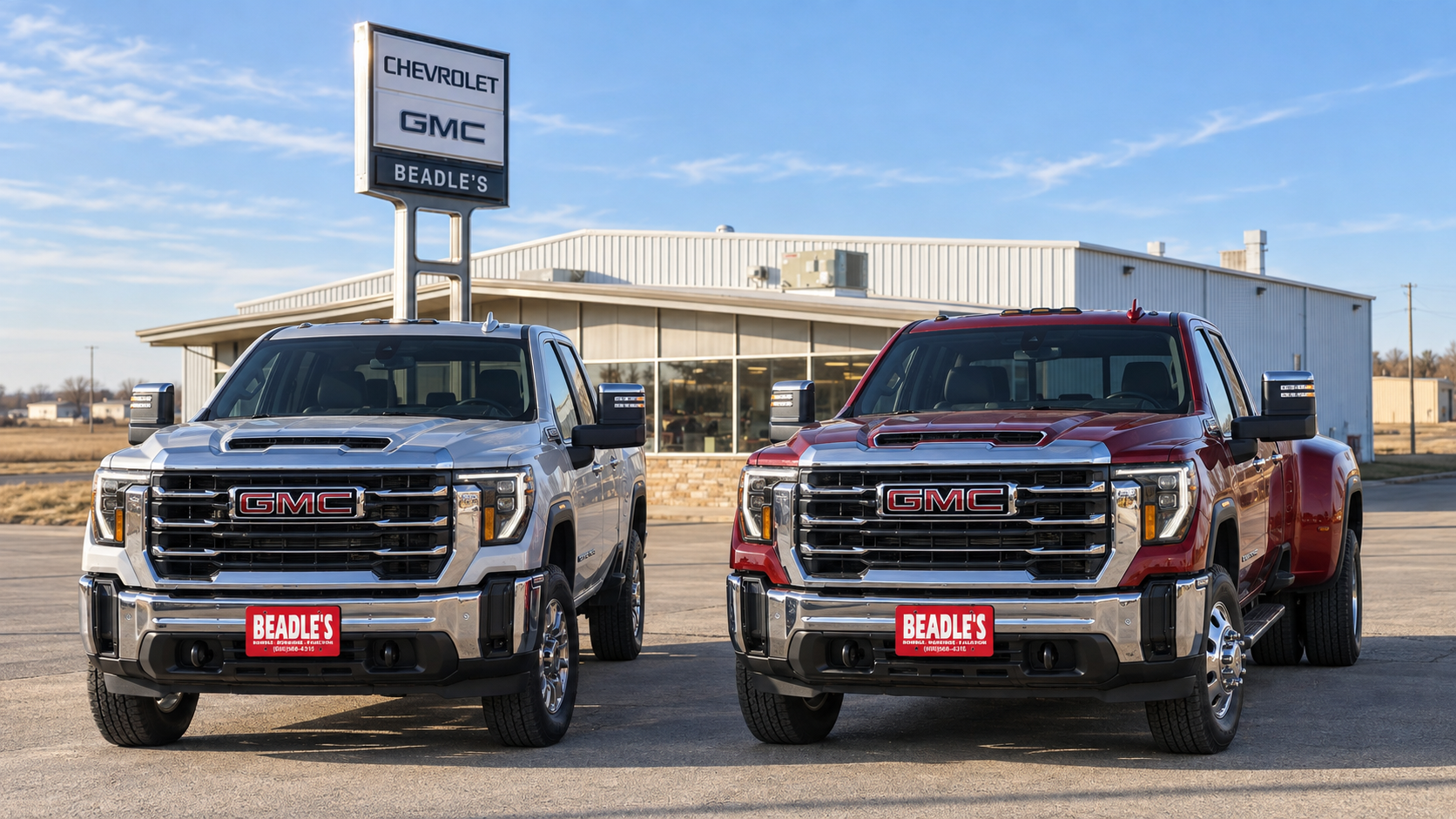
Two trucks sit side by side on our lot most weeks, and from twenty feet away they look like the same pickup in two colors. Same Crew Cab, same doors, same 6.6L Duramax under the hood. One of them is a 2026 GMC Sierra 2500 HD and one is a 3500 HD, and the question I get at Beadle Chevrolet GMC more than any other in a one-ton conversation is whether the step up is worth it or whether the three-quarter-ton will do the job.
Short answer: if your loaded gooseneck puts more than about 3,500 pounds on the ball, you have already outgrown a 2500 HD Crew Cab, whatever the tow rating says. The 3500 HD single rear wheel buys you a little more, and the dually buys you a lot more. This post lays the two trucks next to each other on the configuration most people here actually order, a Crew Cab long bed 4WD with the Duramax, and shows you exactly where the line falls.
On This Page
Is the Sierra 3500 HD Just a 2500 HD With Bigger Springs?
No, but the family resemblance is real. Both trucks share the same cabs, the same 6.6L gas V8 at 401 horsepower and 464 lb-ft, the same 6.6L Duramax turbo-diesel at 470 horsepower and 975 lb-ft, and the same 10-speed automatic behind either one. What changes is everything that carries weight: the springs, the rear axle rating, the gross vehicle weight rating, and on a dually the rear wheels themselves.
Here is the clearest way I know to say it. The Max Trailering Package on a Sierra 2500 HD works by borrowing one-ton parts: it puts the 3500 HD frame, 3500 HD leaf springs, a 12-inch rear axle, and 3500 HD shocks under the three-quarter-ton, along with the gooseneck prep and a spray-on bedliner. A 2500 HD ordered that way is partway to a one-ton already. A 3500 HD starts there and then adds its own margin on top.
The ratings tell the same story. A 2026 Sierra 2500 HD Crew Cab with the Duramax tops out at 11,900 pounds of GVWR when it is ordered with the Max Trailering Package. A 2026 Sierra 3500 HD Crew Cab long bed 4WD with the Duramax is 12,250 pounds as a single rear wheel and 14,000 pounds as a dually, and there is no lowered-GVWR option anywhere in the 3500 HD lineup the way there is on the 2500 HD. Rear axle rating follows: 7,250 pounds on a single-rear-wheel truck of either size, 10,400 pounds on any 3500 HD dually.
The dually rule on the one-ton is worth knowing before you shop. Dual rear wheels require a long bed and the 14,000-pound GVWR, which means no dually on a standard-bed Crew Cab, and the AT4 is single rear wheel only. There is no AT4X at all on the 3500 HD. The full breakdown lives in our 2026 Sierra 3500 HD buyers guide, and the decision itself gets its own post in single rear wheel or dually.
What Do the Numbers Look Like Side by Side?
Compared on the truck most people here order, a Crew Cab long bed 4WD with the Duramax, the 3500 HD single rear wheel adds about 2,500 pounds of gooseneck rating and about 600 pounds of payload over a 2500 HD without the Max Trailering Package. The dually adds roughly 12,000 pounds of gooseneck rating and about 2,100 pounds of payload. Every figure below is GM's rating for that exact configuration, properly equipped.
| Crew Cab long bed 4WD, Duramax | 2026 Sierra 2500 HD | 2026 Sierra 3500 HD, SRW | 2026 Sierra 3500 HD, dually |
|---|---|---|---|
| Conventional towing | 18,500 lb, or 20,000 lb with Max Trailering | 20,000 lb | 20,000 lb |
| Gooseneck towing | 19,000 lb, or 21,500 lb with Max Trailering | 21,460 lb | 31,000 lb |
| Payload | 3,566 lb | 4,195 lb | 5,647 lb |
| GVWR | 11,900 lb with Max Trailering | 12,250 lb | 14,000 lb |
| Rear axle rating | 7,250 lb | 7,250 lb | 10,400 lb |
| Body width, no mirrors | 81.85 in | 81.85 in | 96.62 in |
Three things in that table surprise people. First, conventional bumper-pull towing is nearly a wash: the Duramax hits 20,000 pounds on the 3500 HD whether it wears four rear tires or six, and a 2500 HD with the Max Trailering Package gets to the same place. If all you pull is a bumper-pull trailer, the step up buys you very little towing.
Second, the combination rating moves less than you would guess on the single-rear-wheel trucks. A 2500 HD with Max Trailering and a 3500 HD single rear wheel are both rated at 30,000 pounds of GCWR with the Duramax. A 3500 HD dually is rated at 40,000 pounds of GCWR with a gooseneck hitch. With a fifth-wheel hitch that combination rating is 32,000 pounds.
Third, the width. A 3500 HD single rear wheel is exactly as wide as a 2500 HD; a dually is 14.77 inches wider across the rear fenders, and that number decides more purchases in Walworth County than any tow rating does. The 2026 Sierra 2500 HD buyers guide carries the full three-quarter-ton tables.
Why Does Pin Weight Decide This, Not the Tow Rating?
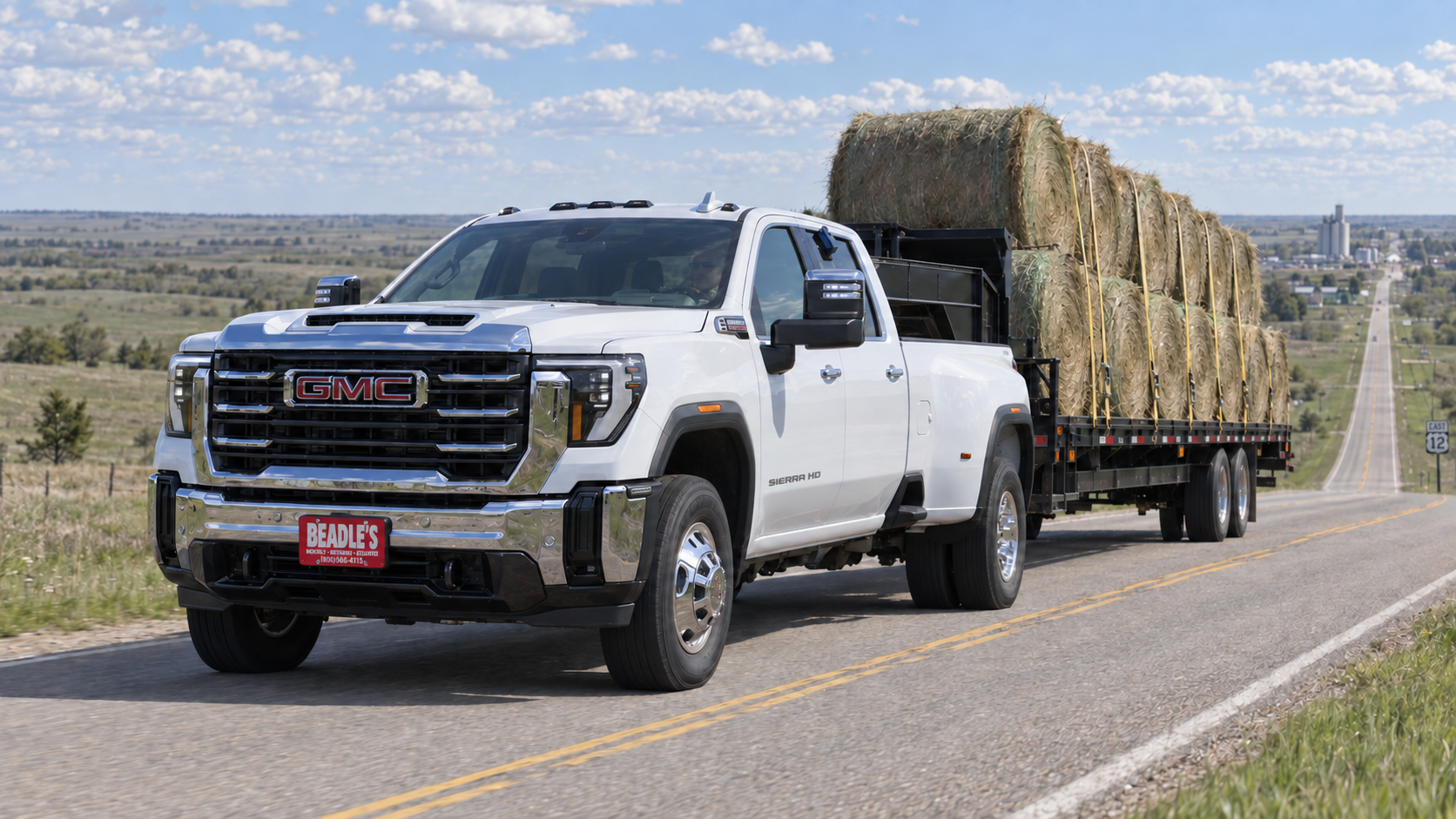
Because a gooseneck trailer sets a quarter of its weight down in your bed, and that weight comes straight out of payload. GM puts the kingpin load on a gooseneck or fifth-wheel at 15 to 25 percent of the trailer weight, and 10 to 15 percent for a bumper-pull tongue. Almost every buyer who steps up to a one-ton around here does it because of that number, not because they ran out of tow rating.
An illustration, using round numbers rather than a real trailer: say your tandem-dual aluminum stock trailer weighs 20,000 pounds loaded with pairs. At 22 percent, the pin puts 4,400 pounds on the truck. A 2500 HD Crew Cab long bed 4WD Duramax has 3,566 pounds of payload, so the truck is over its own limit before the driver climbs in, even though 20,000 pounds is inside its 21,500-pound gooseneck rating with the Max Trailering Package. The 3500 HD single rear wheel, at 4,195 pounds of payload, is still short. The dually, at 5,647 pounds, has about 1,200 pounds left for people, fuel, and the toolbox.
Lighten that trailer to 15,000 pounds and the picture flips. A 22 percent pin is 3,300 pounds, the 2500 HD clears it with a little room, and there is no reason on earth to buy more truck. That is the whole decision in two paragraphs: weigh the pin, not the trailer. Your own scale ticket beats every estimate in this post, and the trailering information label in the driver door jamb of the specific truck is the final word on both ratings.
The 3,500-pound rule of thumb
If the pin weight of your loaded trailer is under about 3,000 pounds, a Sierra 2500 HD Crew Cab handles it with margin. Between 3,000 and 3,500 pounds you are living close to the line and a 3500 HD single rear wheel is the easy fix. Over 3,500 pounds, a dually is the honest answer, and no amount of package content on a three-quarter-ton changes that. Weigh it once at the elevator and you will never wonder again.
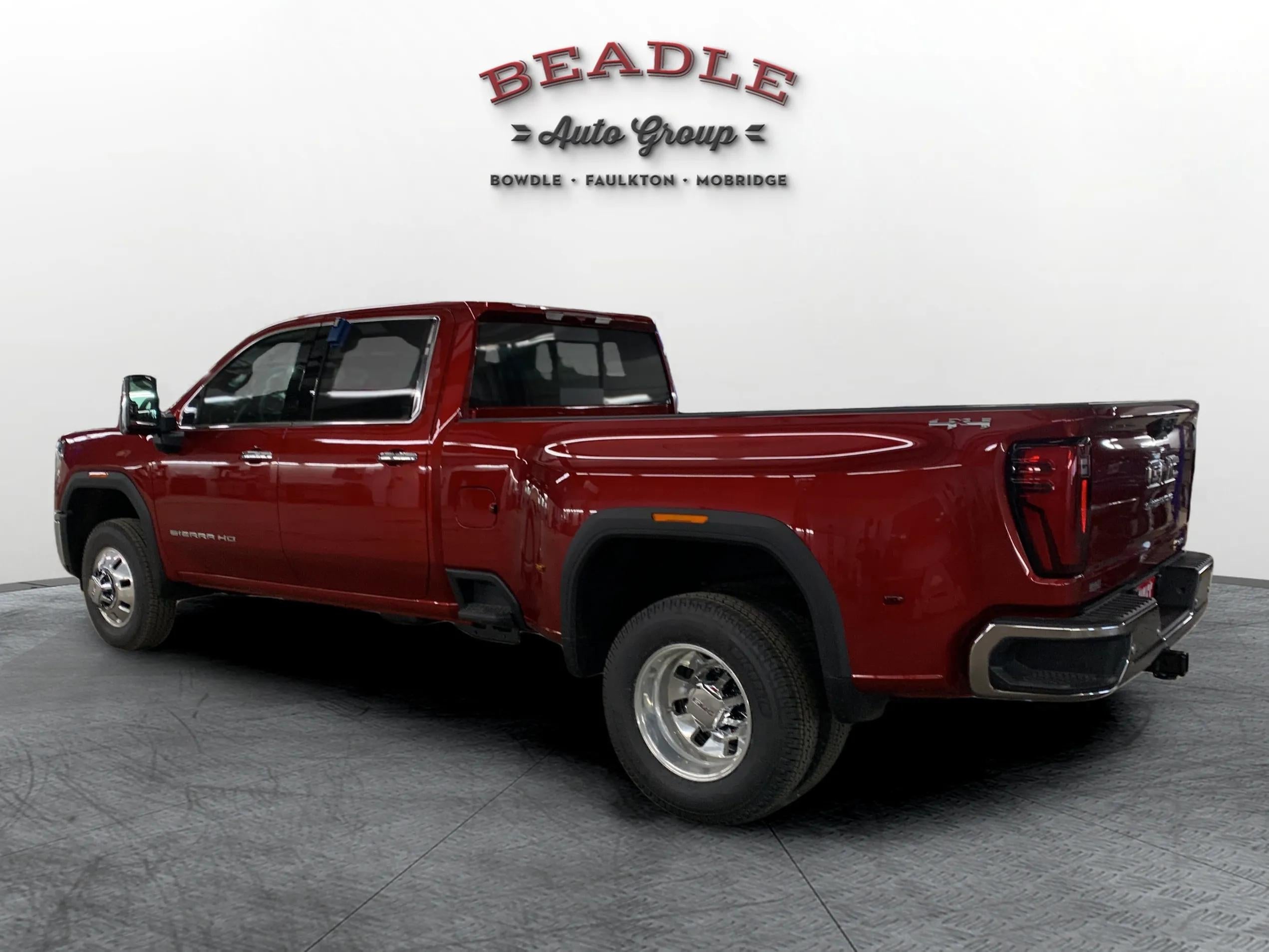
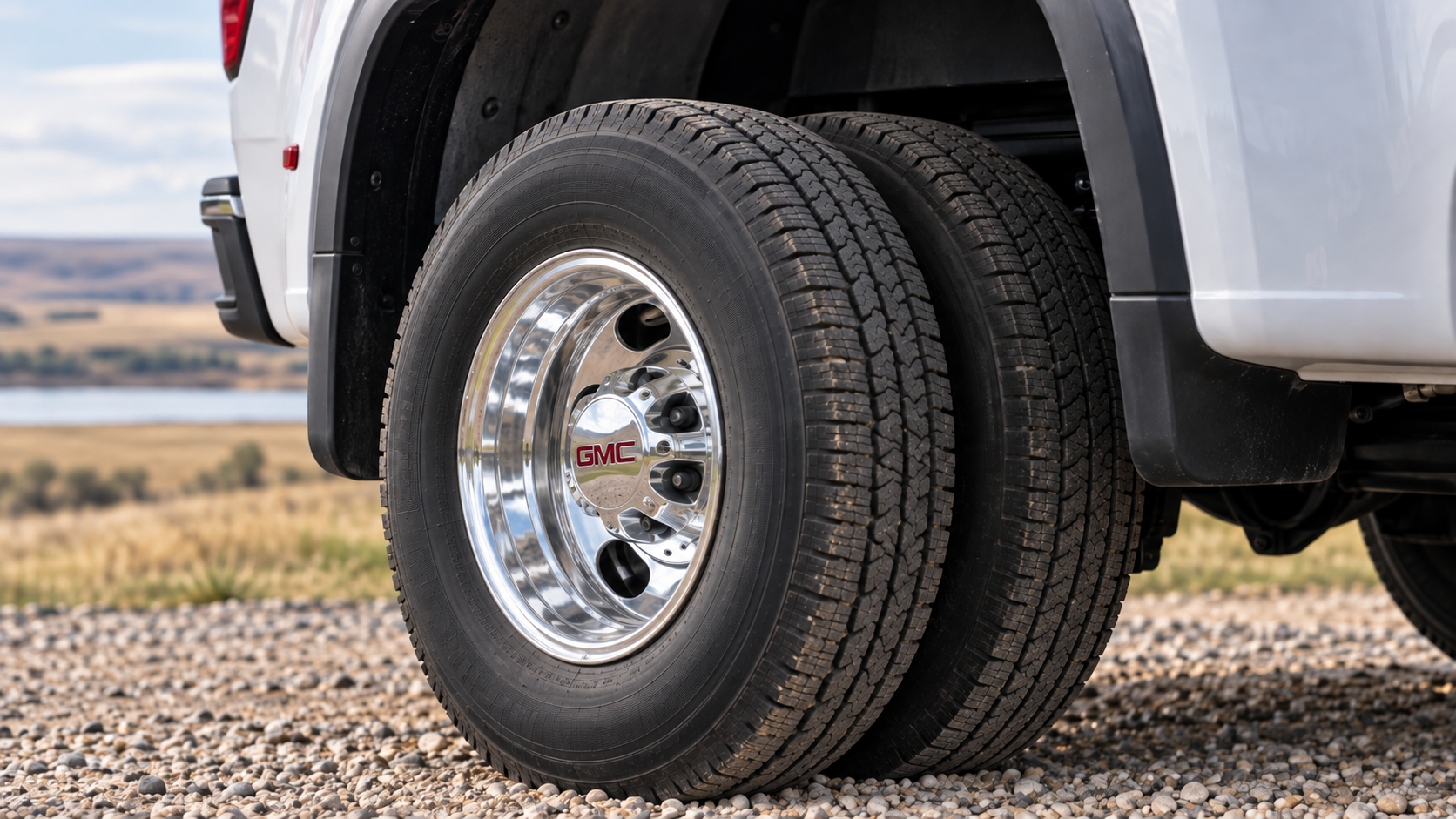
The 14.77 inches that separate a dually from every other Sierra: rear fenders, six tires, and a 10,400-pound rear axle rating.
When Should You Stay With the Sierra 2500 HD?
Three cases, and I make all three at the desk regularly. The three-quarter-ton is the right truck for most operations in this trade area.
The truck is empty most of the week. A one-ton dually rides harder empty, because the springs and the rear axle are built for weight that is not there on a Tuesday run to the co-op. If the trailer comes out twice a month and the rest of the time you are hauling a dog and a cooler, the 2500 HD is the better truck to live with.
Width matters where you park it. A dually is 96.62 inches across the fenders, wider than many shop doors, most car washes, and every drive-through in a small town, and it means six tires at replacement time instead of four. A 3500 HD single rear wheel dodges that problem entirely.
The budget is doing other work. A comparably equipped 3500 HD is usually closer in price than buyers expect, but it is not free, and neither are the tires. Ask us to put the two window stickers side by side before you decide, and get the financing question out of the way early with our pre-qualification form.
If that is you, the three-quarter-ton conversation continues in our Sierra 2500 HD gooseneck post, and you can see what is in stock on the 2500 HD inventory page.
When Is It Time to Step Up to the 3500 HD?
Three cases again, and the first one sends most of our one-ton buyers over here. Buy the margin now instead of finding the ceiling at the scale in the middle of harvest.
The pin weight already beat the payload. You bought a bigger trailer, or you started hauling pairs instead of calves, and the math stopped working. This is not a slow-truck problem. A Duramax pulls the load either way. It is a carrying problem, and the fix is a 14,000-pound GVWR with 10,400 pounds of rear axle under it. The full dually gooseneck math runs in our one-ton gooseneck post.
You haul at capacity every week, not a few times a month. Custom harvest crews, hotshot outfits running a 40-foot deck, hay operations moving loads to the yard from June through August, and anybody with a snow contract from November to March are all buying for the heavy day, not the average one. Margin is cheaper than a broken week.
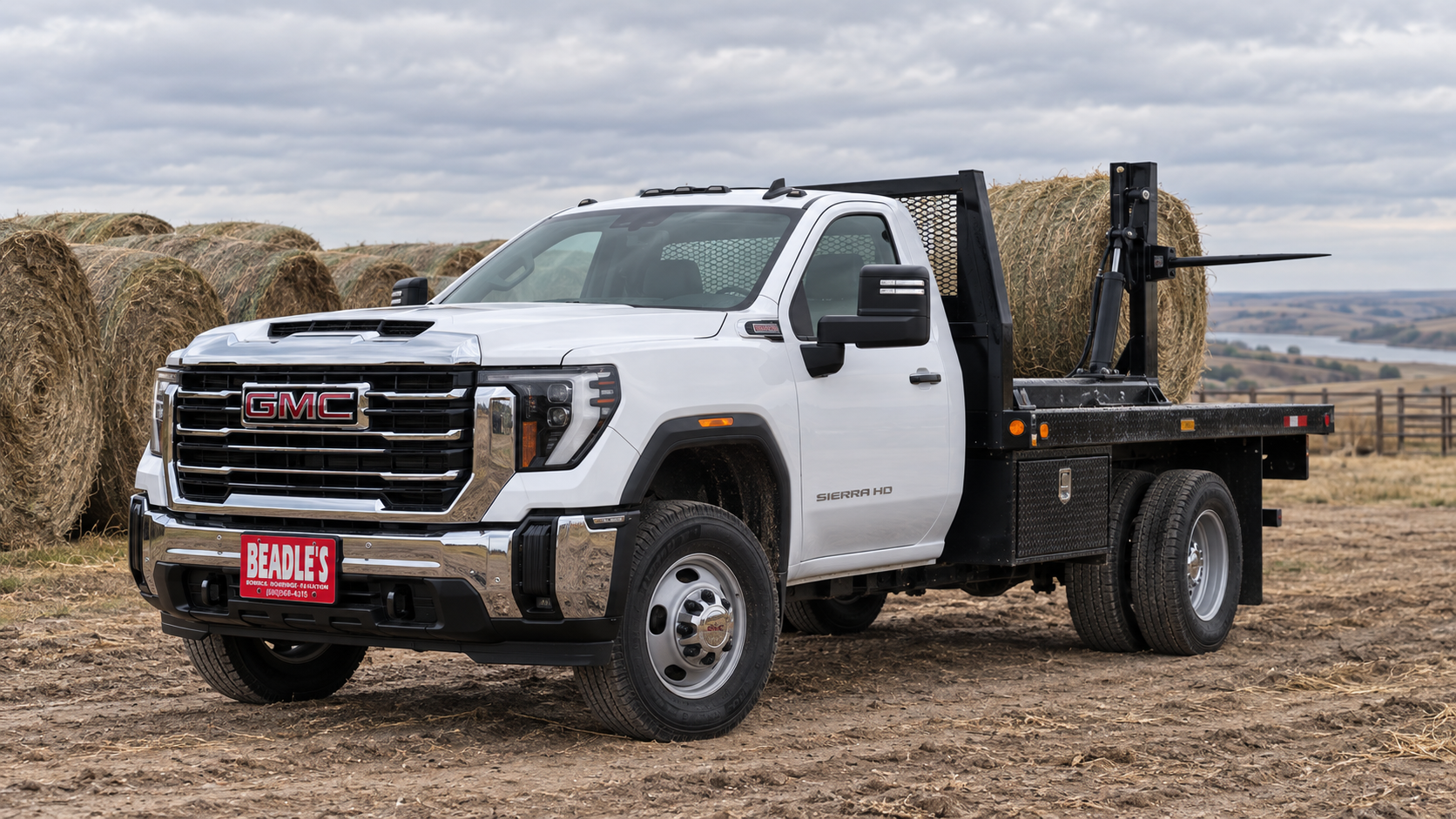
You are building something on the truck. Bale beds, flatbeds, service bodies, welder rigs, and fuel transfer tanks all eat payload before the trailer is ever hooked up, and a long bed at one-ton payload gives the upfitter room to work. A 2500 HD with a bale bed and a loaded gooseneck runs out of numbers in a hurry.
One thing to know before you order: the Max Trailering Package on the 3500 HD is a Pro, 2WD, Regular Cab, dually-only option, so the Crew Cab trucks on our lot are rated on their own springs with no package to add. On a 3500 HD dually that is not a limitation, it is just how GM rates the truck. What you do want to order is the gooseneck and fifth-wheel prep, which puts the hitch platform, the capped bed holes, and the bed-mounted 7-pin connector in the truck from the factory on any of the six trims.
How to Compare the Two Trucks on the Same Afternoon
Five steps. Bring the trailer if you can, and plan on two hours.
- Weigh the pin first: before you shop, run the loaded rig across the elevator scale, then weigh the truck alone hitched with the trailer axles off the scale. The difference is your pin weight, and it decides this whole question.
- Measure your shop door: write down the narrowest opening the truck has to clear at home, at the shop, and at the place you park in town. Compare it to 96.62 inches before you fall in love with a dually.
- Read both door jambs: open the driver door on each truck and read the trailering information label. Write down the gooseneck rating, the payload, and the GCWR for those two specific trucks, not the brochure figures.
- Do the subtraction out loud: payload minus pin weight minus driver, passengers, fuel, tools, and feed. Whatever is left is your real margin. If it is under a few hundred pounds, you have your answer.
- Drive both empty, then hitched: take each one down a gravel section line and out onto Highway 12, then back a trailer into a tight spot with the hitch guidance on the camera. The ride difference shows up in the first mile, and the dually track width feels normal by the third try.
Quick Overview: Is the Step Up to the One-Ton Worth It?
| Worth it if | Skip it and stay with the 2500 HD if |
|---|---|
| Your loaded pin weight is over about 3,500 pounds You haul at or near capacity every week through the season A bale bed, flatbed, or service body is going on the truck You run a tandem-dual stock trailer or a 40-foot gooseneck deck You want the 14,000-pound GVWR and the 10,400-pound rear axle behind you |
Your loaded pin weight stays under about 3,000 pounds You pull a bumper-pull trailer and nothing heavier The truck is empty most days and doubles as the family rig A 96.62-inch-wide truck will not fit your shop or your parking Six tires at replacement time is a number you do not want |
Key Takeaways
- Both trucks share the same cabs, the same gas V8 and Duramax, and the same 10-speed; the frame, springs, rear axle, and GVWR are what change.
- On a Crew Cab long bed 4WD Duramax the 3500 HD carries 4,195 pounds single rear wheel and 5,647 pounds as a dually, against 3,566 pounds for a 2500 HD, properly equipped.
- Gooseneck ratings on that same truck run 19,000 pounds for the 2500 HD, 21,500 with its Max Trailering Package, 21,460 for the 3500 HD single rear wheel, and 31,000 for the dually.
- Conventional bumper-pull towing is nearly identical at 20,000 pounds, so the step up is about payload and stability, not pulling power.
- Pin weight decides it. Weigh the loaded trailer and the pin once, then compare both to the trailering label in the driver door jamb.
Frequently Asked Questions
Does a 3500 HD cost a lot more than a comparably equipped 2500 HD?
The gap is usually closer than buyers expect once the two trucks are equipped the same way, because a 2500 HD ordered with the Max Trailering Package is already paying for one-ton hardware. Ask us for current pricing on the specific trucks in stock and we will lay both window stickers side by side.
Can I get the Max Trailering Package on a Sierra 3500 HD Crew Cab?
No. On the 2026 Sierra 3500 HD the Max Trailering Package is a Pro trim, 2WD, Regular Cab, dual-rear-wheel, Duramax option only, so a Crew Cab one-ton is rated on its own springs with nothing to add. That is different from the 2500 HD, where the package is the way you reach the top of the range. What you should order on a 3500 HD is the gooseneck and fifth-wheel prep package, available on all six trims.
Is a 3500 HD single rear wheel worth it over a 2500 HD with Max Trailering?
It is if payload is what you are short on. The gooseneck ratings are close, 21,500 pounds for the packaged 2500 HD against 21,460 pounds for the 3500 HD single rear wheel on a Crew Cab long bed 4WD Duramax, properly equipped. The difference is that the one-ton carries 4,195 pounds against 3,566 pounds and runs a 12,250-pound GVWR. Same width, same parking, more room on the label.
Which trims come as a dually on the 2026 Sierra 3500 HD?
Pro, SLE, SLT, Denali, and Denali Ultimate can all be built as duallys, always on a long bed with the 14,000-pound GVWR. The AT4 is single rear wheel only, and there is no AT4X on the 3500 HD. Pro, SLE, and SLT duallys ride on 17-inch steel wheels, while Denali and Denali Ultimate duallys use 18-inch polished forged wheels; no 20-inch or 22-inch wheel is offered on any dually.
My Take on Choosing Between the 2500 HD and the 3500 HD
I sell both, and I am not trying to move anybody up a size for the sake of it. Most cow-calf outfits in Walworth and Corson counties are well served by a Sierra 2500 HD. The trucks that need to be one-tons announce themselves: the pin weight is over the payload, the trailer got longer, or there is a bale bed going on the back.
If you land in the middle, look hard at a 3500 HD single rear wheel before you jump to a dually. It parks like a three-quarter-ton, wears four tires, and still gives you 4,195 pounds of payload and a 12,250-pound GVWR on a Crew Cab long bed 4WD Duramax. On our lot as this is written we have two SLT Crew Cab long bed duallys and one Denali single rear wheel, all Duramax, so you can stand between them and feel the difference in about ten minutes.
The complete tables, trims, engines, and packages for the one-ton are in the 2026 GMC Sierra 3500 HD buyers guide. Or bring your scale ticket to Beadle Chevrolet GMC at 2200 US Hwy 12 in Mobridge, or call or text 605-845-7277, and we will match the numbers to a truck. We are open Monday through Friday 8:00 a.m. to 5:30 p.m. and Saturday 8:00 a.m. to noon.
About the Author
Lexy Tabbert — Beadle Chevrolet, Mobridge, SD
Lexy Tabbert is the Director of Sales and Marketing at Beadle Chevrolet in Mobridge, South Dakota. She covers Chevrolet and GMC vehicles, trim comparisons, and buyer guidance — helping families, ranchers, and ag operators across the region find the right truck and configuration for their needs. Learn more about Lexy.